

With the growing trend of global photovoltaic energy, photovoltaic bracket systems are an indispensable key supporting structure for both home rooftop photovoltaic systems and large-scale commercial and outdoor new energy power stations. The reliability of photovoltaic brackets directly affects the service life and power generation efficiency of the entire photovoltaic module. At present, the mainstream bracket materials in the market are mainly divided into aluminum alloy photovoltaic brackets and carbon steel photovoltaic brackets. Among them, aluminum alloy photovoltaic brackets occupy a dominant position in the mid-to-high-end market and are widely used in solar aluminum alloy brackets, solar bracket accessories, aluminum alloy tripods, aluminum alloy stampings, and other scenarios.
Introduction to AL6005-T5 aluminum alloy
AL6005-T5 is a heat-treated strengthened medium-strength aluminum-magnesium-silicon alloy with excellent corrosion resistance, good machinability, suitable for welding, moderate strength, and good anti-oxidation performance. It is the preferred material in the manufacture of aluminum alloy photovoltaic brackets.
Table: Performance comparison between aluminum alloy photovoltaic bracket and carbon steel photovoltaic bracket
| Performance index | AL6005-T5 aluminum alloy bracket | Q235B carbon steel bracket | Comparison of advantages |
| Density (g/cm³) | 2.7 | 7.85 | Aluminum alloy is 65% lighter |
| Tensile strength (MPa) | 255-290 | 375-500 | Carbon steel is higher |
| Yield strength (MPa) | ≥215 | ≥235 | Carbon steel is slightly higher |
| Corrosion resistance | Excellent (natural oxide film) | Galvanized protection required | Aluminum alloy is better |
| Service life (years) | 30+ | 15-25 (galvanized) | Aluminum alloy is longer |
| Coefficient of thermal expansion (x10⁻⁶/℃) | 23.6 | 11.7 | Carbon steel is more stable |
| Recycling rate | 100% | 90% | Aluminum alloy is better |
| Typical installation cost (yuan/W) | 0.15-0.20 | 0.10-0.15 | Carbon steel is lower |

Corresponding international standards
Table: Comparison of main technical parameters of AL6005-T5 aluminum alloy with international standards
| Parameter category | AL6005-T5 typical value | Test standard | International corresponding brand |
| Density (g/cm³) | 2.70 | ASTM B210 | EN AW-6005A |
| Tensile strength (MPa) | ≥255 | GB/T 228.1 | 6005A-T5 (ASTM) |
| Yield strength (MPa) | ≥215 | GB/T 228.1 | EN AW-6005A-T5 |
| Elongation (%) | ≥8 | GB/T 228.1 | ISO 6892-1 |
| Hardness (HBW) | ≥75 | GB/T 231.1 | ASTM E10 |
| Elastic modulus (GPa) | 68.9 | ASTM E111 | EN 12390-13 |
| Thermal conductivity (W/m·K) | 180 | ASTM E1461 | ISO 22007-2 |
| Electrical conductivity (%IACS) | 50-55 | ASTM B193 | IEC 61788 |
| Coefficient of thermal expansion (x10⁻⁶/℃) | 23.6 | ASTM E831 | ISO 11359-2 |
Physical properties
Table: Comparison of physical properties of AL6005-T5 aluminum alloy and photovoltaic bracket-related materials
| Physical properties | AL6005-T5 | 6061-T6 | 6063-T5 | Q235 | carbon steel 304 stainless steel |
| Density (g/cm³) | 2.70 | 2.70 | 2.70 | 7.85 | 8.00 |
| Melting point (℃) | 600-655 | 580-650 | 615-655 | 1420-1460 | 1400-1450 |
| Thermal conductivity (W/m·K) | 180 | 167 | 193 | 50 | 16 |
| Conductivity (%IACS) | 50-55 | 43 | 54-58 | 10 | 2.4 |
| Coefficient of thermal expansion (x10⁻⁶/℃) | 23.6 | 23.6 | 23.4 | 11.7 | 17.3 |
| Specific heat capacity (J/g·K) | 0.896 | 0.896 | 0.900 | 0.449 | 0.500 |
Physical properties and environmental resistance of AL6005-T5
As the core material of photovoltaic brackets, the physical properties of AL6005-T5 aluminum alloy are directly related to the long-term reliability of the bracket system under various environmental conditions. In terms of density, AL6005-T5 maintains the lightweight characteristics of typical aluminum alloys, which is only 2.70g/cm³, which is about 1/3 of carbon steel and 1/3.558 of stainless steel. Such low density makes Aluminum Photovoltaic Bracket Accessories show significant advantages in roof applications, which not only reduce transportation and installation costs but also reduce the additional load requirements on building structures. Calculations show that the weight of a photovoltaic bracket system using AL6005-T5 profiles is usually between 8-12kg/m², while the weight of a carbon steel bracket of the same strength is 15-20kg/m², and the weight difference can reach more than 40%110.
Thermophysical properties are a key consideration in the selection of photovoltaic bracket materials. The thermal conductivity of AL6005-T5 reaches 180W/(m·K), which is about 3 times that of carbon steel, which means that Aluminum Accessories for Solar Mountings can more effectively conduct and dissipate the heat generated by photovoltaic modules, avoiding local excessive temperatures that lead to a decrease in system efficiency28. Experimental data show that under the same sunshine conditions, the operating temperature of the components on the aluminum alloy bracket is 3-5℃ lower than that of the carbon steel bracket, which is equivalent to an increase in power generation efficiency of 0.5-1.0%5. In terms of thermal expansion coefficient, AL6005-T5 is 23.6×10⁻⁶/℃, which is higher than carbon steel (about 11.7×10⁻⁶/℃), but through reasonable structural design (such as sliding connection, expansion joint, etc.), it is possible to compensate for the dimensional changes caused by temperature changes and ensure the stability of the system.
Processing method
1. Extrusion molding: Suitable for the production of aluminum profiles such as the main beam and auxiliary beam of photovoltaic brackets, with complex cross-sections and multi-cavity structures.
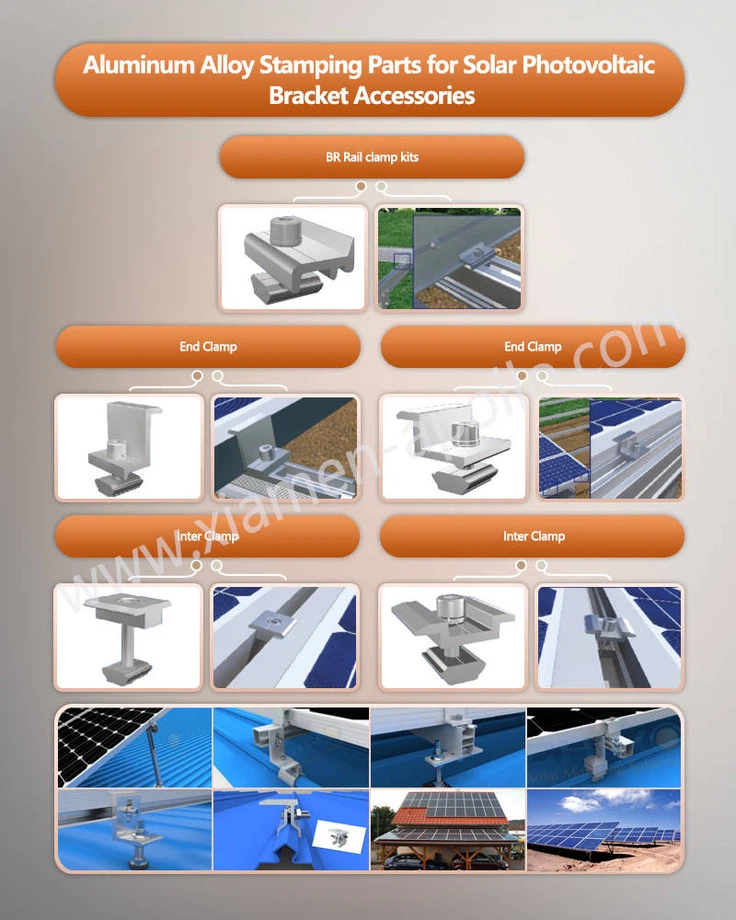
2. CNC stamping: Process aluminum alloy plates or strips into aluminum alloy stamping parts, and solar bracket accessories, such as connectors, hooks, etc.
3. Cutting/drilling: Accurately process interfaces and mounting holes according to bracket design requirements.
4. Welding: The connection between aluminum alloys can use TIG or MIG welding technology to ensure mechanical properties.
5. Assembly: Combined with standard parts such as bolts, nuts, and slots to form a complete photovoltaic bracket system.

Surface treatment method
To enhance the weather resistance and extend the service life of aluminum alloy photovoltaic brackets, AL6005-T5 aluminum profiles are usually subjected to the following surface treatments after forming:
1. Anodizing treatment
Thickness range: 10–20μm (15μm or more is recommended for outdoor photovoltaics)
Advantages: Improve corrosion resistance, enhance appearance decoration, and enhance adhesion
2. Sandblasting + oxidation
The surface is more delicate and uniform, with better anti-reflection performance, suitable for projects with high aesthetic requirements.
3. Spraying (powder coating)
Provides a variety of color options to enhance visual unity
Good protection against UV and corrosion
Application areas
Application areas
Household roof photovoltaic system
High strength and lightweight, easy installation, long corrosion resistance
01
Commercial roof/ground power station
Reliable strength, good long-term outdoor weather resistance
02
BIPV building photovoltaic integrated system
Various structural profiles can be customized, taking into account both load-bearing and aesthetics
03
Carport photovoltaic
Used in car charging pile areas, with a simple structure and strong wind resistance
04
Agriculture/fishery-light complementary projects
Adapt to complex climate environments such as high salt and humidity
05
With the increasing requirements of the new energy industry for system reliability and service life, Aluminum Clamp Hook for Roof Photovoltaic Supports with advantages such as high strength, corrosion resistance, and recyclability have become the mainstream choice in the industry. AL6005-T5 aluminum alloy is widely used in the manufacture of solar aluminum alloy brackets, solar bracket accessories, aluminum alloy strokes, and aluminum alloy stampings due to its excellent physical properties, electrical compatibility, and good processing performance. It is an important material basis for achieving efficient utilization of green energy.
contact us
