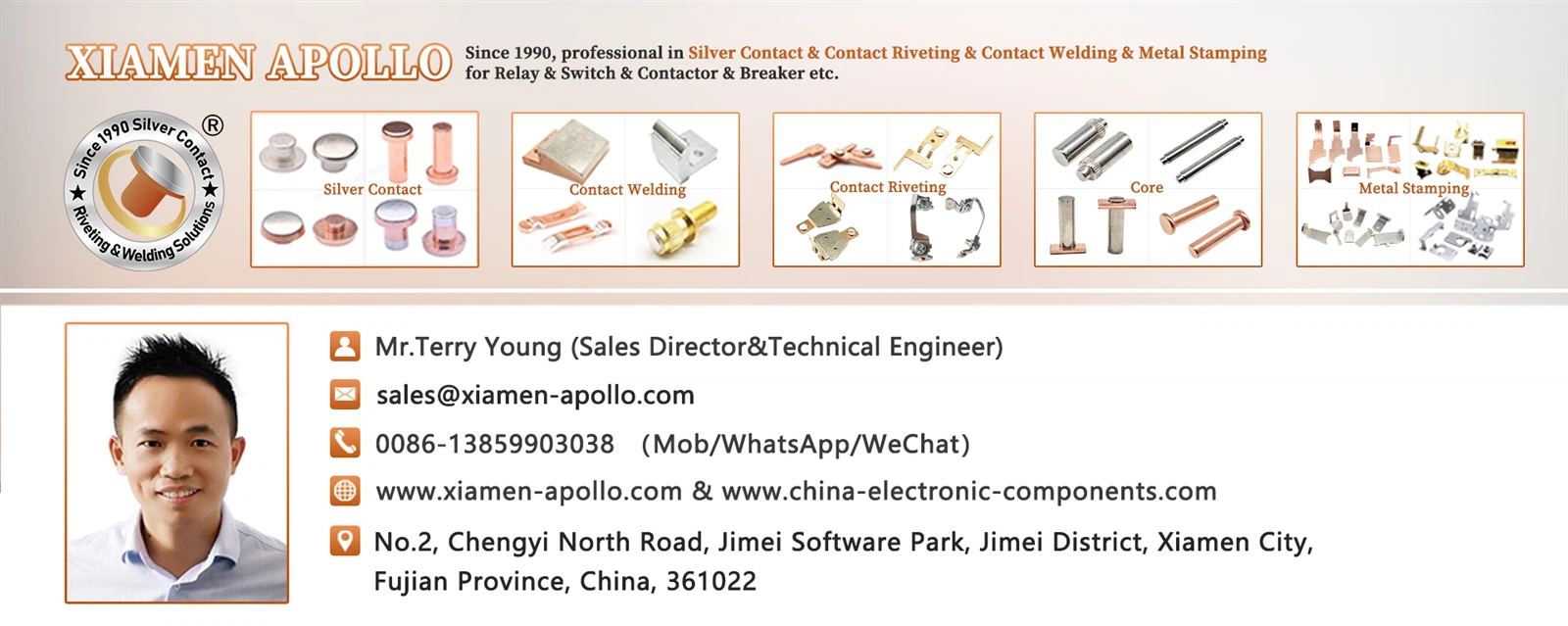
Tungsten, as a metal material with a high melting point, high hardness, and excellent electrical and thermal conductivity, is widely used in electrical contact materials. Especially in the field of car horns and smart home relays, tungsten contacts have become key functional components, and their performance directly determines the response speed, arc resistance life, and reliability of the product. Tungsten contacts are mainly made of pure tungsten powder metallurgy sheets or tungsten rod slices, which are connected to copper or iron substrates by brazing, and finally nickel-plated to form nickel-plated tungsten contacts.

Classification and definition of tungsten materials
1. Pure tungsten powder metallurgy sheets
(1). Preparation method: Use high-purity tungsten powder to press and form, sinter and densify, and then process into thin sheets;
(2). Advantages: Low cost, suitable for mass production;
(3). Disadvantages: Slightly lower density, relatively weak arc resistance;
(4). Application direction: Commonly used in low-end car horn tungsten contacts and small switch products.
2. Tungsten rod slices (tungsten steel slices)
(1). Preparation method: Use high-density tungsten rods (rod density ≥ 19.0 g/cm³) as raw materials and mechanically cut into thin slices;
(2). Advantages: High density, strong mechanical strength, and electrical corrosion resistance;
(3). Application direction: Widely used in high-end Motorcycle Horn Tungsten Rivets and smart home relay tungsten contacts and other occasions with higher requirements for life and reliability.

Technical parameters of tungsten materials and comparison with international standards
| Parameter category | Pure tungsten powder metallurgy sheet | Tungsten rod slice | Main international standards |
| Density (g/cm³) | 17.5-18.5 | ≥19.0 | ASTM B777, GB/T 4187 |
| Purity (%) | ≥99.95 | ≥99.96 | ASTM B760, GB/T 4188 |
| Tensile strength (MPa) | 550-800 | 900-1200 | ASTM E8, GB/T 228.1 |
| Hardness (HV) | 350-450 | 400-500 | ASTM E384, GB/T 4340.1 |
| Electrical conductivity (%IACS) | 28-32 | 30-35 | ASTM B193, GB/T 3048.2 |
| Thermal conductivity (W/m·K) | 160-180 | 170-190 | ASTM E1461, GB/T 22588 |
| Thermal expansion coefficient (×10⁻⁶/K) | 4.5 (20-100℃) | 4.3 (20-100℃) | ASTM E228, GB/T 4339 |
| Melting point (℃) | 3410 | 3410 | - |
Tungsten contact structure type and manufacturing method
1. Iron-based tungsten contact (applicable to mid- and low-end speakers)
(1). Base material: low-carbon cold-heading iron;
(2). Brazing method: vacuum brazing;
(3). Advantages: low cost;
(4). Structural features: generally pure tungsten powder metallurgy sheets are used;
(5). Application cases: electric car horns, ordinary small car horns, etc.;
(6). Keyword matching: iron-based tungsten contacts, brazed tungsten contacts, car horn tungsten contacts.
2. Copper-based tungsten contacts (suitable for high-end relays and automotive electronics)
(1). Base material: copper rivets (T2 material);
(2). Welding method: vacuum brazing or hydrogen-shielded welding;
(3). Advantages: better conductivity and excellent corrosion resistance;
(4). Structural features: tungsten rod slices are usually selected;
(5). Application cases: smart home relays, high-end car speakers, etc.;
(6). Keyword matching: copper-based tungsten contacts, nickel-plated tungsten contacts, smart home relay tungsten contacts
Brazing process and surface treatment technology
1. Vacuum brazing process
(1). Applicable materials: tungsten and dissimilar metals such as copper and iron;
(2). Solder selection: silver-based solder or Ni-Cu solder;
(3). Process flow: assembly → cleaning → fixing → vacuum brazing → slow cooling;
Key control points:
The welding interface must be free of the oxide layer;
The brazing temperature is generally controlled at 850\~950℃;
The vacuum degree must be below 10⁻⁴Pa.
2. Surface treatment: nickel plating process
Purpose: Improve conductivity, oxidation resistance, and friction resistance;
Coating thickness: Generally 2\~5μm;
Process type:
Chemical nickel plating: Suitable for complex structural parts;
Electroplating nickel: Suitable for mass production;
Effect: Extend the service life of tungsten contacts and improve stability;
Keyword matching: nickel-plated tungsten contacts, brazed tungsten contacts.

Typical application areas
Due to its superior mechanical and electrical properties, tungsten contacts are widely used in the following electrical connection and disconnection occasions:
1. Car horn tungsten contacts
Applied to various 12V or 24V car electric horns;
Requires strong arc resistance, non-melting welding, and fast response;
Iron-based tungsten contacts are used for economic models;
Copper-based tungsten contacts are used for high-end and durable horns.
2. Smart home relay tungsten contacts
Used for smart lighting, home security systems, etc.;
Requires frequent action and high long-term stability;
Usually made using tungsten rod slices + copper rivets + nickel-plated brazing process;
Matching keywords: smart home relay tungsten contacts
3. Other application scenarios
Microswitch
High-frequency circuit control contact
Industrial switch equipment
Table: Performance comparison of tungsten contact materials and common contact materials
| Performance index | Tungsten rod slice contact | Powder metallurgy tungsten sheet contact | Silver contact | Copper contact |
| Density (g/cm³) | 19.0-19.2 | 17.5-18.5 | 10.5 | 8.96 |
| Melting point (℃) | 3410 | 3410 | 961 | 1083 |
| Hardness (HV) | 400-500 | 350-450 | 60-80 | 40-60 |
| Electrical conductivity (%IACS) | 30-35 | 28-32 | 105 | 100 |
| Thermal conductivity (W/m·K) | 170-190 | 160-180 | 430 | 400 |
| Coefficient of thermal expansion (×10⁻⁶/K) | 4.3 | 4.5 | 19 | 17 |
| Arc erosion rate (mg/thousand times) | 0.1-0.3 | 0.2-0.5 | 1.5-3.0 | 5.0-8.0 |
| Typical contact resistance (mΩ) | 0.5-1.5 | 0.8-2.0 | 0.2-0.5 | 0.3-0.8 |
Processing and manufacturing process of tungsten contacts
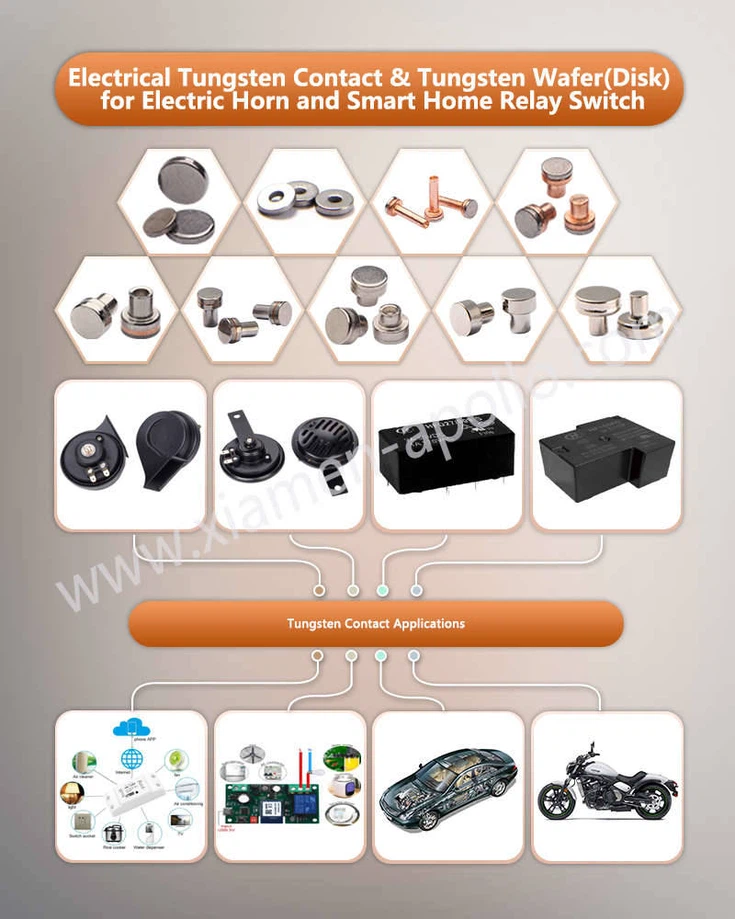
The choice of manufacturing process for tungsten contacts directly affects the final product's performance level and application range. From raw materials to finished products, the processing flow of tungsten contacts can be divided into three main stages: tungsten sheet preparation → brazing connection → surface treatment. For pure tungsten powder metallurgy sheets, the preparation begins with the precise proportioning and mixing of high-purity tungsten powder which is formed by cold isostatic pressing (CIP) or molding technology. The pressure range is usually 200-400MPa to obtain a sufficiently high green density (about 55-65% theoretical density)710. The subsequent sintering process is divided into two key steps: pre-sintering at 1200-1400℃ for 4-8 hours to remove the compression stress and initially form particle bonding; then high-temperature sintering at 2000-2300℃ for 10-16 hours under hydrogen protection to achieve a density of 90-95% of the theoretical value67. To improve performance, sintered tungsten sheets are often hot-rolled or hot-forged, with the processing temperature controlled in the range of 1400-1600℃ and a total deformation of 30-70%, which can significantly refine the grains and eliminate residual pores, increasing the density to 18.0-18.5g/cm³
The processing route for tungsten rod slicing is more direct, starting from high-density tungsten rods (usually 10-50mm in diameter), using precision diamond wire cutting or slow-wire electrical discharge machining (EDM) to obtain discs of the required thickness, and the cutting thickness tolerance can be controlled within ±0.005mm69. To obtain the best surface quality, the cut tungsten sheet needs to be double-sided ground and polished using diamond paste (particle size gradually reduced from 15μm to 1μm), and the final surface roughness can reach Ra≤0.2μm. It is worth noting that doped tungsten rods (such as WLa20) need to be stress annealed (1200-1400℃, 1-2 hours) after cutting to eliminate processing stress and stabilize the distribution of the doping phase, which is crucial to the reliability of subsequent brazing process910.
Vacuum brazing is the core process for connecting tungsten sheets to base metals (copper or iron), and its quality directly determines the mechanical strength and conductive properties of the contacts. For iron-based tungsten contacts, copper-based brazing filler metals (CuMnNi or CuZnNi alloys) are usually used, with a brazing temperature of 900-950℃, a vacuum degree of ≤5×10⁻³Pa, and a holding time of 5-10 minutes46. For copper-based tungsten contacts, silver-based solder (such as AgCu28 or AgCu20Zn5) is often used due to the low melting point of the substrate. The brazing temperature is reduced to 780-850°C, but a higher vacuum degree (≤1×10⁻³Pa) is required to prevent silver volatilization68. Before brazing, all components must undergo strict surface pretreatment: chemical cleaning (acetone ultrasonic degreasing) → acid cleaning (10% HNO₃+2% HF solution) → plasma cleaning to ensure good wetting of the solder. The design of the brazing fixture is also extremely critical. The difference in thermal expansion between tungsten and copper/iron must be considered. Graphite or molybdenum fixtures are usually used, and 0.5-1.
Key points for quality control and performance testing
To ensure the stable performance and welding reliability of tungsten contacts, the following controls are required:
| Test items | Control standards |
| Tungsten purity test | Spectral analysis, XRF |
| Density test | Archimedes method (above 18.5g/cm³) |
| Welding strength | Peel force ≥10N (5mm welding surface) |
| Surface coating thickness | Nickel layer thickness 2\~5μm, good uniformity |
| Arc resistance test | >5000 arcs non-melting welding |
| Appearance inspection | No black spots, ablation, oxide layer |
As a high-performance electrical connection component, the material selection and manufacturing process of tungsten contacts play a decisive role in the performance of the final product. Pure tungsten powder metallurgy sheets are suitable for cost-sensitive products, while tungsten rod slices are more suitable for high-reliability occasions; with iron matrix or copper matrix, through brazing technology and nickel plating, tungsten contacts with excellent performance can be formed to meet the stringent requirements of various low-voltage electrical appliances, especially car horns and smart home relays. With the development trend of miniaturization and high frequency of electrical appliances, tungsten contacts will play their unique advantages in a wider range of intelligent control devices.
contact us