Silver contacts are indispensable electrical contact components in various low-voltage electrical appliances such as relays, switches, contactors, circuit breakers, and thermostats. Their performance directly affects the conduction capacity, life stability, and safety of electrical products. To achieve its on-off function in the circuit, the silver contacts must be firmly mounted on the conductive substrate, and this process is usually achieved by riveting with stampings made of materials such as copper or brass. This article will focus on comparing three common silver contact riveting methods, analyzing their advantages and disadvantages, and highlighting the advancement of "in-mold silver contact riveting".
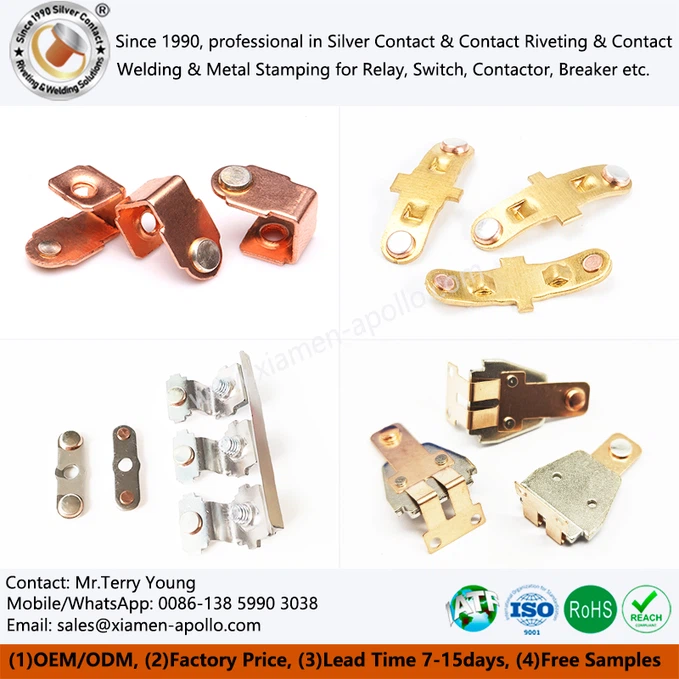
The basic principle of silver contact riveting
Silver contact riveting refers to fixing the electrical contacts made of silver alloy materials and the conductive substrate (usually copper stampings or brass stampings) into an integrated component through a physical connection, thereby achieving the functions of structural integration and electrical conduction. This process has a decisive influence on the dimensional consistency, reliability, and mass production efficiency of electrical components.
Comparison of three silver contact riveting methods
Table: Comparison of key indicators of three Silver Contact Riveted Assembly methods
| Comparison indicators | Manual riveting | Semi-automatic riveting | In-mold riveting |
| Production efficiency (set/person-day) | 5000-8000 | 10000-30000 | 80000-100000 |
| Dimensional consistency (height deviation) | ±0.1mm or more | ±0.05mm | ±0.02mm |
| Equipment investment cost | Low (ten thousand yuan level) | Medium (hundred thousand yuan level) | High (million yuan level) |
| Applicable production scale | Sample/very small batch | Small batch | Large batch |
| Degree of manual dependence | Full dependence | Moderate dependence | No need |
| Process controllability | Poor | General | Excellent |
| Typical yield | 95%-98% | 98%-99% | 99.5% or more |
1. Manual riveting
Manual riveting is a traditional riveting method, which is usually suitable for initial sample proofing and small-scale trial production. This method processes the silver contacts and copper or brass stampings into separate parts, and relies on skilled workers to use tools to assemble and rivet them one by one.
Advantages: low equipment investment, high process flexibility, suitable for small batch or customized production;
Disadvantages: high dependence on manual operation, poor dimensional consistency, low efficiency (daily output of 5,000-8,000 sets), not suitable for mass production.
2. Semi-automatic riveting
Semi-automatic riveting introduces an automatic feeding mechanism based on manual In-Mold Riveting Components. Automatic feeding is achieved through the silver contact vibration plate, and workers only need to hold the copper stamping or brass stamping and align it with the riveting die for assembly.
Advantages: Compared with manual riveting, the production efficiency is greatly improved (up to 10,000-30,000 sets per day), and the riveting consistency is relatively improved;
Disadvantages: Still requires manual intervention, high labor intensity, suitable for small and medium batch production, and limited degree of automation.
3. Riveting in progressive die (riveting in silver contacts)
This process uses a multi-station high-speed progressive stamping die and an automatic feeding system. The silver contacts are fed through a vibrating plate, and the copper strip or brass strip is continuously stamped through a progressive die. The silver contacts are precisely positioned and riveted inside the die, realizing true in-mold silver contact riveting.
Advantages:
High efficiency: fast production cycle (up to 80,000-100,000 sets/day), suitable for large-volume orders;
High consistency: through precise positioning control of the die, the dimensional stability of each set of riveted components is extremely high;
High degree of automation: reduce manual intervention, reduce labor costs and defective rates;
High integration: stamping, positioning, and In-Die Electrical Riveting Contacts are completed in one.
Disadvantages: The early mold development cycle is long and the cost investment is high, which is suitable for medium- and long-term batch order projects.
Process flow of in-mold silver contact riveting
1. Material preparation: The finished silver contact is automatically fed through the vibration plate, and the copper or brass strip is ready;
2. Automatic feeding system: The silver contacts are arranged and transported to the specified position of the mold;
3. In-mold riveting: In a certain station of the high-speed progressive mold, the silver contacts and the copper or brass strips are precisely riveted;
4. Subsequent stamping and forming: After multiple stations, the punching, bending, forming, and other processes are completed to form a complete riveted assembly;
5. Inspection and material collection: The automatic inspection system is optional to monitor key parameters such as Electrical In-Die Riveted Connections strength and position deviation.
Table: Comparative analysis of the comprehensive costs of In-Mold Riveting Electrical Contacts and alternative processes (based on an annual output of 10 million sets)
| Cost category | Manual riveting | Semi-automatic riveting | In-mold riveting | Remarks |
| Labor cost (10,000 yuan/year) | 120-150 | 60-80 | 10-15 | Based on an annual per capita cost of 80,000 yuan |
| Equipment depreciation (10,000 yuan/year) | 2-5 | 10-15 | 30-50 | The life of the in-mold riveting mold is 5 million times |
| Site occupation (m²) | 200 | 150 | 50 | Including raw materials and finished product stacking |
| Quality loss (10,000 yuan/year) | 30-50 | 15-25 | 5-10 | Including rework, scrap, and customer claims |
| Energy consumption cost (10,000 yuan/year) | 5-8 | 10-15 | 20-25 | The power of In-Die Rivet Electrical Contacts equipment is relatively high |
| Total cost (10,000 yuan/year) | 157-213 | 95-135 | 65-100 | The overall cost of in-mold riveting is the lowest |

Technical features of a progressive stamping die
Multi-station integration, stamping, and riveting are completed simultaneously;
High-precision processing of mold parts (tolerance within ±0.01mm) to ensure accurate positioning of silver contacts and stamping parts;
Customized designs can be made according to riveting strength, silver contact diameter, and stamping part thickness;
Can adapt to various shapes of silver contacts, such as dots, square pieces, special-shaped contacts, etc.
Table: Detailed explanation of the functions of the progressive die stations for riveting in typical silver contact molds
| Station number | Functional description | Key technical points | Accuracy requirements |
| 1-3 | Strip guiding and positioning | Guide pin positioning, eliminating material tolerance | ±0.01mm |
| 4-6 | Punching reference holes and process holes | Provide positioning reference for subsequent stations | ±0.01mm |
| 7-9 | Pre-punching and shaping of riveted holes | The hole diameter is 0.05-0.10mm smaller than the contact rod diameter | ±0.005mm |
| 10-12 | Strip flattening and stress release | Eliminate material internal stress and improve flatness | Flatness 0.02mm |
| 13-15 | Silver contact feeding and presetting | Air-blowing assisted positioning to ensure the verticality of the contact | ±0.01mm |
| 16-18 | Primary riveting forming | Control the direction of metal flow and initial forming | Pressure control ±3% |
| 19-21 | Final riveting shaping | Achieve final shape and bonding strength | Height tolerance ±0.02mm |
| 22-24 | Shape punching and blanking | Finished product separation, maintained edge quality | Burr ≤0.02mm |
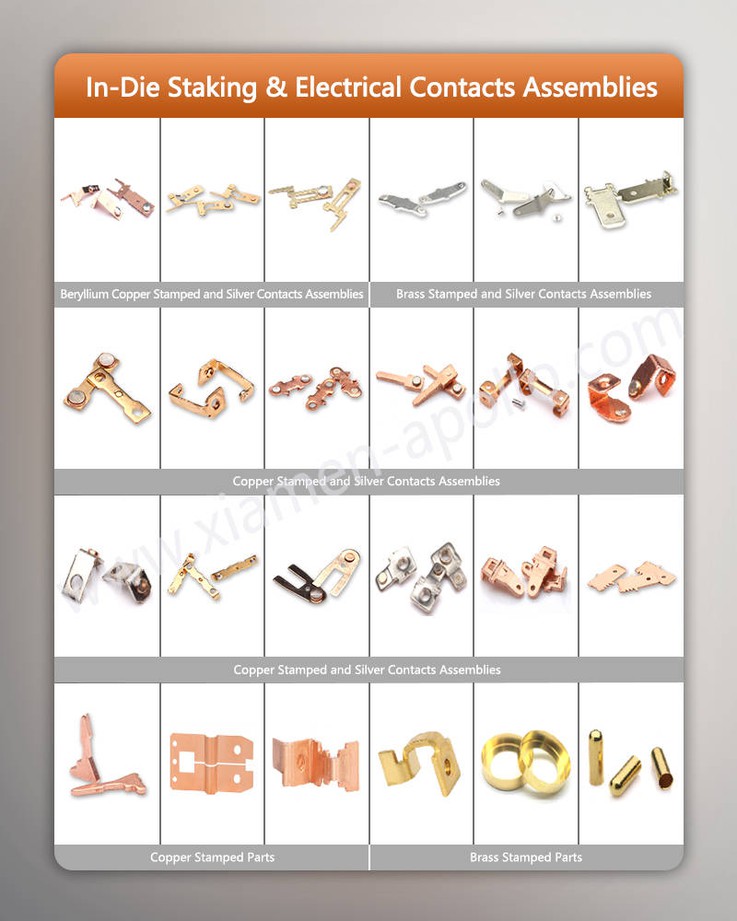
Dimension control and quality assurance of silver contact riveting
(1). Use mold design limit structure and precision guide column system to control riveting depth and position;
(2). Riveting force control system ensures firm connection without deformation;
(3). CCD visual recognition system can be integrated into the mold to detect the feeding status of silver contacts and position deviation after riveting in real time;
(5). Finished products pass the peel the orce test and resistance test to ensure riveting reliability.
The process optimization of Copper Beryllium Riveting Silver Contact is a continuous process. Through the design of experiments (DOE) method, the riveting force, speed, and temperature parameters are systematically adjusted to find the best process window; metal flow and crystal phase changes at the riveting interface are studied through metallographic analysis to guide mold structure improvement; and the long-term reliability of riveted components is verified through accelerated life tests8. These in-depth technical studies have enabled the in-mold riveting process to continuously break through the limits. For example, the latest ultrasonic-assisted in-mold riveting technology promotes metal interface fusion through high-frequency vibration, which increases the riveting strength by more than 20%, and is particularly suitable for application scenarios with high-reliability requirements.
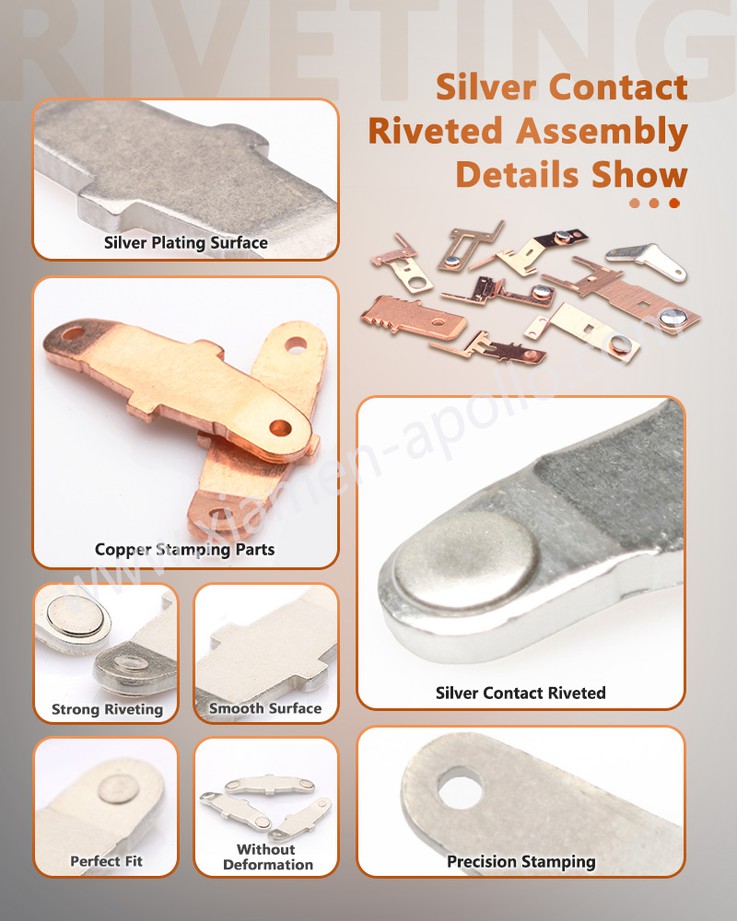
Application scenarios of silver contact riveting
Silver contact riveting of copper stamping parts: widely used in situations requiring high conductivity, such as relay moving contacts and circuit breaker connecting pieces;
Silver contact riveting of brass stamping parts: used for switches, buttons, and other structural parts that require a certain degree of elasticity;
Progressive die stamping silver contact riveting: supports multi-specification contact products and adapts to the comprehensive requirements of the modern electrical industry for "high efficiency, stability, and low cost".
As the manufacturing industry develops towards intelligence and automation, traditional manual or semi-automatic silver contact riveting methods can no longer meet the requirements of the modern electrical component industry for "high consistency, high efficiency, and low labor dependence". In-mold silver contact riveting technology is gradually becoming the mainstream trend of silver contact processing with its advantages of high process integration, excellent efficiency, and good precision. In the future, with the development of high-precision progressive die technology, the Relay Moveable Spring Riveting Assembly process will play a more important role in many electrical components such as relays, contactors, and thermostats.

contact us