As a metal stamping and welding product manufacturer focusing on copper, brass, manganese copper, aluminum alloy, stainless steel, carbon steel, and zinc alloy die castings, we have long provided customized services for customers in the fields of power, electric meters, magnetic latching relays, smart terminals, new energy devices, etc., and provide a variety of metal stress elimination annealing treatment solutions to effectively improve the stability and reliability of products.
Definition and function of metal annealing
Metal annealing refers to heating the metal to an appropriate temperature, keeping it at this temperature for some time, and then slowly cooling it at a controlled rate to achieve recrystallization of the crystal structure or the harmony of the structure, achieving the following effects:
(1). Eliminate work hardening and internal stress (stress annealing);
(2). Soften the metal to improve plasticity, which is convenient for subsequent processing;
(3). Improve the uniformity of the structure, improve electrical conductivity or magnetic permeability;
(4). Stabilize the size and performance, and extend the service life of the product.
For stamping and welding parts, annealing is not only a functional strengthening step but also a key technical link to ensure the stability of product batches.
Annealing characteristics, functions, and applications of different metal materials
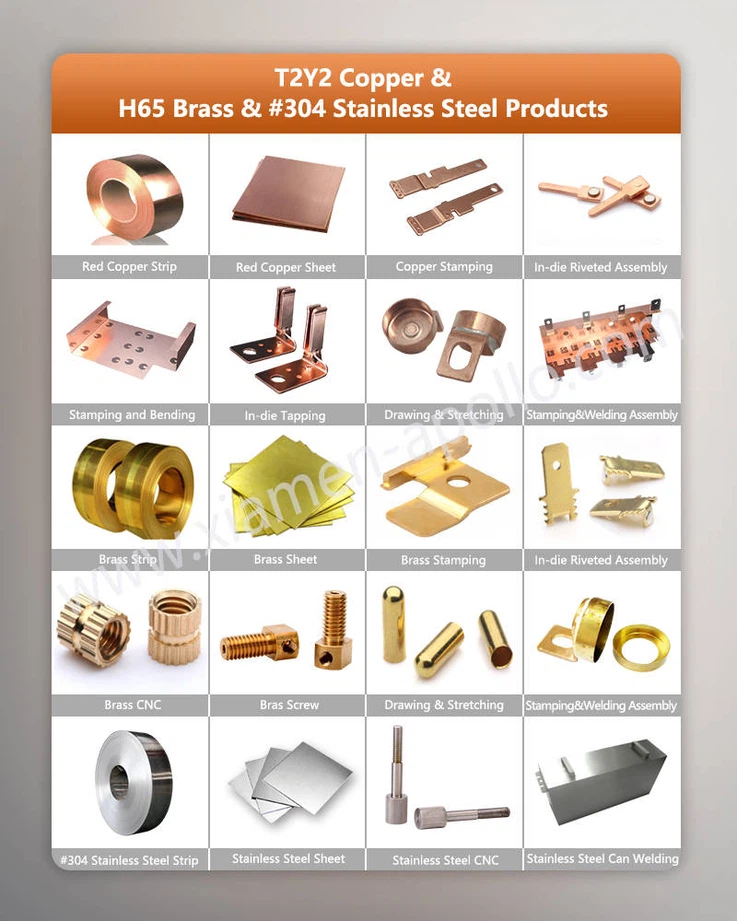
1. Annealing of copper and brass stampings
Copper and brass are widely used in electrical connectors and contacts due to their good conductivity and ductility, but they often produce obvious hardening after cold processing (such as stamping and bending):
(1). Annealing of copper: The annealing temperature is generally 300\~400°C. Annealing can restore its flexibility and is suitable for multiple stamping or deep drawing processes.
(2). Annealing of brass: Usually controlled at 450\~650°C, the material is more uniform after annealing, effectively reducing the risk of cracking and breaking.
(3). Typical applications: power pins, wiring harness terminals, conductive sheets, motor connectors, etc.
2. Annealing of manganese copper shunts (key applications)
Manganese copper materials have excellent low resistivity and stable temperature coefficient and are the core raw materials of shunts in electric meter magnetic latching relays. However, it is easy to accumulate residual stress during stamping and electron beam welding, affecting electrical properties and dimensional stability.
(1). Manganese copper annealing: The annealing temperature is about 300\~350°C, and the time is adjusted according to the thickness and structure of the piece. Annealing can significantly reduce internal stress and prevent strain or deformation during use.
(2). After annealing, the resistance stability of the shunt is improved, ensuring the measurement accuracy and long life of the meter.
Typical applications: magnetic latching relay shunt, current sensing module, precision measurement resistor, etc.

Comparison of key parameters:
| Processing state | Resistivity (μΩ·cm) | Temperature coefficient (ppm/℃) | Tensile strength (MPa) |
| Before annealing | 48±2 | ±30 | 520-580 |
| After annealing | 44±0.5 | ±15 | 420-450 |
3. Stress relief annealing of electrical pure iron stamping parts (yoke, armature, core)
Electrical pure iron (such as DT4C, and DT4E) is widely used in electromagnetic parts such as yokes, armature, and a core of relays, requiring high magnetic permeability and low remanence. However, after stamping or cold heading, its magnetic properties will be significantly reduced due to residual stress.
(1). Stress annealing of electrical pure iron: usually controlled at 750\~800°C, annealing in a protective atmosphere (such as hydrogen or nitrogen) to prevent oxidation;
It can effectively restore the material's magnetism and improve the relay's pull-in sensitivity and response speed;
For cold-headed core parts, annealing can also improve the deformation rate and dimensional consistency.
(2). Typical applications: magnetic latching relay core, smart home controller, industrial control relay, etc.

4. Softening annealing of aluminum alloy stamping parts
Aluminum alloys are mostly used for lightweight structural parts, such as photovoltaic brackets, radiators, and housing parts, but their forming process often causes cracking or instability due to hardening.
(1). Annealing of aluminum alloys: Generally, full annealing (O state treatment) at 300\~420°C is used to improve ductility;
It can be used as a pre-treatment process before stamping to enhance subsequent forming performance;
For aluminum parts after welding, it can also be used to release stress in the welding area to improve structural stability.
(2). Typical applications: aluminum alloy photovoltaic brackets, control housings, instrument housings, etc.

5. Solution and stress annealing of stainless steel and carbon steel stampings
Stainless steel annealing: Austenitic stainless steels such as 304 and 316 need to be solution annealed at around 1050°C to improve corrosion resistance and toughness;
Carbon steel annealing: Annealing and softening treatment is performed according to the material strength grade (such as SPCC, Q235, etc.) to improve welding performance and assembly stability after stamping;
Commonly used for shell structural parts, welding brackets, molded assemblies, etc.

Our quality control and process guarantee in metal annealing treatment
As a metal processing factory with many years of heat treatment experience, we have established a complete annealing treatment quality system, from equipment configuration, process control, and inspection methods to document records, to ensure the performance stability and consistency of each batch of products.
1. Multiple heat treatment furnace configurations
High-temperature box annealing furnace, continuous mesh belt annealing furnace, hydrogen protection annealing furnace;
Suitable equipment can be selected according to different metal materials, workpiece sizes, and quantities;
Maximum annealing uniformity and process adaptability.
2. High process temperature control accuracy
An intelligent temperature control system is adopted, with a temperature control accuracy of ±1°C;
Multi-stage heating/insulation/cooling curves can be set and monitored in real time;
For high-requirement parts (such as manganese copper, and electrical pure iron), oxygen-free annealing under atmosphere protection is supported.
3. Strict performance testing after annealing
Hardness testing, grain observation, magnetic permeability testing, and resistance stability testing are performed on annealed parts;
Dimensional rebound/deformation control testing to ensure assembly accuracy;
Batch traceability and quality retention samples are implemented to ensure quality consistency.

Our advantages in the diversification of metal heat treatment processes
We are committed to providing customers with "one-stop metal parts solutions". We are not only proficient in stamping and welding technology but also provide customers with products with higher reliability and cost-effectiveness through flexible cooperation of heat treatment processes.
| Support customized annealing curves. | Customize heat treatment solutions according to different structural parts or special performance requirements of customers; |
| Achieve integrated production of stamping + welding + annealing | Reduce the difficulty of logistics and multi-supplier cooperation, and shorten delivery time; |
| Adapt to a variety of material processing capabilities | Copper, iron, aluminum, stainless steel, and alloy parts can be processed; |
| Special optimization for functional parts | For example, the annealing experience of manganese copper and electrical iron for magnetic latching relays is mature and widely praised by industry customers. |
In metal parts manufacturing, metal annealing is not just a simple heat treatment, but also a key technology to ensure product performance consistency and customer stability. We will continue to optimize metal heat treatment and metal stress relief-related processes, improve overall manufacturing capabilities and response speed, and become your trusted stamping and welding parts supply partner.
contact us