Technical copywriting of relays and their key metal parts
1. What is a relay
A relay is an electrically controlled switching device that uses a small current signal to control the on and off of a large current load to achieve automatic control and remote operation. In electrical systems, relays play a vital role, such as automatic adjustment, protection switching, circuit isolation, signal transmission, and other functions. Depending on the application scenario, the types and structures of relays also vary.
2. Main types of relays
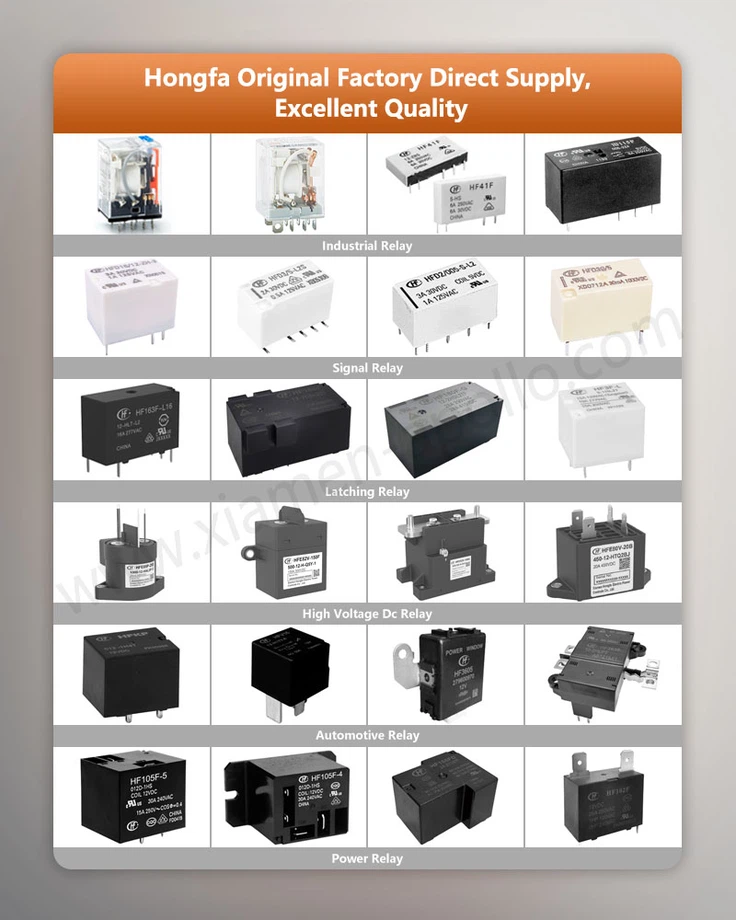
There are many types of relays, which are mainly divided into the following categories:
1. Power relay: Suitable for circuit control with large currents, such as motors, compressors, etc.
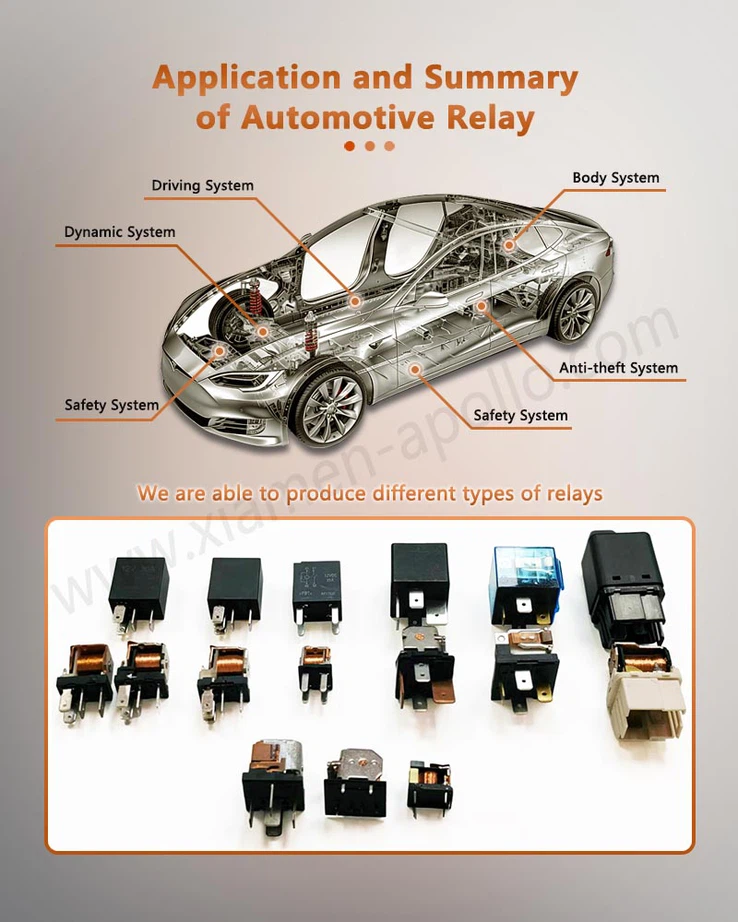
2. Automotive relay: Widely used in vehicle lighting, electric windows, electric seats, and other systems.
3. High-voltage DC relay (HVDC relay): Mainly used in new energy electric vehicles and high-voltage energy storage systems.
4. Power relay (magnetic latching relay): Used for state maintenance and energy consumption optimization in power grid distribution systems.
5. Signal relay: Used for low current and small signal control, such as communication equipment and security alarm systems.
6. Industrial relay: widely used in PLC control, industrial automation, and mechanical control systems.
7. Relay socket: provides quick installation, replacement, and wiring functions for relays.
| Relay type | Working voltage | Typical load | Main application scenarios |
| Power relay | 12-240VAC/DC | 10-30A | Home appliances, industrial equipment |
| Automotive relay | 12/24VDC | 20-70A | Vehicle electrical system |
| High-voltage DC relay | 200-1000VDC | 50-200A | New energy vehicles |
| Magnetic latching relay | 5-48VDC | 20-100A | Smart meter, power system |
| Signal relay | 5-24VDC | 0.1-2A | Communication equipment, control system |
| Industrial relay | 24-480VAC/DC | 10-50A | Automated production line |
The role of silver contacts in relays
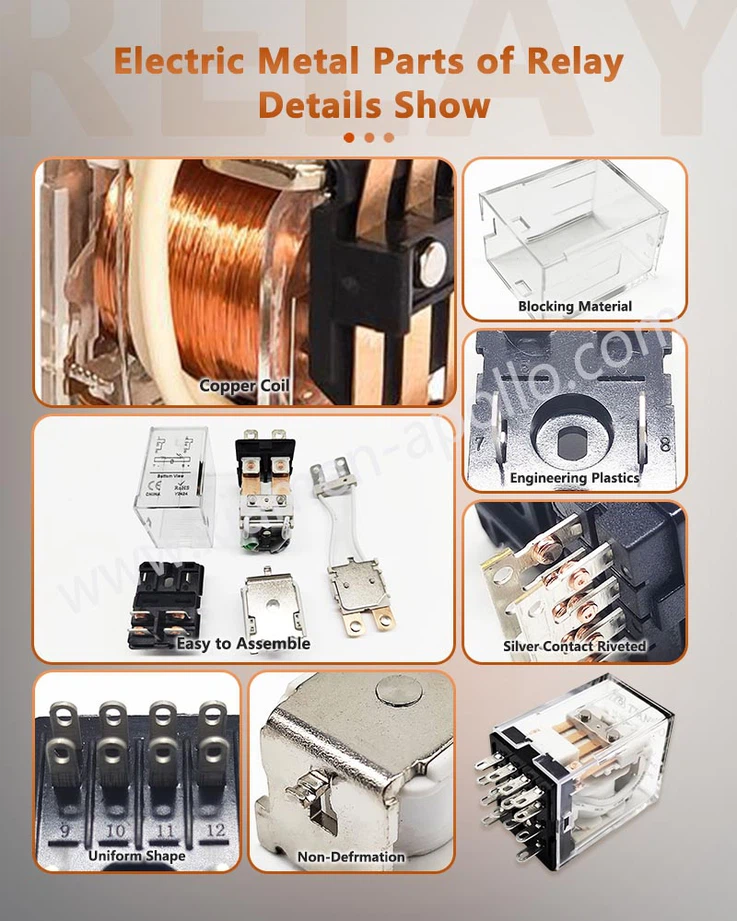
Inside the relay, the Silver Alloy Rivets are one of the core functional components, and their function is to realize the on and off of the circuit. Silver contacts are widely used in relays due to their excellent conductivity, corrosion resistance, and arc resistance. They are the preferred material for achieving high-reliability conduction performance.
When the relay switches, the Silver Solid Contact Rivets can withstand high current shocks, ensure low contact resistance and high conductivity, and reduce energy loss. At the same time, good resistance to welding and corrosion resistance extends the life of the contacts and improves the reliability of the entire relay.
Types of raw materials for silver contacts
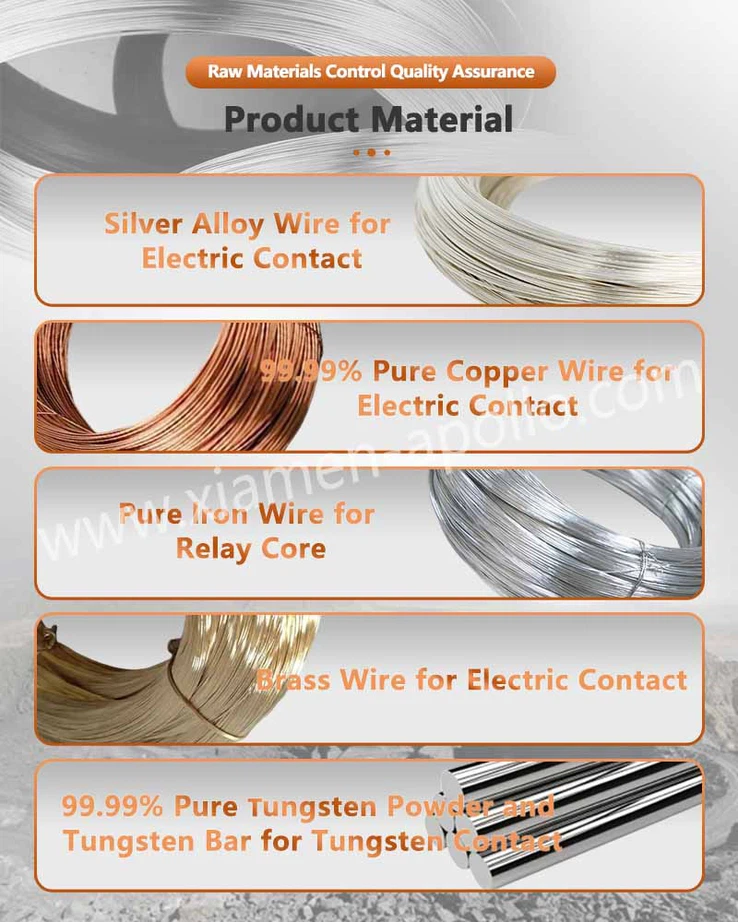
Silver Alloy Contacts can be divided into the following types of materials according to different application requirements:
1. AgNi (silver nickel): high strength, excellent anti-adhesion performance, suitable for small and medium load relays.
2. AgCdO (silver cadmium oxide): strong arc resistance, suitable for high current occasions (gradually replaced due to environmental restrictions).
3. AgSnO₂ (silver tin oxide): environmentally friendly material with good corrosion resistance.
4. AgCu (silver copper): suitable for applications with high conductivity requirements but low arc intensity.
The Alloy Silver contacts produced by our company are strictly selected from high-quality silver alloy materials. All raw materials have passed ROHS environmental certification and SGS component testing to ensure that their physical and electrical properties are stable and reliable.
Introduction to the types of silver contact riveting components and stamping parts of our company
Our company has been focusing on the production of core metal parts for relays for more than 30 years. The main products include:
1. Silver contact riveting components
The Silver Contact Points are combined with the base (copper, iron, and other stamping parts) through cold heading, riveting, and other methods to form a complete conductive component. According to customer needs, single-sided riveting, T-type, L-type, and other structures can be designed to meet the needs of different relay structures.
2. Copper stamping parts
Used for Solid contact support, conductive connection, and other functions, with excellent conductive performance. The material is selected from high-purity copper such as C1100, and high-speed stamping is used to ensure dimensional consistency and batch stability.
3. Brass stampings
With good strength and wear resistance, it is suitable for structural support and medium current conducting parts. It uses materials such as H62 and H65, which have good formability and welding performance.
4. Relay yoke stampings
As part of the magnetic circuit, it is used to guide the magnetic flux of the electromagnetic coil and enhance the magnetic attraction. Our company uses electrical pure iron DT4E and DT4C materials, which are low in carbon, low in silicon, and high in magnetic permeability. After stamping, it is demagnetized and annealed to ensure excellent magnetic properties.
5. Relay armature stampings
The armature is a moving part that responds to the magnetic force of the coil and drives the contact switch. Our armature is processed by high-precision molds, combined with grinding, deburring, and other treatments to ensure sensitive action, low noise, and long life.
6. Relay core
The core column is made by cold heading or turning, which is used for electromagnetic coil induction magnetic field and control armature action. Our company uses high-permeability pure iron raw materials, precision cold heading forming, high dimensional accuracy, and strong mechanical strength.
Quality control of our silver contacts and riveted components
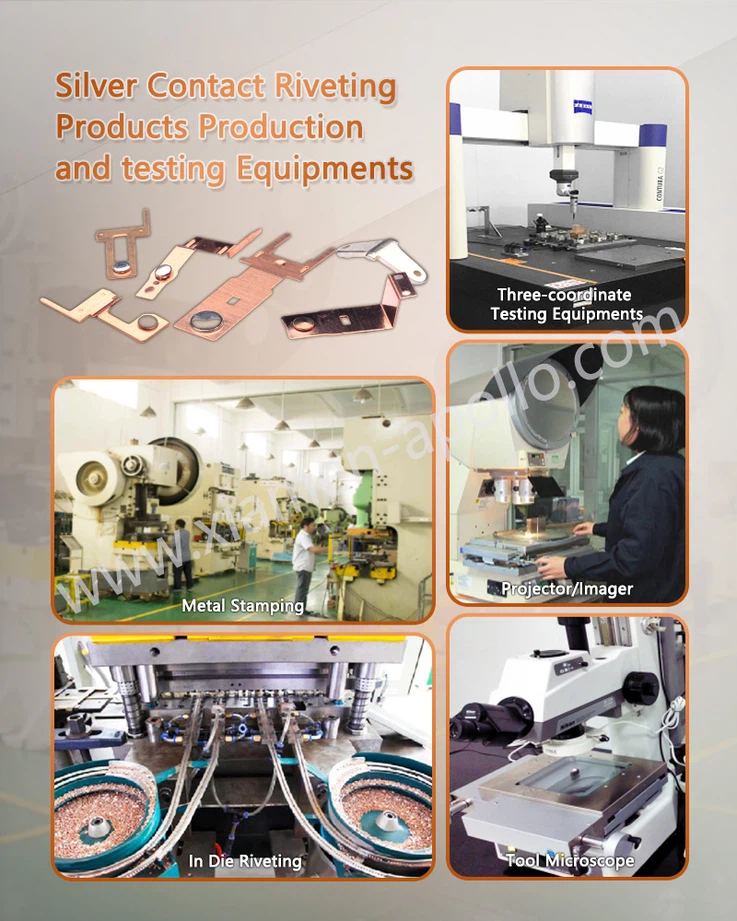
The production process of silver contacts adopts cold heading forming technology, which has the following quality control advantages:
1. Cold heading precision mold manufacturing: high mold life and good dimensional consistency to ensure batch Silver electrical contacts without deviation.
2. Automated riveting assembly line: equipped with visual positioning and force control detection system to achieve high consistency of riveting quality.
3. 100% conduction resistance test: Each silver contact component is tested before leaving the factory to ensure that the contact resistance is stable and less than the specified standard.
4. Arc ablation durability test: Test the contact life and anti-welding performance under simulated actual on-off load conditions.
5. Material composition spectrum detection: Analyze the feed composition of silver alloy materials to prevent non-compliant materials from entering the production process.
Comprehensive advantages of our company in the manufacturing of silver contacts and metal parts
1. Rich customization experience: 30 years of experience in the relay metal parts industry, can customize various complex structures and multi-process integrated silver contact components according to customer drawings.
2. Integrated production capacity: Integrate raw material shearing, mold design, stamping, cold heading, riveting, welding, and testing in one, shortening delivery time and reducing costs.
3. Quality traceability system: Record the entire process from raw material storage, semi-finished product circulation, and final inspection and shipment to achieve product traceability.
4. Multi-process collaborative matching: Stamping parts can be integrated with silver contact cold heading, and then silver-plated, tin-plated, etc., to meet the structural and performance requirements of high-end relay products.
Application fields
Our silver contacts and metal stampings are widely used in:
(1). Home appliance relays: such as refrigerators, air conditioners, and rice cookers
(2). Smart home control relays: such as smart sockets and smart lighting controls
(3). New energy vehicle control modules
(4). Rail transit signal control systems
(5). Industrial automation equipment relays
(6). Power grid smart switches, power magnetic latching relays
Silver contacts, silver contact riveted components, copper stampings, brass stampings, relay yoke stampings, armature stampings, and iron cores are indispensable core metal parts in relay structures. With years of deep technical accumulation, our company continues to provide global customers with stable and reliable high-performance relay metal parts solutions. In the future, we will continue to uphold the concept of "quality-oriented, technology-leading" to help the relay industry continue to move towards a more efficient and intelligent development direction.
contact us