In the manufacturing field of electrical silver contacts and related products, the selection and processing of materials are key factors in determining product quality and performance. Among them, silver contacts, as an indispensable and important component in various low-voltage electrical appliances, play an important role in switching current, conducting current, and preventing arc damage. Especially in relays, switches, contactors, circuit breakers, thermostats, and other equipment, their performance directly determines the service life and reliability of electrical products. To improve the comprehensive performance of silver, silver is usually made into silver alloys with other metal elements to produce different forms of contact materials such as rivet-type silver contacts and welding-type silver contacts. Xiamen Apollo Electric Co., Ltd., with more than 30 years of industry experience, carefully selects and uses a variety of high-quality materials, combined with advanced processing technology, to provide global customers with high-performance and high-reliability electrical product solutions.
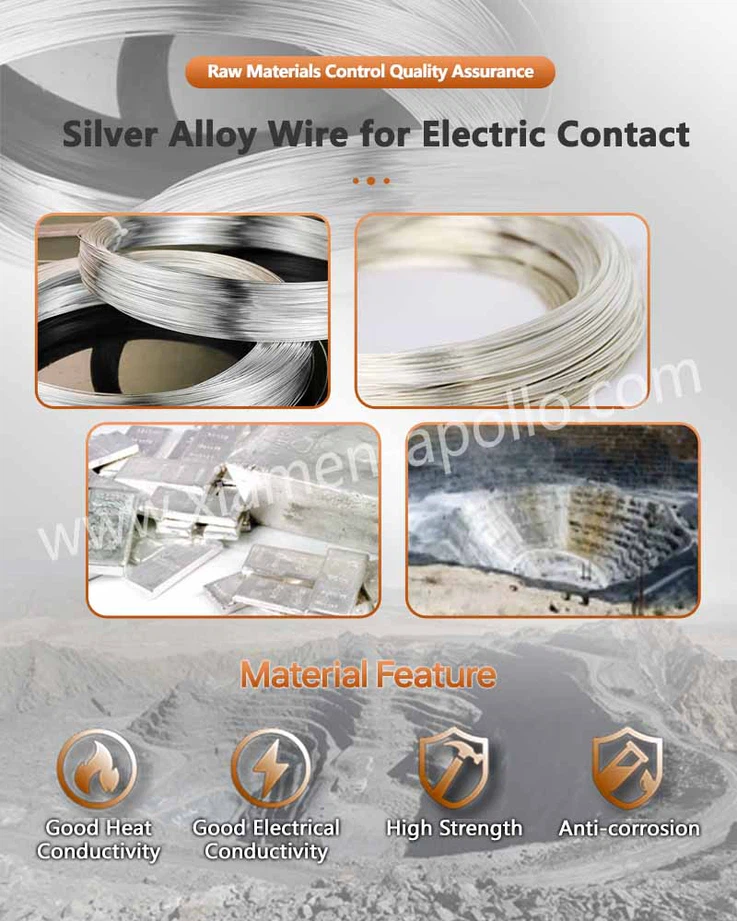
Types of silver alloy wire materials
According to different use environments and performance requirements, electrical silver contacts often use the following types of silver alloy materials:
Types of silver alloy wire materials
FAg (fine-grained silver)
Pure silver improves its welding resistance and wear resistance by adding a small amount of trace elements (such as Ni, Mg, etc.) and controlling grain refinement. FAg has high conductivity and excellent processing performance and is suitable for occasions with extremely high electrical performance requirements.
01
AgNi (silver-nickel alloy)
It is one of the most commonly used silver alloys. AgNi usually contains 5%\~30% Ni, has good resistance to fusion welding, arc ablation resistance, and high mechanical strength, and is suitable for products such as relays and micro switches.
02
AgCdO (silver-cadmium oxide alloy)
This alloy is based on silver and dispersed with CdO particles. It has excellent arc erosion resistance and welding resistance and is a traditional Silver Alloy Rivets material. However, due to the toxicity of cadmium, AgCdO is gradually being replaced by environmentally friendly alloys.
03
AgSnO (Silver-Tin Oxide Alloy)
As one of the cadmium-free alternative materials, AgSnO has good conductivity and strong arc resistance and is particularly suitable for small and medium current switch devices.
04
AgSnO₂In₂O₃ (Silver-Tin Oxide-Indium Oxide Alloy)
It is an advanced environmentally friendly silver alloy with excellent comprehensive performance and is widely used in home appliance switches, DC contactors, and automotive electrical systems.
05
Physical and electrical properties
The properties of silver alloys are mainly reflected in the following aspects:
| Alloy type | Conductivity (%IACS) | Hardness (HV) | Melting point (°C) | Welding resistance | Arc resistance | Remarks |
| FAg | 95\~100 | 65\~80 | 961 | Medium | Medium | Excellent processability |
| AgNi (15%) | 45\~65 | 80\~120 | 960 | Good | Good | Strong versatility |
| AgCdO (10\~15%) | 60\~75 | 85\~125 | 960 | Excellent | Excellent | Contains cadmium, phased out |
| AgSnO (8\~12%) | 55\~70 | 90\~130 | 960 | Good | Good | Environmentally friendly |
| AgSnO₂In₂O₃ | 50\~65 | 100\~140 | 960 | Excellent | Excellent | High-end application |
Processing methods and forms
Silver alloy materials are mainly processed in the form of wire and strips according to the different contact types of the final application:

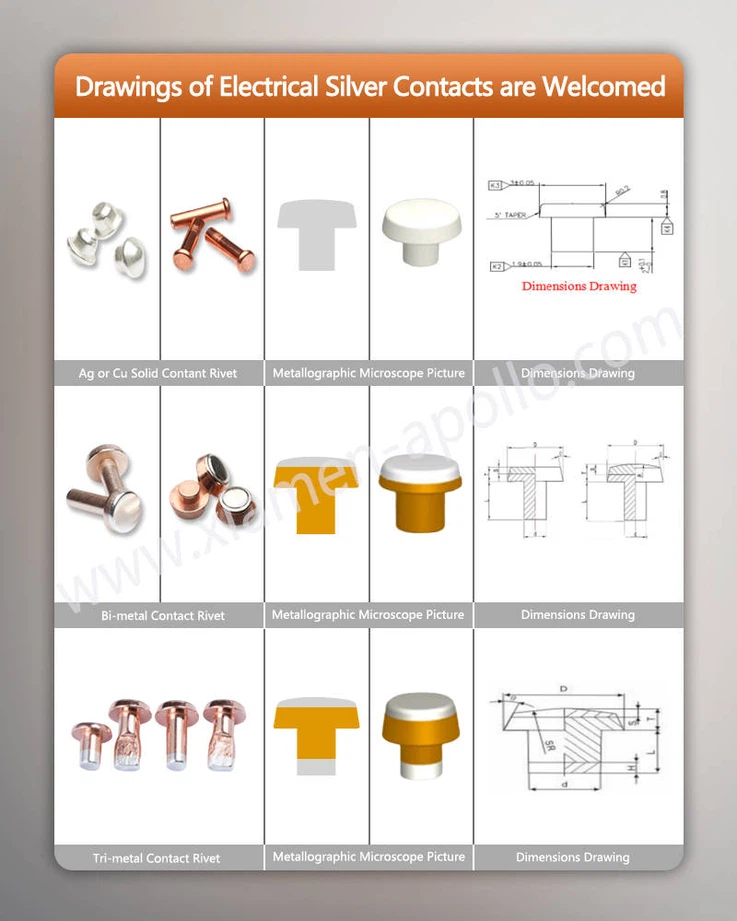
Rivet-type silver contact
Rivet-type silver contact is a rivet-shaped contact of a certain specification processed by cold heading process with silver alloy wire. The types include integral silver alloy contact, composite silver contact, three-composite silver contact, special-shaped silver contact, etc. Its characteristics are:
1. Good formability, batch processing;
2. High strength, suitable for welding or riveting installation;
3. Commonly used in switches, contactors, and other occasions with complex structures and large current carrying capacity.
Welding silver contacts
Welding silver contacts are usually punched into the required shape using silver alloy strips and fixed to the copper substrate by resistance welding, brazing, or soldering. There are square-shaped welding silver contacts, round-shaped welding silver contacts, convex-shaped welding silver contacts, etc. Its advantages include:
1. Customizable thickness and shape;
2. Suitable for automated processing;
3. Widely used in precision electrical appliances such as relays and micro switches.

Technical parameter control
production process
Composition ratio
The metal elements in the alloy must be accurately proportioned, and the error is usually controlled within ±0.1%;
01
Grain size
Control the grain size through heat treatment or deformation treatment to improve conductivity and wear resistance;
02
Purity control
The Silver Solid Contact Rivet content is usually not less than 99.9% to ensure excellent conductivity;
03
Surface treatment
The strip needs to be annealed, polished, or plated to improve the surface quality and welding adaptability.
04

Application fields
Silver Alloy Contacts are widely used in the following electrical appliances and equipment:
1. Low-voltage electrical appliances: such as household circuit breakers, AC contactors, molded case circuit breakers, etc.;
2. Automotive electrical systems: electric window controllers, wiper relays, ignition relays;
3. Household appliances: air conditioning control switches, rice cooker timers, microwave oven control modules;
4. Communication and automation equipment: PLC relays, electronic controllers, etc.;
5. New energy fields: photovoltaic DC switches, electric vehicle charging pile switches, etc.

Summary
Silver contacts, especially rivet-type silver contacts, and welded silver contacts, are key electrical connection components in the field of low-voltage electrical appliances. Choosing the right silver alloy material can not only significantly improve the durability and safety of electrical products, but also adapt to different current carrying requirements and working environments. With increasingly stringent environmental regulations, cadmium-free silver alloys such as AgSnO and AgSnO₂In₂O₃ will gradually become the mainstream of the market. In the research and development and application of silver alloy raw materials, material performance, cost control, and environmental friendliness must be taken into account. This will be the core direction of the future development of electrical silver contacts.

contact us