

In high-current conduction application scenarios such as modern power systems, new energy vehicles, data center energy storage, and power grid equipment, the metal insulation process has become a key step to ensure power safety, and improve component life and system stability. Especially for products with high conductivity copper busbars, copper foil diffusion welding flexible connection busbars, copper braided wire flexible connection busbars, etc., accurate selection and implementation of appropriate insulation methods can not only effectively prevent short circuits and electrical sparks, but also be important means of protection for high voltage, high humidity, and high-frequency environments.
As a manufacturer focusing on copper metal connectors, our company has a variety of copper busbar insulation process capabilities, mainly including PET insulation, PVC dipping insulation, powder spraying insulation, PE heat shrink tube insulation, PA66 injection molding insulation, etc., covering a variety of terminal application needs from new energy vehicles, power and electricity to cloud computing servers, with a high degree of customization capabilities and a mature insulation quality control system.
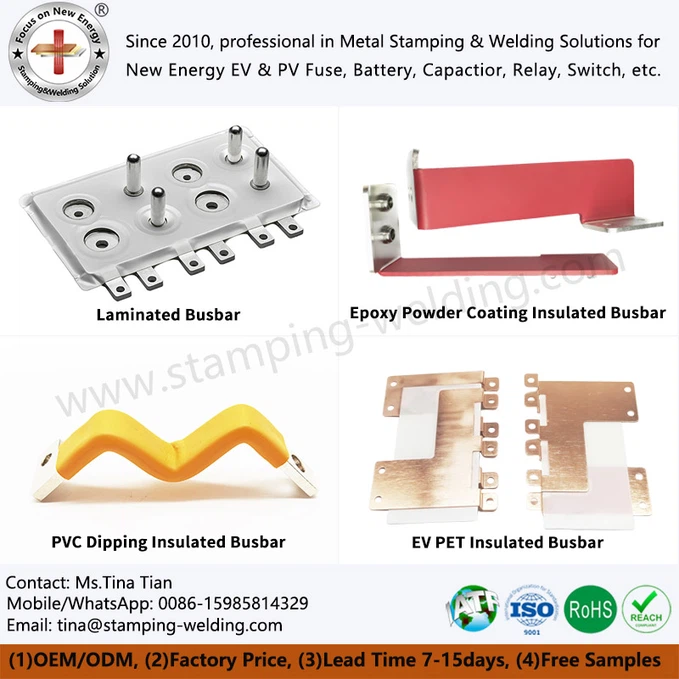
Comparison of common busbar insulation process technologies
1. PET insulated busbar (film coating)
PET insulation film is a polyester film with excellent performance, excellent electrical insulation, heat resistance, and mechanical strength. The main brands we use include GTS of the United States and KREMPEL of Germany. The color is often white and is widely used in film capacitor busbars for new energy vehicles.
(1). Insulation performance: Withstand voltage can reach 3\~10kV, and the insulation resistance is high.
(2). Process method: Automatic lamination and hot pressing processes are adopted, with a clean surface and consistent thickness.
(3). Application scenarios: New energy vehicle film capacitors, onboard electronic control systems, and assembly environments with limited space.

2. PVC dip-coated insulated busbar
PVC dip-coated is a uniform plastic layer formed on the surface of the copper busbar or copper foil flexible connector by high-temperature dip coating. It has good flexibility and adhesion and is the mainstream insulation method for the PACK battery module copper foil diffusion welding flexible connection busbar.
(1). Colors are various: Orange, green, red, black, etc. can be customized.
(2). Voltage resistance: Generally up to 3\~5kV, the insulation layer thickness is adjustable.
(3). Environmental resistance: Acid and alkali resistant, moisture resistant, adaptable to complex working conditions.
(4). Application scenarios: New energy PACK battery, BMS system electrical connection, flexible busbar connection components.
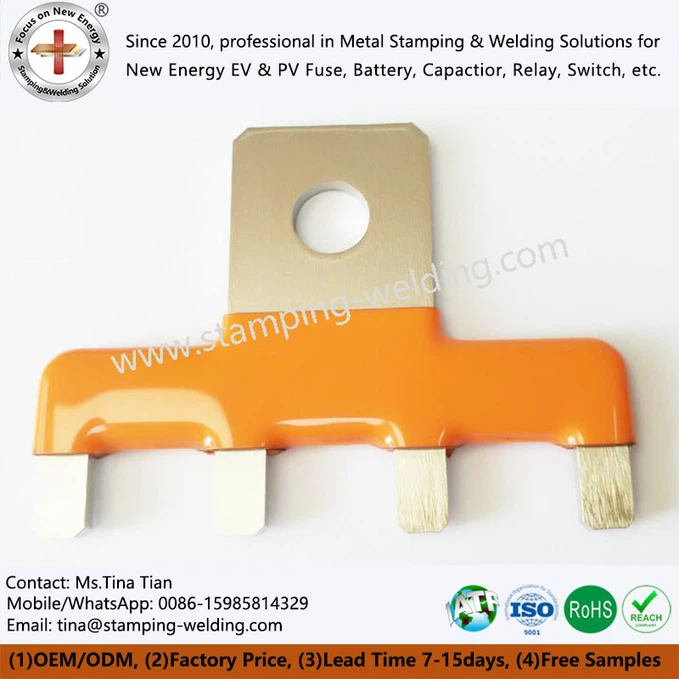
3. Powder-sprayed insulation busbar
Powder-sprayed insulation (powder electrostatic spraying) is suitable for copper busbars with complex structures that require both corrosion protection and insulation. It is a surface treatment method with a flexible process, uniform coverage, and rich colors.
(1). Mainstream colors: Orange, green, red, black, etc.
(2). Dense insulation layer: Excellent adhesion and wear resistance.
(3). Environmental advantages: Powder is solvent-free and meets RoHS and REACH requirements.
(4). Typical applications: Power distribution cabinet busbar, uninterruptible power supply (UPS), new energy storage module, battery PACK internal connection system.

4. PE heat shrink tube insulation busbar
PE heat shrink tube is an insulation material widely used in power systems. It adopts the dating shrink-wrapping method to achieve fast construction and effective coverage.
(1). Process characteristics: Shrinkage can be completed by manual or automatic hot air system;
(2). Uniform shrinkage: Close to the surface of copper busbar, good temperature resistance;
(3). Strong color recognition: Convenient electrical identification and installation identification.
(4). Main applications: Internal connection of power electrical cabinets, rail transit, and charging pile modules.
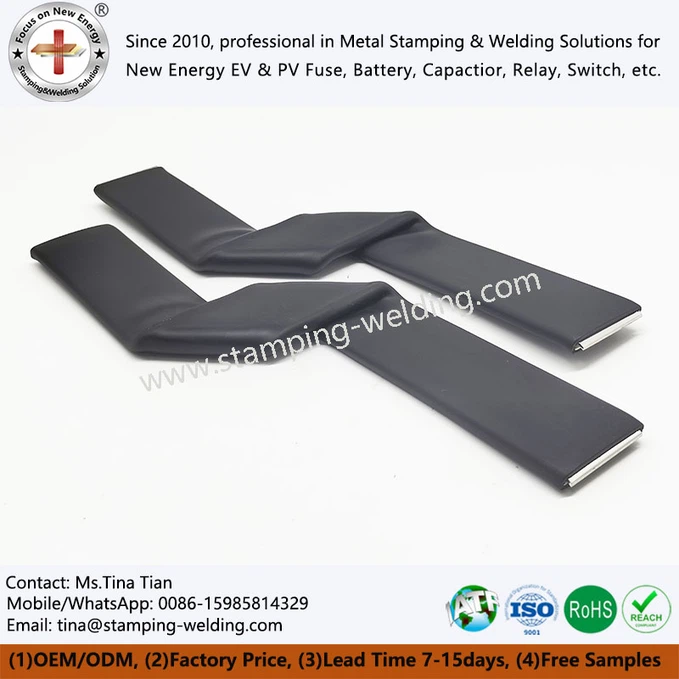
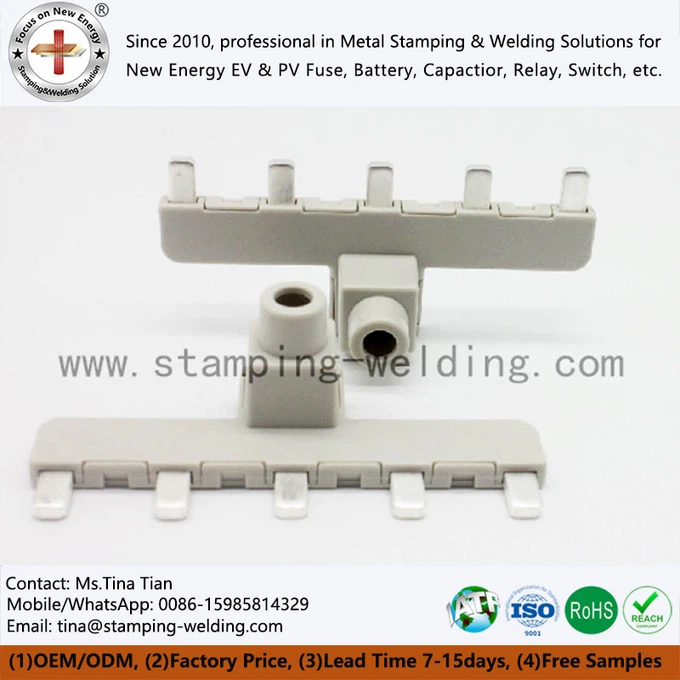
5. PA66 injection molded insulation busbar
PA66 injection molded insulation uses thermoplastic nylon (polyamide) material to wrap the outside of the copper busbar through an injection mold to achieve structural insulation and support.
(1). High mechanical strength: good impact resistance and dimensional stability;
(2). Suitable for customization: suitable for complex structures with multiple pins and multiple slots;
(3). Stable voltage resistance: widely used in high-voltage electrical systems;
(4). Typical applications: power busbar systems, switchgear, intelligent circuit breaker systems, etc.
Copper foil and braided wire flexible connection busbar insulation solution
In the field of flexible connectors, we provide personalized insulation solutions for copper foil diffusion welding flexible connection insulation busbar and red copper braided wire flexible connection insulation busbar. Since flexible connectors are frequently used in bending, vibration, and thermal expansion scenarios, higher requirements are placed on the flexibility, adhesion, and fatigue performance of the insulation layer.
Copper foil diffusion welding products can use PET film or PVC dipping as the first choice, which has the advantages of bending resistance, high-pressure resistance, and lightweight;
Braided wire products mostly use PE heat shrink tubes or PVC dipping to ensure dynamic performance while maintaining insulation integrity.
Laminated Busbar and New Insulation Method
Facing high-speed, high-frequency, and high-current power electronic systems, laminated busbars have become a new trend. The interior is made of multiple layers of copper bars laminated and bonded by PET/PVC insulation films to form a compact insulation system.
(1). Functional advantages: low stray inductance, compact structure, and uniform heat diffusion;
(2). High insulation control accuracy: uniform thickness of each layer, suitable for short-path conduction of large current;
(3). Application areas: new energy vehicle controllers, IGBT modules, photovoltaic inverters, etc.

Quality control and process advantages of our factory
1. Raw materials and supply chain quality control
Use global mainstream brand insulation materials (such as GTS, KREMPEL, etc.);
Conduct factory inspections on insulation performance, voltage breakdown strength, environmental protection performance, etc. for raw material batches;
All copper busbar products are made of oxygen-free copper T2, which has high conductivity and good weldability.
2. Multi-process parallel capability
We have a dependent film laminating/hot pressing line, PVC dipping line, powder spraying line, heat shrink tube shrinking station, and PA66 injection molding workshop;
Flexible switching between small batch customization + large batch production can be realized;
Full-process testing capabilities such as insulation thickness, voltage resistance, and temperature resistance are available to ensure stable and reliable product delivery.
3. Environmental compliance and certification system
All insulation materials and processes comply with RoHS, REACH, UL94-V0 flame retardant grade, and other international standards;
Passed ISO9001, IATF16949, and other quality management system certifications;
Support insulation voltage resistance test reports, environmental test reports, and material traceability reports for export products.

contact us
