

Silver contact welding components are indispensable key components in modern medium and high-current electrical equipment. They are widely used in industrial control relays, new energy relays, new energy high-voltage DC contactors, circuit breakers, contactors, railway switches, automobile starting power switches, and other medium and high current working conditions. This type of component achieves excellent electrical connection performance by welding the welding type silver contact with the base material such as copper or brass to form an integrated structure.
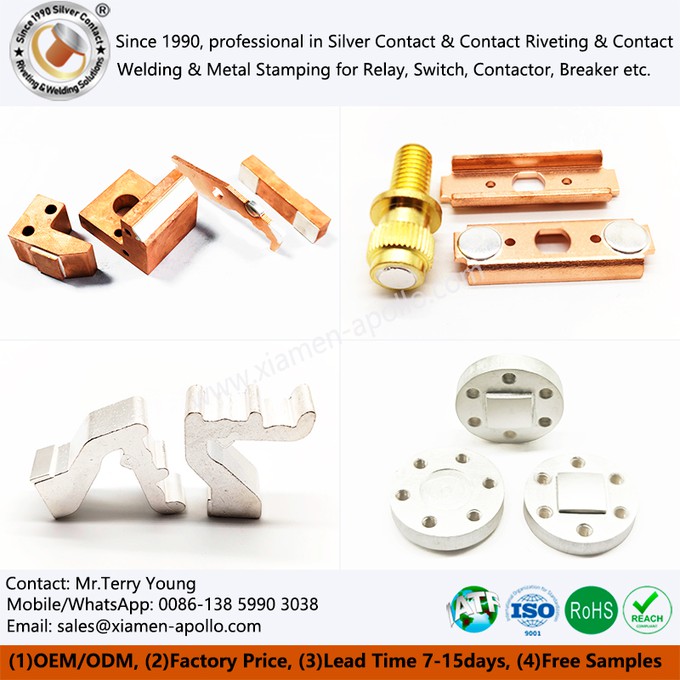
Composition and types of silver contact welding components
1. Types of silver contact welding (brazed silver contacts)
Brazing Electrical Contacts can be divided into the following types according to their appearance:
(1). Square welding silver contacts (size is usually 2×2mm to 10×10mm, thickness 0.5-3mm)
(2). Circular welding silver contacts (diameter 1-15mm, thickness 0.3-2mm)
(3). Button convex welding silver contacts (with the raised contact surface, diameter 3-8mm, overall height 1-4mm)
2. Types of welding substrates
Welding substrates are generally composed of the following categories:
(1). Copper stampings or CNC machined parts
(2). Brass stampings or CNC machined parts
3. Welding methods
The following welding methods are often used to connect silver contacts to substrates:
(1). Soldering of silver contacts (high-temperature soldering): It is the most traditional connection method. It uses tin-based solder (such as SnAgCu) to achieve connection at a temperature of 200-300℃. The equipment is simple but the joint strength is low. It is suitable for applications with low mechanical requirements and general current requirements. It is low-cost and easy to operate.
(2). Resistance welding of silver contacts (resistance brazing): It uses the resistance heat (usually 600-800℃) generated by the current passing through the contact surface to melt the silver brazing material (such as BAg-8) to form a connection. It has the characteristics of a small heat-affected zone and high efficiency. It has become the first choice for medium-scale production.
(3). High-frequency welding of silver contacts (high-frequency brazing): It achieves connection through high-frequency induction heating (temperature 700-900℃). The heating is uniform and can be precisely controlled. It is particularly suitable for welding special-shaped parts and high-requirement products.
Table: Comparison of technical characteristics of three mainstream silver contact welding methods
| Technical parameters | High-temperature soldering | Resistance brazing | High-frequency brazing |
| Welding temperature (℃) | 200-300 | 600-800 | 700-900 |
| Joint strength (MPa) | 30-60 | 120-200 | 150-220 |
| Conductivity (%IACS) | 20-30 | 75-90 | 80-95 |
| Heat affected zone | Small | Small | Minimum |
| Equipment cost | Low | Medium | High |
| Typical applications | Low load relay | Contactor, circuit breaker | High voltage DC contactor |

Comparative analysis of silver contact welding methods
1. Manual silver contact welding
Process characteristics: Workers manually operate, and the silver contacts and substrates are welded one by one.
Advantages: Flexible operation, suitable for samples and small batch production; strong adaptability to non-standard structural parts.
Disadvantages: Low efficiency (average daily output of skilled workers is about 5,000-8,000 sets), poor dimensional consistency, and high reliance on manual labor.
2. Semi-automatic welding of silver contacts
Process characteristics: The welding of Silver Contact Brazing on Copper Bars is fed by an automatic vibration plate, and workers hold the substrate for welding operations.
Advantages: Higher efficiency than manual (output can reach 10,000-20,000 sets/day), moderate dimensional stability.
Disadvantages: There is still manual intervention, technical proficiency is required, and it is suitable for small and medium-sized orders.
3. Fully automatic welding of silver contacts
Process characteristics: Silver contacts, substrates, and solder are all completed through an automated feeding system, with robots or automatic welding platforms.
Advantages:
High efficiency (output of about 30,000-50,000 sets/day)
Good dimensional consistency and high yield rate
Full process automation, saving manpower, suitable for large-volume orders
Disadvantages:
High initial equipment investment
Long debugging cycle, high requirements for product standardization
Table: Typical configuration and performance indicators of silver contact automatic welding system
| System module | Core configuration | Technical indicators | Advanced functions |
| Feeding system | Vibration plate + linear guide + CCD vision | Positioning accuracy ±0.01mm | Foreign matter detection and automatic removal |
| Welding power supply | Medium-frequency inverter DC/high-frequency generator | Current fluctuation ±1% | Parameter adaptive adjustment |
| Actuator | Servo pressure system + water-cooled electrode | Pressure control ±2N | Pressure curve programmable |
| Detection unit | Laser ranging + infrared temperature measurement + machine vision | Detection speed <0.5s/piece | Big data quality analysis |
| Control system | PLC + industrial PC + HMI | Storage 100+ recipes | OEE real-time monitoring |
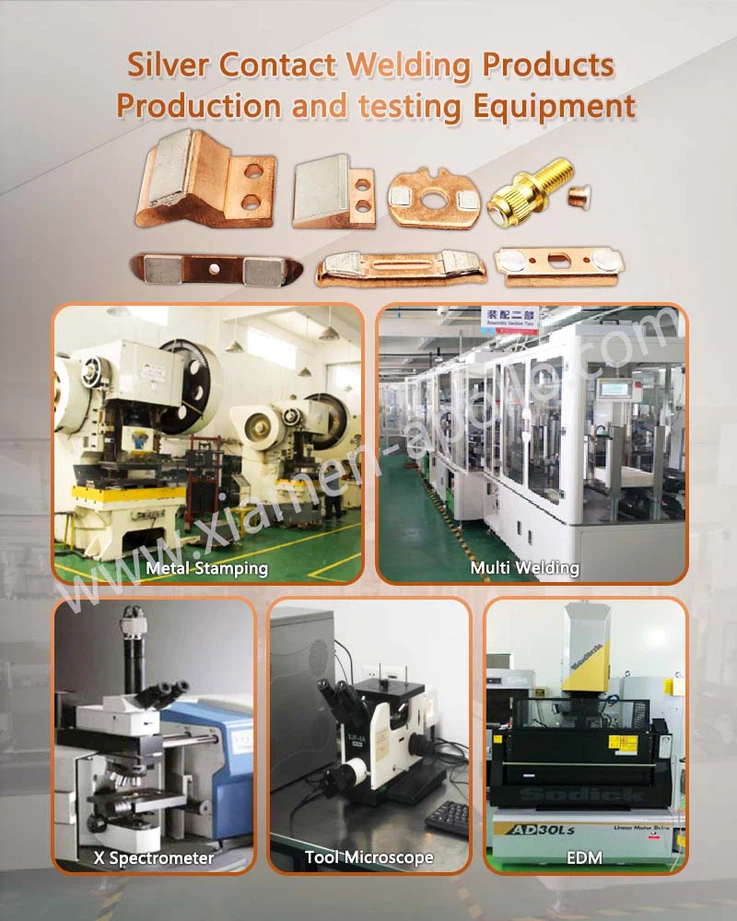
Silver contact welding technology and size control
During the silver contact welding process, size consistency control is one of the key factors for product quality, especially in industrial control relays, new energy high-voltage contactors, and other equipment that require extremely high current conduction accuracy. Automated welding equipment can be equipped with image recognition systems and position correction systems to achieve precise positioning and constant welding pressure control.
In addition, different silver contact welding processes have different applicable characteristics:
(1). Soldering silver contacts: The solder has good fluidity and is suitable for a variety of structural parts; the solder joints are smooth but the strength is slightly lower.
(2). Resistance welding silver contacts: The welding depth and time can be precisely controlled, which is suitable for scenes with high conductivity requirements.
(3). High-frequency welding silver contacts: The welding can be completed in a very short time, which is suitable for high-efficiency production lines.
Table: Performance comparison of three welding methods in typical applications
| Performance index | High-temperature soldering | Resistance brazing | High-frequency brazing | Test standard |
| Shear strength (MPa) | 30-60 | 120-200 | 150-220 | GB/T 8642 |
| Contact resistance (mΩ) | 1.5-3.0 | 0.5-1.2 | 0.3-0.8 | GB/T 5586 |
| High temperature stability (200℃) | Poor (easy to creep) | Good | Excellent | IEC 61810-1 |
| Thermal cycle performance | Failure after 100 times | No abnormality after 1000 times | No abnormality after 3000 times | IEC 60512 |
| Typical application current | <20A | 20-200A | >200A | - |
| Single point cost (yuan) | 0.02-0.05 | 0.05-0.10 | 0.10-0.20 |

Application fields of silver contact welding components
Silver contact welding components are widely used in the following industries due to their excellent conductivity, wear resistance, and high-temperature performance:
(1). Industrial automation equipment (such as industrial control relays)
(2). New energy vehicle components (such as high-voltage DC contactors, and charging protection switches)
(3). Power system switch devices (such as circuit breakers, and contactors)
(4). Railway traffic signal systems (such as railway switch control units)
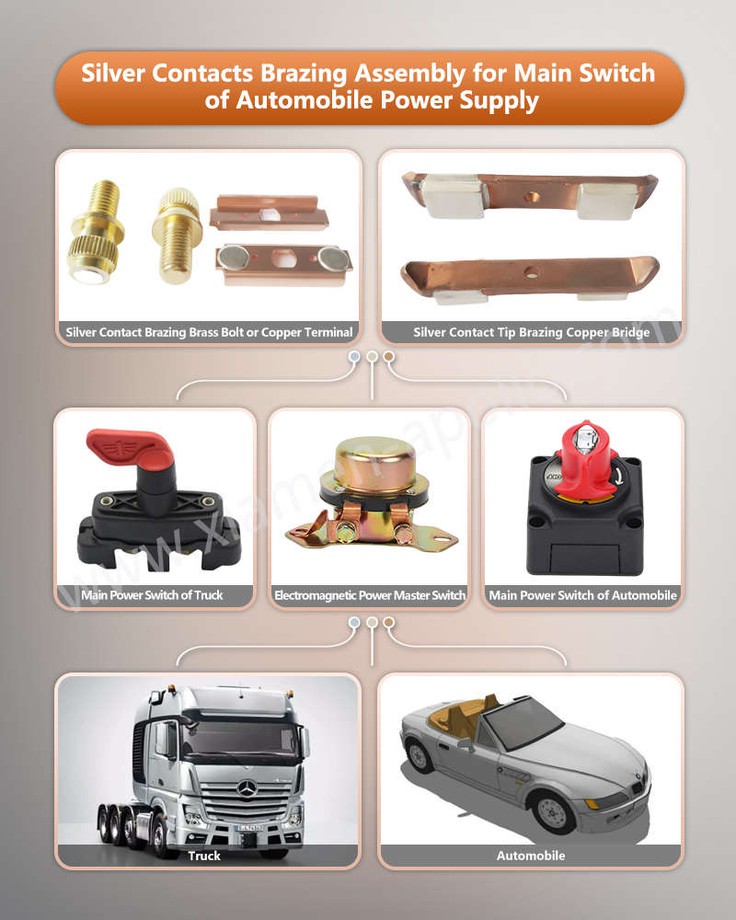
(5). Automobile power main switch (such as truck power main switch)
In these applications, the performance of Brazing Silver to Coppers directly affects the stability and safety of the entire circuit system, so its reliability and consistency requirements are extremely high.

By comparing the three main welding methods: manual welding, semi-automatic welding, and fully automated welding, it is not difficult to find that Silver contact automated welding has obvious advantages in terms of dimensional consistency, production efficiency, and product reliability, and is especially suitable for the current large-scale and standardized needs of Industry 4.0 and new energy industries for high-quality parts. With the improvement of the intelligence of welding equipment and the maturity of technology, the fully automated production of Spot Welding Silver Contact components will gradually replace traditional manual and semi-automatic processes and become the mainstream method of silver contact electrical connection solutions in the future.
contact us
