

Brass is an alloy material composed of copper and zinc, named for its golden color. As an important processing form of this alloy copper, the brass strip has excellent formability, conductivity and mechanical strength. It is widely used to manufacture various brass stampings and brass terminals, especially suitable for electrical connection structures of low-voltage electrical appliances such as relays, switches, sockets and connectors.
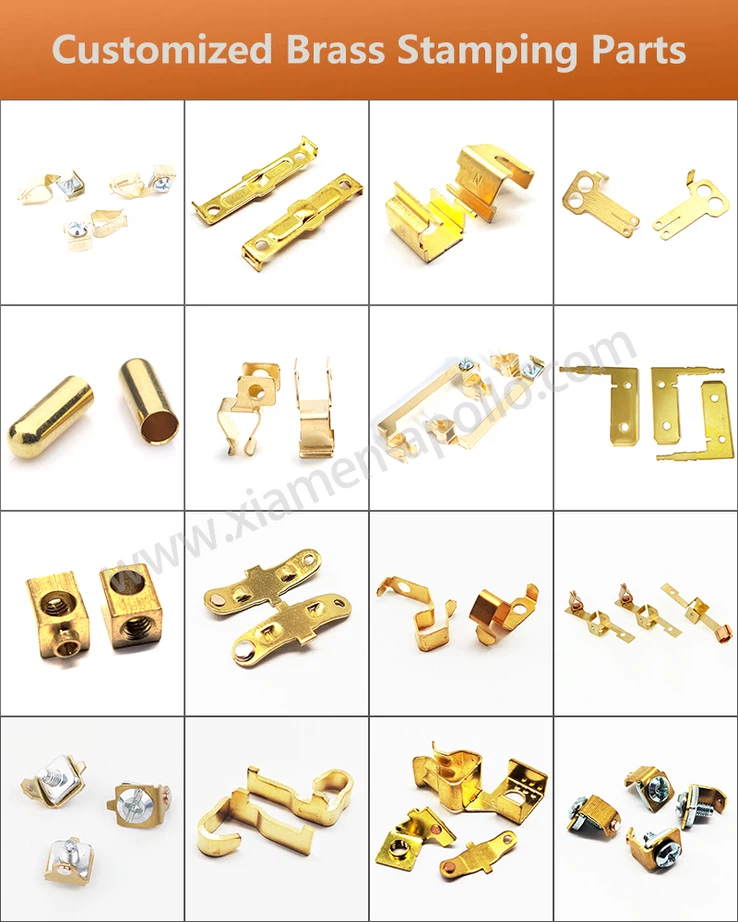
Basic introduction of brass strip
1. Definition and classification
A brass strip is a metal strip made of Brass Sheet Stamping parts through hot rolling, cold rolling, and other processes. According to the different zinc content, brass is mainly divided into:
| Brand | Composition range (wt%) | Typical characteristics |
| H62 | Cu 60.5\~63.5, Zn remainder | General type, high strength, good plasticity |
| H65 | Cu 63.5\~68.0, Zn remainder | Excellent conductivity, suitable for precision parts |
| H68 | Cu 67.0\~70.0, Zn remainder | Better ductility, suitable for complex forming |
| H59 | Cu 57\~60, Zn remainder | Low cost, suitable for medium precision parts |
2. International standard correspondence table of brass strip
| Country/region | Corresponding standard | Common corresponding brand |
| China GB | GB/T 2059 | H62, H65, H68 |
| American ASTM | ASTM B36 | C26000 (corresponding to H65), C26800 |
| Japanese JIS | JIS H3100 | C2600, C2680 |
| German DIN | DIN 17660 | CuZn37, CuZn36 |
| European EN | EN 1652 | CW505L, CW507L |

Physical and electrical properties
1. Physical properties
| Performance items | Value range (take H65 as an example) |
| Density | 8.4\~8.7 g/cm³ |
| Melting point | 880\~920°C |
| Thermal expansion coefficient | 19 × 10⁻⁶ /℃ |
| Thermal conductivity | 109 W/m·K (20℃) |
| Processing hardness state | O state (soft state), 1/2H (semi-hard), H (hard), etc. |
Brass strip has good plasticity and medium strength. It is easy to stamp, bend and stretch at room temperature and is suitable for the production of large quantities of precision brass stampings.
2. Electrical properties
| Performance items | Numerical description |
| Conductivity | 20\~28 % IACS |
| Resistivity | 0.06\~0.08 μΩ·m |
| Contact resistance | Lower than steel and aluminum, suitable for conductive connection |
| Electromagnetic performance stability | Strong anti-interference ability, suitable for electrical applications |
Although the conductivity of brass is slightly lower than that of pure copper, its mechanical properties are better, so it is widely used in electrical connectors, such as brass terminals, brass inserts, pins, etc.
Processing methods and manufacturing processes
1. Processing process
The forming of brass strips usually goes through the following process:
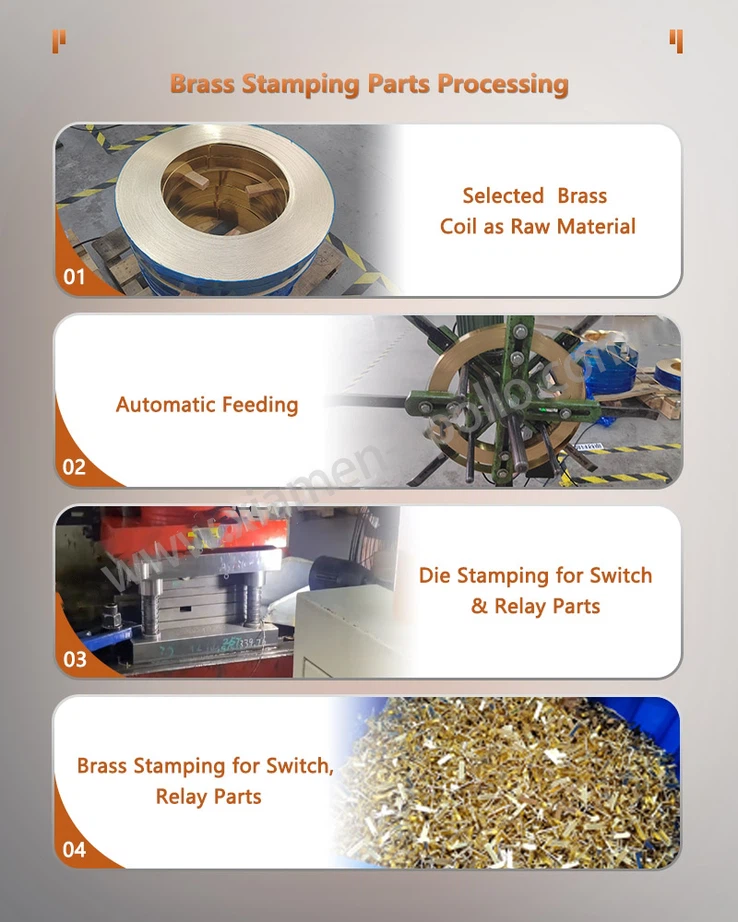
Smelting alloy → hot rolling → pickling and descaling → cold rolling → annealing → surface polishing → stripping or slicing → packaging
The thickness, hardness, and strength of the material can be controlled during the cold rolling process to meet the requirements of different stamping forming.
2. Stamping forming
Brass strips are often processed into various Brass Sheet Metal Stampings and terminals. The processes include:
(1). High-speed continuous stamping: suitable for precision connectors;
(2). Multi-station die forming: suitable for electrical connectors with complex structures;
(3). Upsetting, bending, embossing: improve contact or mechanical matching accuracy.
Surface treatment of brass stampings
To enhance the corrosion resistance, conductivity, and appearance quality of Electrical Brass Switch Socket Parts, the following surface treatments are usually required:
| Surface treatment process | Functional description |
| Electroplating nickel (Ni) | Improve corrosion resistance, hardness, and contact reliability |
| Electroplating tin (Sn) | Improve weldability and electrical contact stability, widely used in terminals |
| Electroplating gold (Au) | Suitable for high-end connectors, enhance signal transmission and wear resistance |
| Hot dip tin | Low cost, suitable for batch electrical connectors |
| Oxidation passivation | Prevent surface oxidation and improve subsequent coating adhesion |
Typical application areas
Typical application areas
Low-voltage electrical industry
1. Relay contact terminals
2. Miniature circuit breaker connector
3. Push switch spring structure
4. Socket terminal and connector
01
Electronics and communications field
1. Connector pin
2. Signal terminal
3. Board-to-board plug structure
02
Automotive electronic system
1. Automotive wiring harness connection terminal
2. Car relay copper sheet
3. Automotive fuse contact
03
Home appliances and lighting products
1. Lamp contact sheet
2. Switch structure connection copper sheet
04

Key points of quality control
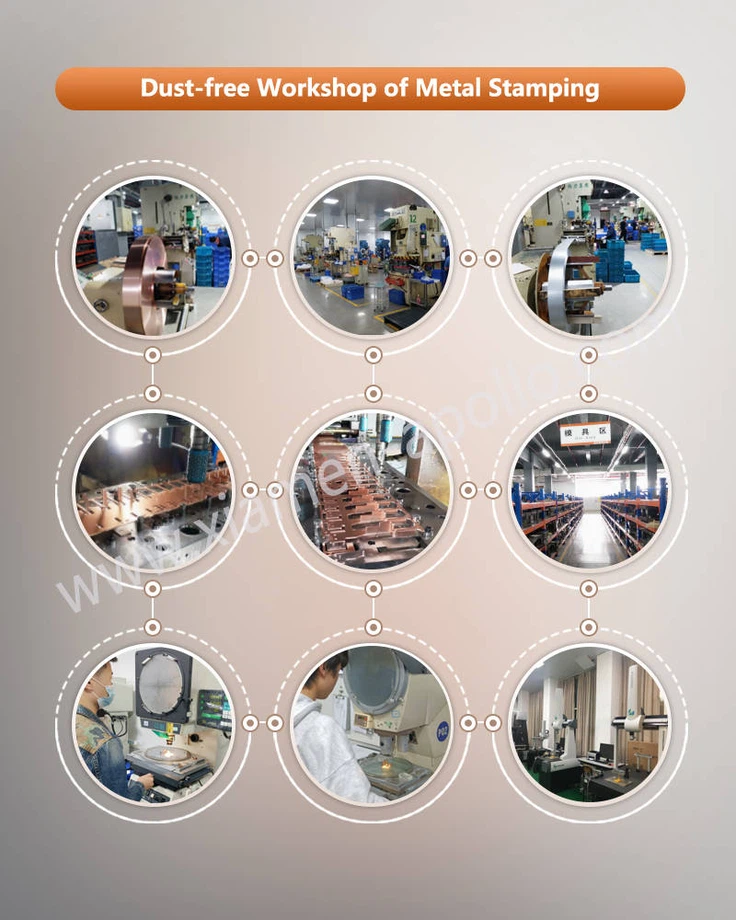
To ensure the use effect of brass strip and Sheet Metal Brass Stampings, the whole process should be controlled from raw material procurement to product delivery:
(1). Material testing: composition analysis (spectrometer), hardness test (HV);
(2). Dimension control: use precision measuring tools or 2.5D testing equipment;
(3). Surface quality control: check for defects such as oxidation, scratches, peeling, etc.;
(4). Conductivity test: Ensure that the electrical performance requirements of the terminal are met;
(5). Electroplating thickness monitoring: Use XRF to test the uniformity and thickness of the plating.
With its excellent machining performance, good conductivity, and wide adaptability, brass strips have become an indispensable metal material in electrical connectors, low-voltage components, and precision stampings. Brass Stamping Switch Terminal Accessories and brass terminals not only improve the reliability of electrical products but also provide higher efficiency and safety for electrical connections. As electronic and electrical equipment continues to develop towards lightweight, integrated, and high-performance, the application scenarios of brass strips will continue to expand and become an important bridge connecting the future.
contact us
