A detailed explanation of cold forging process technology for silver contacts
As the core component of the electrical contact system in low-voltage electrical appliances, silver contacts are widely used in relays, switches, contactors, circuit breakers, and other products. Their performance directly affects the switching capacity, service life, and safety reliability of electrical appliances. With the development of precision manufacturing, the cold forging silver alloy contact forming method has become the mainstream process for silver contact manufacturing due to its advantages of high efficiency, high consistency, and low cost.

Basic structural classification of silver contacts
According to the materials used and the structural level, electrical silver contacts can be roughly divided into the following categories:
| Type | Structural form | Process adaptability |
| Integral silver contact | Integral forging of silver alloy wire | Traditional cold forging (single layer) |
| Integral copper contact | Integral forging of pure copper wire | Traditional cold forging (single layer) |
| Composite contact | Composite forging of silver alloy wire and copper wire (two layers) | One die two punch cold forging process |
| Triple composite contact | Head silver layer + middle copper layer + foot silver layer (three layers) | One die three punch cold forging new technology |
Table: Performance and process comparison of different types of silver contacts
| Contact type | Material composition | Manufacturing process | Silver layer thickness | Contact resistance | Cost index |
| Integral silver contact | Silver alloy | One die one punch | All silver | 10-20μΩ | 100 |
| Finished copper contact | Pure copper | One die one punch | All copper | 40-80μΩ | 10 |
| Compound contact | Ag/Cu | One die two punches | 0.3-1.0mm | 20-50μΩ | 30-50 |
| Triple compound contact | Ag/Cu/Ag | One die three punches | 0.3-1.0mm | 30-60μΩ | 20-40 |
Cold heading forming technology of silver contact
Cold heading is a technology that uses a die and a punch to perform room-temperature plastic forming on metal wire, which has the characteristics of high efficiency, low material loss, and high repeatability. The cold heading process of Silver Alloy Rivets is divided into the following three types according to the structural level:
1. Cold heading of traditional integral silver contacts (single-layer cold heading)
Material: Silver or silver alloy wire (AgNi, AgSnO₂, AgCdO, etc.)
Process flow:
Loading → One-die-one-punch cold heading → Cleaning → Annealing → Cleaning → Inspection
Features: Simple process, suitable for small and medium current applications, good contact integrity, but high material cost.
2. One-die two-punch cold heading technology for Bimetal Silver Contacts (two-layer structure)
Material: Silver alloy wire + copper wire
Process flow:
Silver wire → Copper wire → One-die two-punch upsetting → Cleaning → Annealing → Cleaning → Inspection
Advantage:
Reduce silver usage and cost
Controllable silver layer thickness, suitable for batch automatic production
Good conductivity and structural strength
3. One-die three-punch cold heading technology for Trimetal Silver Contacts (high-performance three-layer structure)
Material: Silver alloy wire + copper wire + silver alloy wire
Process flow:
Silver wire → Copper wire → Silver wire → One-die three-punch automatic upsetting → Cleaning → Annealing → Cleaning → Inspection
Features:
Precise control of the silver layer at the head and the silver layer at the foot
The silver layer and the copper base are strengthened by the alloy transition layer
Can be used for switching switches, industrial control relays, etc.
Compared with the overall silver contacts, it can reduce more than 50% of the material cost

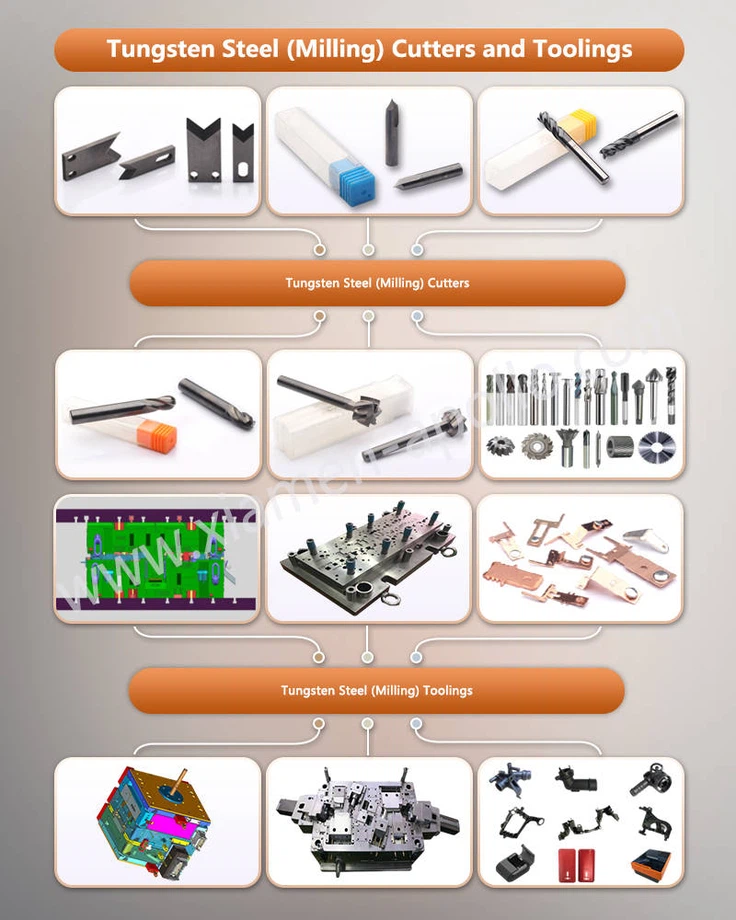
Tungsten steel alloy mold for cold heading
During the cold heading process of Silver Solid Contact Rivets, the precision and wear resistance of the mold directly determine the product quality and mold life.
Mold material: Ultrafine grain tungsten steel (hard alloy YG15, YG20C)
Mold Accuracy: Tolerance is controlled within ±0.005 mm
Mold structure:
Upper mold: Punch is used to punch out the silver surface of the head
Lower mold: The forming cavity accurately controls the depth and shape of the silver layer
Cooling and lubrication: Special micro-emulsified lubricant to ensure mold temperature control and smooth upsetting
Cold upsetting characteristics of silver alloy materials
| Alloy type | Feature description | Application adaptation |
| AgNi | Strong resistance to welding, wear resistance, high mechanical strength | Contactor, switch |
| AgCdO | Strong arc ablation resistance, excellent conductivity | Medium and high load relays |
| AgSnO₂ | Environmentally friendly material, good arc resistance | Miniature circuit breakers, home appliance switches |
| AgCu | Cheap, good conductivity, suitable for medium and low loads | Low-voltage switches, meter contacts |
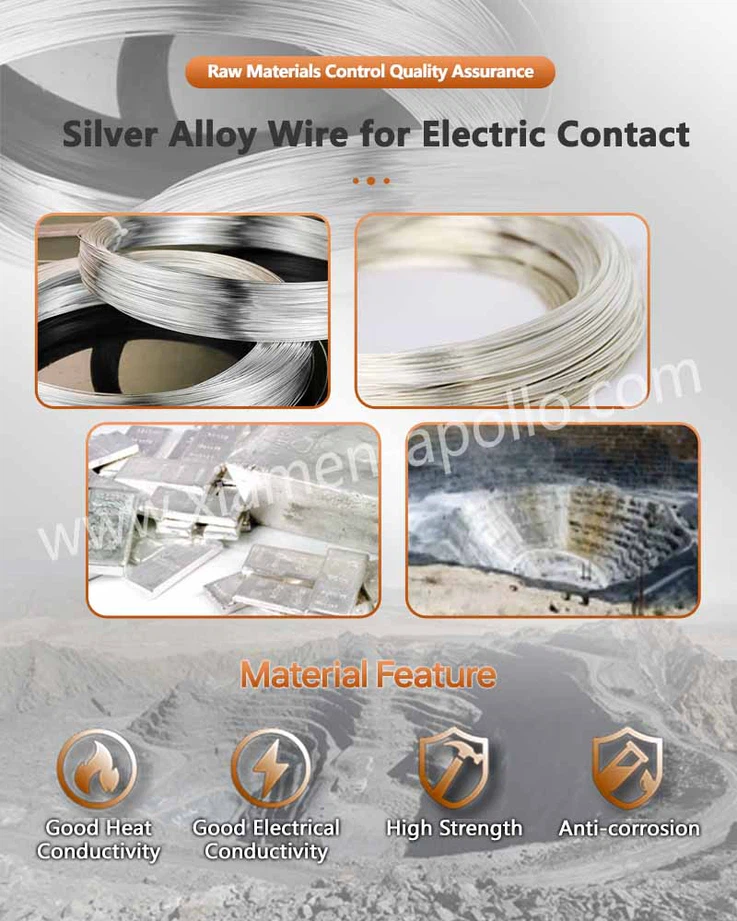
Cold heading performance has high requirements for the plasticity of silver alloys. Controlling the uniformity of the alloy structure and fewer impurities can significantly improve the forming quality and the consistency of the silver surface of the head.
Dimension control and silver layer optimization during cold heading
1. The importance of silver layer control:
The process control of Silver electrical contacts cold heading production is the core link to ensure product quality consistency, among which the control of the silver layer of the head is particularly critical, which directly determines the electrical performance and production cost of the product. As a traditional method for the production of composite contacts, the one-die two-punch process has the technical key point of accurately allocating the deformation of the two processes to ensure the reasonable distribution of the silver layer in the final product. The first punch usually completes the pre-upsetting and preliminary forming of the material, and the deformation is controlled at 30-50%. At this stage, special attention should be paid to the synchronous flow of the silver layer and the substrate to avoid interface separation; the second punch completes the final shape forming and size finishing, and the deformation is about 20-30%. At this time, the matching accuracy of the mold directly affects the thickness and surface quality of the silver layer on the head. During the process debugging stage, the silver layer distribution needs to be confirmed by slice detection, and the mold parameters are adjusted until the silver layer thickness tolerance reaches within ±0.02mm.
The one-mold three-punch process is an advanced technology for the production of Trimetal Electrical Contacts. Compared with the traditional method, a transition forming process is added to make the metal flow more controllable. The typical process flow is: the first punch completes the material pre-upsetting and the preliminary distribution of the silver layer (deformation 30-40%); the second punch realizes the transition forming and volume distribution of the intermediate layer (such as the nickel layer) (deformation 25-35%); the third punch performs final finishing and size shaping (deformation 15-25%). This multi-step progressive forming method can effectively control the thickness ratio of each functional layer and evenly distribute the silver layer even if it is as thin as 0.1mm. The three-punch process requires higher equipment precision, and the coaxiality between each station must be controlled within 0.005mm. The clearance between the punch and the die is usually only 1-2% of the material thickness.
Thickness control range: 0.2–1.0 mm (designed on demand)
Accuracy requirement: within ±0.03 mm
Detection method: digital display projector automatic detection system
Process optimization: precise and stable upsetting is achieved through mold cavity adjustment and punch pressure control
2. Consistency control:
Use an automatic feeding device and metering system
Automatic correction of product length, tolerance, and head flatness
Annealing diffusion and surface treatment process
1. High-temperature annealing and alloy diffusion
Purpose: Eliminate cold upsetting stress and enhance the bonding strength between the silver layer and the copper matrix
Method: high-temperature annealing furnace
Temperature: 350–500°C, keep warm for 30–60 minutes
2. Surface cleaning treatment
Oil stains and impurity residues on the surface of Pure Silver Contacts will significantly affect contact resistance and arc performance and must be cleaned.
Process flow:
Multi-tank ultrasonic degreasing → pure water rinsing → drying
Cleaning standard:
No fingerprints, oil film, or microparticles on the surface
Qualified resistance measurement value (≤1mΩ)

Precautions for packaging, storage, and use
1. Packaging method
Vacuum drying packaging: avoid oxidation
Moisture-absorbing material interlayer: keep dry
Shockproof foam wrapping: prevent bumps and deformation
2. Storage environment
Temperature: 10\~35℃; Humidity: <60%RH
Avoid direct sunlight and corrosive gases
3. Usage suggestions
Make sure the silver surface is clean and free of oxidation before use
It is recommended to use automatic riveting equipment for installation to ensure contact consistency
For those who have been stored for more than 6 months, it is recommended to re-clean the surface before use
Application scenarios and industry Expansion
Cold-forged silver alloy contacts are widely used in the following fields due to their stability, cost-effectiveness, and versatility:
| Application equipment | Functional parts | Reasons for use |
| Relay | Dynamic/static contacts | Good arc resistance and fast response |
| Contactor | Main contacts, auxiliary contacts | Support high current on-off |
| Switch | Rocker arm, conductive sheet contacts | Good cost control and strong reliability |
| Circuit breaker | Fast-break/slow-break structure contacts | High conductivity and high mechanical life |
| Electric meter | Module contacts, power control | Adapt to long-term stable low current load |
Cold-forged silver alloy contact manufacturing technology is an important progress in the field of silver contacts for low-voltage electrical appliances. Through process upgrades such as one-die two-punch and one-die three-punch, not only has the production efficiency been greatly improved, but also significant results have been achieved in reducing material costs, and improving silver layer consistency and contact performance. With the development of automation and intelligent manufacturing, the Fine Silver Contact cold heading process will be applied on a large scale in more fields, helping electrical connection technology to move to a higher level.

Detailed explanation of cold heading process technology for relay core
Cold heading is a processing technology commonly used in metal forming. It refers to an efficient and high-precision manufacturing method that applies high pressure to metal wire at room temperature to make it plastically deform in the mold to achieve a predetermined shape. As the core magnetic conductive component in the relay magnetic circuit system, the relay core is widely produced by the cold heading core process for batch forming, which has the characteristics of a high material-saving rate, good dimensional consistency, and high production efficiency.

Importance and basic structure of relay core
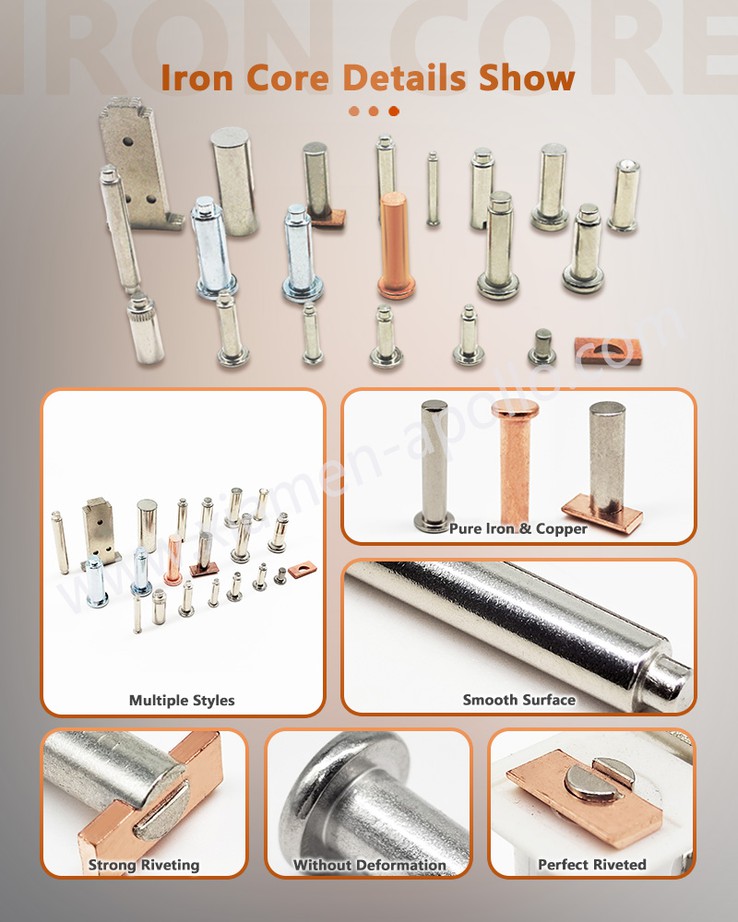
The Relay Iron Core is a key magnetic conductive component in the internal magnetic circuit system of the relay. It often works with yoke iron, armature, and other components to form a closed magnetic circuit after the electromagnetic coil is energized to realize electromagnetic attraction. Under normal circumstances, the relay core needs to have the following characteristics:
(1). High magnetic permeability to ensure magnetic circuit sensitivity;
(2). Low coercive force to reduce residual magnetism;
(3). Good dimensional consistency to ensure component assembly accuracy;
(4). Clean surface and can be electroplated, which is conducive to corrosion resistance and improved conductivity.
To meet these requirements, an electrical pure iron core is the most commonly used material choice, especially DT4C (also known as pure iron C) material, which has extremely high magnetic permeability and extremely low carbon content and is the mainstream material in cold heading core production.
The technical process of cold heading process in core production
1. Material selection: electrical pure iron wire
The raw material used for cold heading core is generally electrical pure iron DT4C wire, which has an iron content of more than 99.8%, excellent impurity control, and excellent magnetic properties. According to the core diameter requirements, wires with a wire diameter between φ2.0mm-φ6.0mm are usually selected, which must have good plasticity and cold processing properties.

2. Cold heading die: high-strength tungsten steel alloy
The forming of cold heading core depends on high-precision dies, and the commonly used material is tungsten steel alloy (hard alloy die), which has extremely high wear resistance and pressure resistance. The cold heading die structure design includes punch die, concave die, guide die, etc., to ensure uniform metal flow during the impact process and avoid defects such as cracks and strain.
3. Cold heading forming: one die two punches or multi-station processing
The cold heading process of the iron core usually adopts a one-die two-punch process, and the core head forming and rod shaping are completed through two impacts; for iron cores with more complex structures or more precise dimensions, multi-station cold heading machines can also be used for step-by-step forming. The Relay Coil Core of this process is to maintain a stable impact load, sufficient lubrication, and concentric molds to prevent problems such as skew and eccentricity.

Dimension control and key quality parameters of cold heading iron core
Dimensional accuracy is an important indicator in the cold heading production of relay iron cores, especially the total length of the iron core, head diameter, shoulder transition radius, end surface flatness, etc., which need to be strictly controlled to meet the tolerance requirements of downstream assembly.
Key control items include:
Coaxiality: ensure that the magnetic field is evenly distributed after the Electromagnet Core is installed in the coil;
Straightness: affects the yoke fit and suction stability;
Dimensional stability: related to the interchangeability of the product;
End flatness: affects the contact quality with the yoke or shell.
Table: Key performance indicators of electrical pure iron TD4C cold heading wire
| Performance indicators | Technical requirements | Testing methods |
| Diameter tolerance (mm) | ±0.02 | Micrometer measurement |
| Out-of-roundness (mm) | ≤0.03 | Roundness meter |
| Surface defect depth (mm) | ≤0.05 | Microscope inspection |
| Tensile strength (MPa) | 265-380 | GB/T 228.1 |
| Sectional shrinkage (%) | ≥50 | GB/T 228.1 |
| Coercive force (A/m) | ≤32 | GB/T 3656 |
Post-cold heading treatment: high-temperature annealing and magnetic property recovery
Cold heading is a strong plastic deformation process, which will cause the deformation of electrical pure iron grains and stress concentration, thereby reducing its magnetic properties. Therefore, the cold heading core must undergo high-temperature annealing after forming, usually annealing at 900℃-1100℃ for 1-2 hours under a protective atmosphere to restore its original magnetic permeability and soft magnetic properties. The protective atmosphere usually uses nitrogen or hydrogen to prevent oxidation of the Electrician Pure Iron Core surface and affect the subsequent electroplating quality.
Table: Example of high-temperature annealing process parameters for TD4C core
| Process stage | Temperature (℃) | Time (h) | Atmosphere requirements | Cooling rate (℃/h) |
| Preheating | 300-400 | 0.5-1 | Air/nitrogen | - |
| First stage insulation | 650±10 | 1 | Nitrogen protection | ≤100 |
| Second stage insulation | 850±5 | 3 | Hydrogen-nitrogen mixture | ≤50 |
| Slow cooling | 850→400 | - | Hydrogen-nitrogen mixture | 30-50 |
| Quick cooling | 400→room temperature | - | Air | Unlimited |
Surface treatment: electroplating nickel for rust prevention and conductivity optimization
After annealing, the surface of the cold-forged DT4C Iron Core may be slightly oxidized and need to be pickled or polished. Then, pre-copper plating and nickel plating surface treatment are carried out according to actual application requirements:
The thickness of the nickel layer is generally controlled at 3μm~8μm;
The nickel layer plays the role of rust prevention, improving contact conductivity, and enhancing corrosion resistance;
The electroplating process needs to ensure uniformity and bonding strength to prevent shedding.
Table: Quality inspection standard for nickel plating of relay core
| Inspection items | Technical requirements | Test methods |
| Coating thickness (μm) | 3-8 (according to drawings) | ISO 2178 |
| Adhesion | No blistering or shedding | ISO 2819 |
| Porosity (pieces/cm²) | ≤5 (key surface) | ISO 4524 |
| Salt spray test | ≥96 hours without red rust | ISO 9227 |
| Surface resistance (mΩ) | ≤50 | Four-probe method |
| Appearance | Uniform and flawless | Visual inspection (20x magnifying glass) |
Precautions for core packaging, storage, and use
To prevent oxidation, rust, or bruises of the cold-forged core after annealing, special attention should be paid to its packaging and storage:
Wrap with anti-rust oil or vapor anti-rust film;
Keep dry and store at room temperature, avoid direct sunlight or humid environments;
Avoid strong impact during transportation to prevent deformation of the Pure Iron Relay Core or degradation of magnetic properties.
Packaging and storage are equally important for maintaining the quality of the Relay steel Core. The nickel-plated iron core should be packed in anti-static packaging to avoid dust adsorption caused by static electricity generated by friction during transportation. Small iron cores are usually packed in PE anti-static bags at 500-1000 pieces/bag, and desiccant (such as silica gel, 5-10g/100 pieces) is added; large iron cores can be loaded in blister trays separated by foam. The outer packaging box should indicate the product name, specifications, quantity, production date, and moisture-proof and shock-proof labels. The storage environment requires a temperature of 15-30℃, a relative humidity of ≤65%, and is away from strong magnetic fields and corrosive gases. Inventory management follows the "first in, first out" principle. The recommended storage period for nickel-plated iron cores is 6 months. If the period is exceeded, the coating quality needs to be re-inspected.

Typical applications of cold-forged cores in relays
Cold-forged cores are widely used in various electromagnetic relays, and common types include:
(1). Communication relays: require a small core size and high magnetic permeability;
(2). Automotive relays: require strong shock resistance and high reliability;
(3). Industrial control relays: focus on suction stability and thermal stability;
(4). Smart home relays: emphasize miniaturization and consistency.
In these relays, cold-forged cores are usually riveted with electrical pure iron yoke iron stampings to form a complete magnetic circuit system, which ultimately determines the electromagnetic performance and response characteristics of the relay.
Cold-forging technology plays an irreplaceable role in the mass production of relay Cores for Electromagnetic Relays with its high efficiency, high precision, and low cost. From electrical pure iron material selection, tungsten steel mold design, and dimensional accuracy control, to subsequent annealing, electroplating, and cleaning treatment, each link has a profound impact on the final performance of the core. By continuously optimizing the cold heading core production process, the performance of relays in the future will be more stable and reliable, and more in line with the development trend of increasing precision and miniaturization of electronic components.

contact us