

Electrical pure iron is a kind of soft magnetic material with extremely high purity iron as the main component and excellent magnetic properties. It is widely used in electromagnetic devices with high requirements for magnetic conductivity. As an important electrical control component, the core magnetic circuit structure of the relay - armature, yoke, and core - all rely on the excellent performance of electrical pure iron. This article focuses on the technical characteristics, processing method, and applications of electrical pure iron DT4E strip and DT4C wire in relay armature, yoke, and core.
Table: Comparison of main performance parameters of DT4E and DT4C
| Performance index | DT4E (special grade) | DT4C (super) | Test standard |
| Coercive force Hc (A/m) | ≤48 | ≤32 | GB/T 3656 |
| Magnetic permeability μm (×10⁻³H/m) | ≥11.3 | ≥15.1 | GB/T 13012 |
| Saturation magnetic induction Bs (T) | ≥1.80 | ≥1.80 | GB/T 13012 |
| Tensile strength (MPa) | ≥265 | ≥265 | GB/T 2975 |
| Elongation (%) | ≥25 | ≥25 | GB/T 2975 |
| Hardness (HBW) | ≤195 | ≤195 | GB/T 4340.1 |

Electrical pure iron DT4E strip and yoke and armature stamping parts
1. Material Overview
Relay yoke and armature are key magnetic conductive parts in the electromagnetic system. Their performance directly affects the switching reliability, response speed, and life of the relay. These parts are usually made of DT4E electrical pure iron strips through a precision stamping process, which gives full play to the excellent electromagnetic performance and forming characteristics of the material. The yoke is the static magnetic conductive part of the relay, and together with the armature, it forms a complete magnetic circuit. Its stamping processing quality has a decisive influence on the efficiency of the magnetic circuit. As a moving part, the armature needs to have precise dimensional stability and mechanical strength while maintaining good magnetic conductivity to withstand repeated attraction and release actions.
2. Technical parameters and standards
| Item | Value | Remarks |
| Brand | DT4E | Equivalent to IEC: C21E4, JIS: SUY-1 |
| Iron content | ≥99.85% | Carbon content ≤0.005%, total sulfur and phosphorus ≤0.02% |
| Density | 7.86 g/cm³ | - |
| Yield strength | About 200 MPa | Annealed |
| Elongation | ≥30% | - |
| Curie temperature | ≈770°C | - |
| Maximum magnetic permeability μm | ≥80000 (800A/m) | - |
| Coercive force Hc | ≤40 A/m | Measured after annealing |
| Hysteresis loss | Very low | Guaranteed low power consumption |

3. Processing method
DT4E strip is widely used in stamping and manufacturing relay armature stampings and relay yoke stampings.
Table: Example of stamping process parameters for DT4E electrical pure iron strip
| Process parameters | Typical value | Description |
| Material thickness (mm) | 0.1-5.0 | Commonly used 0.3-1.0 |
| Punching gap (%) | 5-8 | Percentage of material thickness |
| Punching speed (times/minute) | 30-200 | Depends on the complexity of the part |
| Mold life (10,000 times) | 20-50 | Use high-speed steel mold |
| Flatness tolerance (mm) | ≤0.05/100 | Precision grade requirements |
| Surface roughness | Ra (μm) ≤0.6 | Typical value after stamping |
(1). Stamping: Use a high-speed punch press to perform precision punching on the DT4E strip to ensure dimensional consistency and edge integrity;
(2). Heat treatment annealing: After stamping, perform medium-temperature protective atmosphere annealing to eliminate internal stress and restore magnetic properties;
(3). Surface treatment: Nickel plating is the most commonly used surface treatment method, which can not only effectively prevent corrosion, but also reduce contact resistance and improve electrical conductivity;

4. Application fields
Electrical pure iron stamping parts are the basic materials for various small electromagnetic devices, mainly used for:
Relay yoke: as a fixed magnetic circuit component, it cooperates with the iron core and armature to complete the magnetic flux closure;
Relay armature: as a movable magnetic circuit component, it responds to electromagnetic force action;
Moving and static iron parts in low-voltage circuit breakers and contactors.
Electrical pure iron DT4C wire and cold-forged iron core parts
1. Material overview
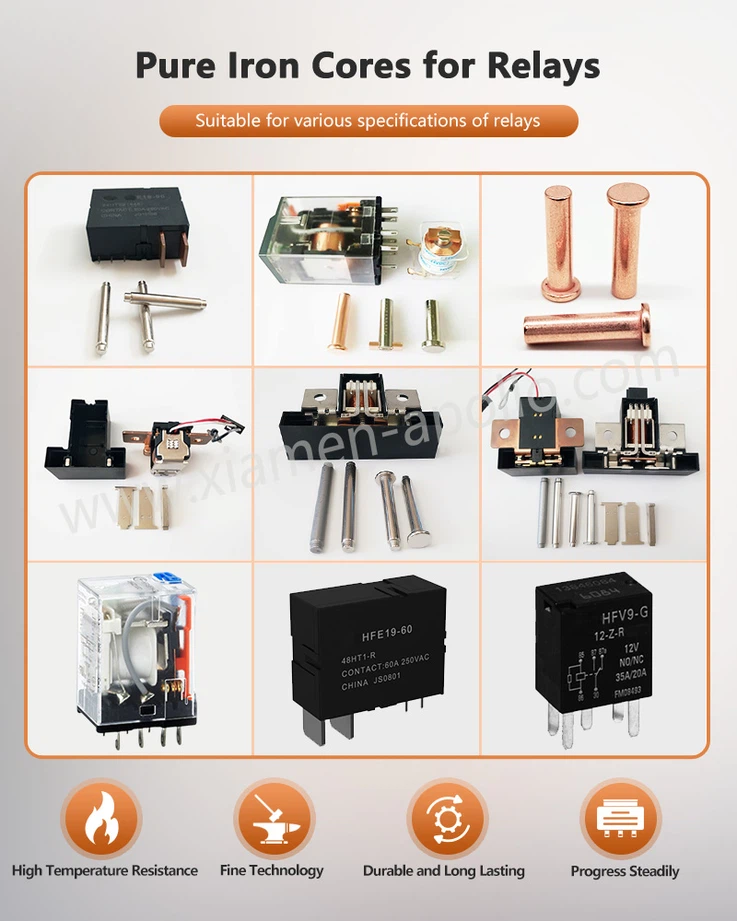
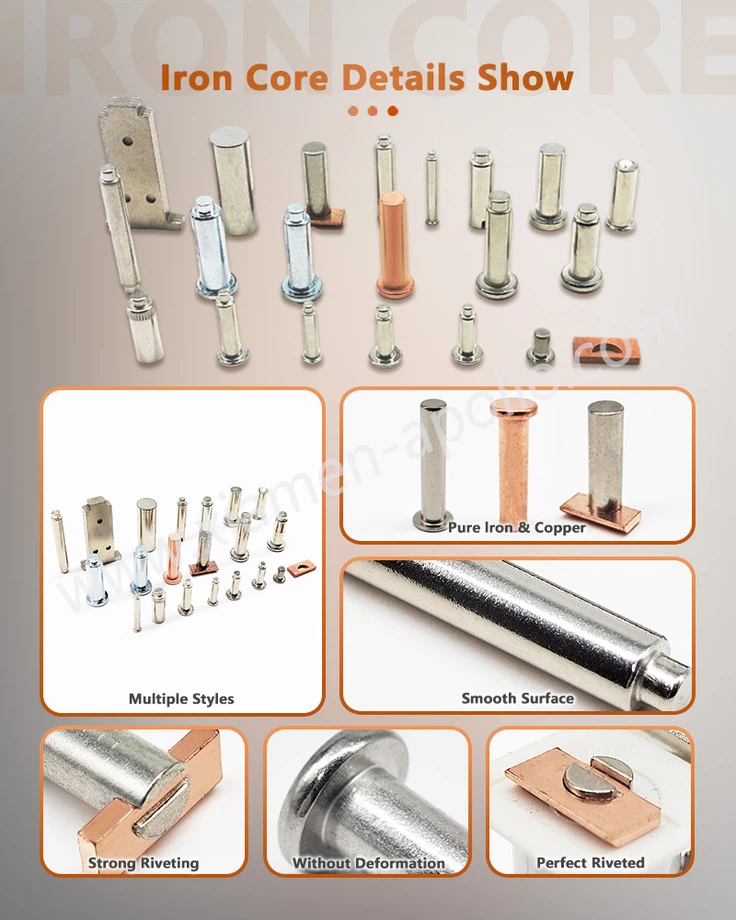
DT4C electrical pure iron wire belongs to the high-purity soft magnet series, and its composition is similar to DT4E, but it is in wire state and is suitable for cold forming processes such as cold forging and drawing. It is the preferred material for manufacturing relay cores, cold forging cores, electromagnetic coil centerpieces, etc. As the core component of electromagnetic conversion, the relay core undertakes the key function of converting electrical energy into mechanical energy. Its performance directly affects the pull-in characteristics, power consumption and reliability of the relay. Unlike stamped yokes and armatures, cores are usually made of DT4C electrical pure iron wire through cold heading, which is particularly suitable for producing shaft parts with complex head shapes. The cold heading process applies high pressure to the metal wire at room temperature to plastically deform it in the mold cavity, which can efficiently form various precision core parts while maintaining the excellent electromagnetic properties of the material.

2. Technical parameters and standards
| Item | Value | Remarks |
| Brand | DT4C | Corresponding international standard IEC C22E4 |
| Iron content | ≥99.80% | Carbon content ≤0.01% |
| Tensile strength | ≥250 MPa | Before annealing |
| Elongation | ≥20% | - |
| Magnetic permeability μm | ≥60000 (800A/m) | - |
| Coercive force Hc | ≤50 A/m | - |
| Resistivity | \~0.10 μΩ·m | Slightly lower than ordinary low-carbon steel |
3. Processing method
DT4C is mainly used for cold heading of relay cores.
Table: Key control points of cold heading process for DT4C electrical pure iron wire
| Control items | Technical requirements | Inspection methods |
| Surface quality | No folding, scratching, microcracks | Visual/microscope inspection |
| Decarburization layer depth | Ferrite decarburization layer ≤0.02mm (diameter ≤5mm) | Metallographic inspection |
| Non-metallic inclusions | Class B inclusions ≤15μm within 2mm from the surface | GB/T 10561 |
| Grain size | 5-7 grade | Metallographic method |
| Hardness (HV) | 80-140 (annealed state) | Vickers hardness tester |
| Cold heading performance | Sectional shrinkage ≥50%, yield strength ratio ≤0.70 | Tensile test |
(1). Cold heading forming: Use a multi-station cold heading machine to quickly form at room temperature to ensure high-precision core size;
(2). Fine turning and grinding: Remove burrs and redundant structures to improve magnetic field consistency;
(3). Annealing: A key step, often using hydrogen-protective atmosphere annealing to improve magnetic permeability and eliminate processing stress;
(4). Surface treatment: copper plating of substrate + nickel plating of surface. In terms of surface treatment, cold-forged DT4C cores usually need to be galvanized, nickel-plated, or passivated to improve corrosion resistance. Unlike stamping parts, the core is often used as a moving part to cooperate with the armature, so the dimensional accuracy and surface finish are extremely high. The coating thickness is generally controlled at 3-8μm, which must ensure protective performance and cannot affect the assembly accuracy and movement flexibility of the parts.

4. Application areas
Cold-forged electrical pure iron parts are widely used, including but not limited to:
(1). Relay core: used to establish an electromagnetic field to drive the armature to move;
(2). Solenoid valve core: improve response speed;
(3). Coil center column: enhance magnetic concentration;
Precision core parts in automotive relays and smart home relays.
Comparison and synergy between DT4E and DT4C materials
| Properties | DT4E (strip) | DT4C (wire) |
| Forming process | Mainly stamping | Mainly cold heading |
| Processed parts | Relay yoke, armature | Relay core |
| Surface treatment | Oiling, electroplating, phosphating | Oiling, electroplating, passivation |
| Application focus | Magnetic circuit closing components | Magnetic field core components |
| Material form | Coil strip | Wire reel |
As the two main materials for key relay components, electrical pure iron DT4E, and DT4C are similar in basic composition but have significant differences in magnetic properties, processing characteristics, and application scenarios. A deep understanding of these differences is crucial for material selection in relay design and manufacturing. From the perspective of magnetic performance level classification, the DT4 series is divided into four levels: general grade (DT4), (DT4A), special grade (DT4E), and super grade (DT4C), and the magnetic performance increases by 9. As a special grade material, DT4E has a coercive force (Hc) ≤48A/m and magnetic permeability (μm) ≥11.3×10⁻³H/m; while DT4C, as a super material, has a coercive force further reduced to ≤32A/m and a maximum magnetic permeability increased to ≥15.1×10⁻³H/m9. This difference in magnetic performance directly affects their application positioning in relays.
As core materials in modern electromagnetic technology, electrical pure iron DT4E strips and DT4C wires are widely used in magnetic circuit structural parts such as relay yokes, armatures, and iron cores due to their excellent magnetic properties and process adaptability. With the continuous development of electronic control technology, this type of high magnetic permeability, low-loss electrical pure iron stampings, and cold-headed cores will play a greater role in smart grids, home appliance control, and automotive electronic control systems.
contact us
