


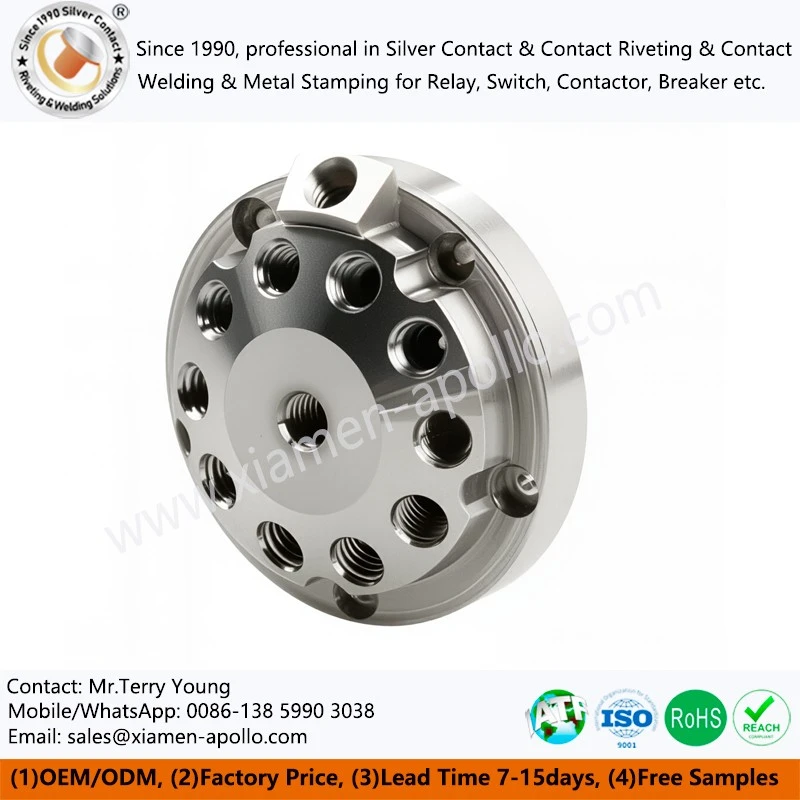
Detailed explanation of machining characteristics of various materials
Our company focuses on the research, development, and production of CNC Parts solutions: Copper CNC Parts, Brass CNC Parts; Aluminum CNC Parts; and Steel CNC Parts. These CNC Parts meet the needs of multiple fields, such as power, new energy, and industrial equipment.

The following are common material grades of copper, brass, aluminum alloy, stainless steel, carbon steel, and plastic used for machining, which are compiled in combination with industry standards and practical applications:
1. Common grades of copper (pure copper) machining
Copper has good electrical conductivity, thermal conductivity, and ductility, and is suitable for precision parts, electrical components, etc.
T1 (high purity copper, Cu≥99.95%)
T2 (standard pure copper, Cu≥99.90%)
TU1 (oxygen-free copper, Cu≥99.97%)
TU2 (oxygen-free copper, Cu≥99.95%)
TP2 (phosphorus-deoxidized copper, containing a small amount of phosphorus)
2. Commonly used grades for brass machining
Brass (copper-zinc alloy) has good cutting performance and corrosion resistance and is widely used in valves, gears, electrical connectors, etc.
H59 (common brass, Cu≈59%)
H62 (general brass, Cu≈62%)
H65 (high plasticity brass, Cu≈65%)
H68 (deep drawing brass, Cu≈68%)
HPb59-1 (lead brass, containing 1% Pb, easy to cut)
HPb63-3 (lead brass, containing 3% Pb, precision parts)
HSn62-1 (tin brass, resistant to seawater corrosion)
3. Common grades for aluminum alloy machining
Aluminum alloy is lightweight and high in strength, suitable for aviation, automobile, electronics, and other industries.
1050A (industrial pure aluminum, high conductivity)
5052 (corrosion resistance, good weldability)
6061 (medium to high strength, general purpose)
6063 (architectural profile, good surface treatment)
7075 (ultra-high strength, for aviation)
LY12 (2A12) (hard aluminum, high strength)
4. Common grades for stainless steel machining
Stainless steel has strong corrosion resistance and is suitable for medical equipment, chemical equipment, etc.
303 (free-cutting stainless steel, containing sulfur)
304 (general-purpose austenitic stainless steel, 18Cr-8Ni)
316 (more corrosion-resistant, containing Mo)
420 (martensitic stainless steel, for cutting tools)
430 (ferritic stainless steel, low cost)
5. Common grades for carbon steel machining
Carbon steel has low cost and high strength and is suitable for mechanical structural parts, automotive parts, etc.
Q235 (ordinary carbon structural steel)
45 (medium carbon steel, for quenching and tempering)
20 (low carbon steel, good cold workability)
T8/T10 (tool steel, high hardness)
GCr15 (bearing steel, wear-resistant)
6. Common grades for plastic machining
Plastics are lightweight and have good insulation properties, suitable for electronics, medical and other industries.
POM (polyoxymethylene) (high rigidity, wear resistance)
PA66 (nylon 66) (high strength, heat resistance)
PTFE (Teflon) (high-temperature resistance, low friction)
PC (polycarbonate) (transparent, impact resistance)
ABS (easy to process, good comprehensive performance)

Whole process quality control and application areas
1. Production process control system
(1). Detection means:
Online detection: random inspection every 2 hours
Three-coordinate measurement: full inspection of key dimensions
Material analysis: spectral detection of each batch
Process control points:
| Process | Control parameters | Standard |
| Turning | Roundness | ≤0.01mm |
| Milling | Flatness | ≤0.02mm |
| Grinding | Roughness | Ra0.4μm |
2. Surface treatment solutions
(1). Metal parts treatment:
Aluminum alloy: hard anodizing (film thickness 50μm)
Stainless steel: electrolytic polishing (Ra0.2μm)
Copper parts: chemical nickel plating (thickness 5-10μm)
(2). Plastic parts treatment:
UV coating
Laser marking
Static elimination

Technical services and quality assurance
1. Technical support:
Provide DFM (Design for Manufacturability) analysis
Material selection suggestions
Process optimization solutions
2. Quality commitment:
ISO9001, IATF16949 quality management system
Full process traceability system
12-month quality assurance period
3. Delivery capability:
7-15 days for regular orders
72 hours for urgent orders
Logistics Tracking System
With 20 years of experience in copper machining, brass machining, aluminum alloy machining, stainless steel machining, carbon steel machining, and plastic machining, we can provide customers with a full range of solutions from design to mass production. Whether it is precision medical equipment or automotive core components, we can meet your highest requirements for precision, quality, and reliability. Feel free to contact our engineering team for professional technical support and customized service solutions.
Factory core advantages and processing capabilities
1. Manufacturing advantages of the entire industrial chain
As a leading metal processing company in Xiamen, we have established a complete manufacturing system:
(1). Mold development capabilities:
15 people in the progressive die design team, developing 200 sets of molds per year
Mold processing accuracy of ±0.005mm
Service life of more than 30 million times
Machining equipment cluster
| Equipment type | Quantity | Processing accuracy | Typical applications |
| CNC machining center | 20 units | ±0.01mm | Precision structural parts |
| CNC lathes | 10 units | ±0.02mm | Shaft parts |
| Surface grinders | 10 units | ±0.002mm | Mold templates |
| EDM machines | 10 units | Ra0.8μm | Complex cavities |

2. Advantages of multi-process collaboration
(1). Stamping-machining integration:
Seamless connection of stamping parts post-processing
Positioning accuracy ±0.05mm
(2). Welding-machining composite process:
Welding deformation compensation technology
Machining allowance control 0.1-0.3mm
(3). Customized service capabilities:
Samples can be produced in as fast as 3 days
Support small batch and multi-variety production
contact us

Hot Tags: CNC Parts, Custom CNC Parts, CNC Machining Parts, Precision CNC Components, Aluminum CNC Parts, Copper CNC Parts, Brass CNC Parts Manufacturer


