


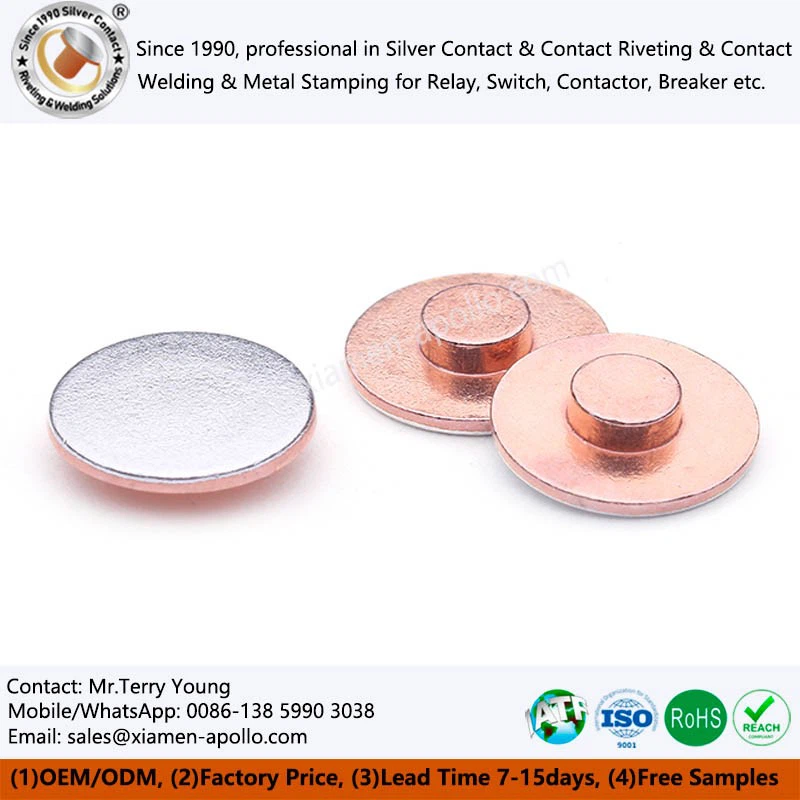


What is Stationary Contact?
Stationary contacts function as immovable conductive anchors within electrical switching assemblies, absorbing severe thermal and mechanical stresses during high‑current making and breaking operations. These fixed components face continuous electrical arcing and mechanical impact, making anti‑fusion capability and contact resistance stability paramount for system safety. Operating as a direct production source, our facility manufactures precision‑engineered contacts utilizing advanced cold‑heading and bimetal rivet welding technologies. Designed for R&D engineers and QA directors demanding strict metallurgical integrity, our components integrate high‑conductivity copper bases with specialized silver‑tin oxide alloy tips to withstand demanding industrial duty cycles.

Technical Specifications & Materials Of Flat Bimetallic Rivet
| Parameter | Specification Detail |
|---|---|
| Shear Strength / Bonding Force | ≥ 220 MPa (Cold‑headed interface) |
| Hardness | HV 90‑130 (Copper base), HV 110‑160 (Silver tip) |
| Contact Resistance | < 0.4 mΩ initial |
| Dimensional Tolerance | ±0.01 mm to ±0.02 mm |

Common Defects of Stationary Electrical Contacts
Arc Erosion and Material Loss
Repeated high‑current interruptions vaporize surface material over time. Utilizing dense silver alloy tips minimizes mass loss and extends the operational lifespan of the Flat Bimetallic Rivet.
Contact Welding Under High Inrush Currents
High inrush currents may lead to fusion between stationary and moving contacts. Our refined AgSnO₂ material composition effectively mitigates micro‑welding issues occurring under high‑power switching conditions.
Interface Delamination Due to Thermal Cycling
Poor metallurgical bonding causes the Noble Materials tip to detach under cyclic thermal expansion. Our cold‑heading process creates a solid diffusion zone to eliminate separation risks.
High Resistance Caused by Surface Oxidation
Exposure to atmospheric oxygen forms high‑resistance oxide layers on unsealed copper bases. We apply protective passivations and selective silver plating to maintain stable conductivity.

Why Choose Our State Contact Rivet?
Contact Geometry Matched to the Moving Side
A Bimetalic Rivet cannot be selected only by silver material. The contact face must correspond with the moving spring or movable contact trajectory.
Manufacturing Routes for Fixed Contact Parts
Available manufacturing capabilities include cold heading, metal stamping, welding, CNC machining, plating, and related metal-processing operations. This allows the State Contact Rivet structure to be evaluated together with its mounting or supporting component rather than treated as a standalone contact point.
Production Control for Custom Parts
Customized State Contact Rivets are manufactured according to approved product drawings and process requirements. The production route can be evaluated against material, contact geometry, tooling requirements, inspection points, and expected order volume before tooling or mass production.
Quality Documentation and Traceability
Material identification, dimensional inspection, electrical testing, and process records can be incorporated according to the customer's quality requirements.

contact us
Submit your rated operating current, switching cycle requirements, and engineering drawings to our technical team today to receive a customized quotation, detailed metallurgical test reports, and factory samples for your Stationary Contact within 24 hours.

Hot Tags: Stationary Contact Wholesale, China Electrical Contact Factory, AgSnO2 Stationary Contact Tips, Arc‑Resistant Fixed Contact Components, High‑Conductivity Bimetal Stationary Rivets, OEM Electrical Relay Stationary Parts, Low‑Resistance Fixed Electrical Contacts, Silver Point Contact, Stationary Electrical Contacts, Electrical Bimetal Silver Contacts, Contactor Electrical Silver Contacts, Slip Ring Contacts, Bimetal Silver Contacts


