


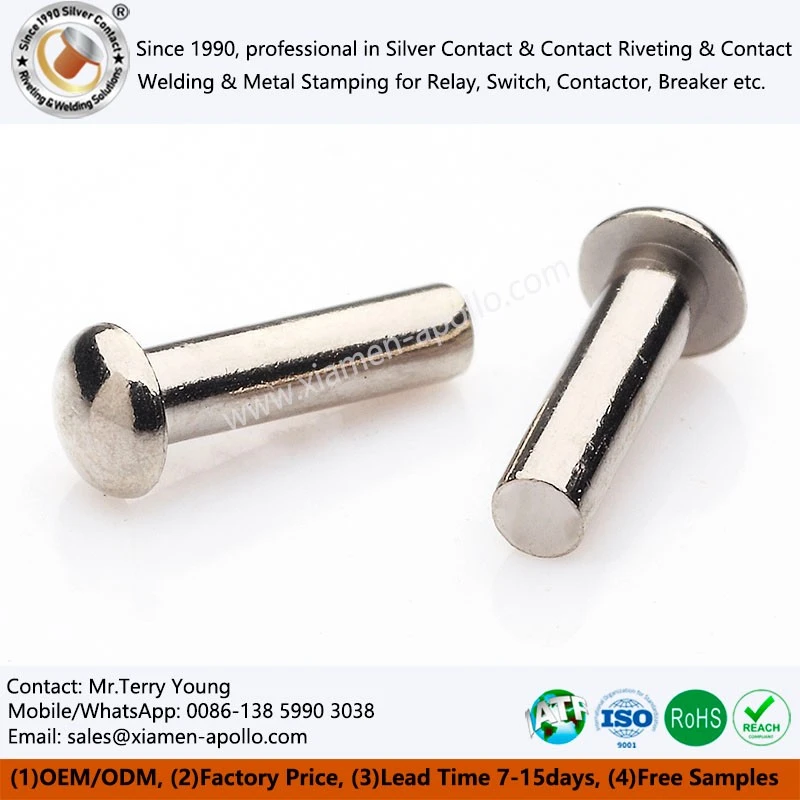


Products Description
Electroless nickel plating contacts are high-performance electrical contacts with a surface treated using electroless nickel plating. Unlike traditional electroplating processes, electroless nickel plating utilizes a self-catalytic reaction to deposit a uniform nickel layer on the substrate surface without the need for an external current. This technology imparts excellent wear resistance, corrosion resistance, and dimensional uniformity to the contacts, while also significantly improving their electrical stability and lifespan.
Electroless nickel-plated contacts are an ideal solution for applications requiring high reliability in demanding electrical environments, such as switches, relays, circuit breakers, new energy charging systems, electric vehicle control units, and industrial automation equipment.

Key Selling Points
1. Chemical Nickel Plating Process: Uniform, Pore-Free Protective Layer for Complete Environmental Corrosion Protection
Unlike traditional electroplating, which uses an electric current to deposit nickel, chemical nickel plating utilizes a redox reaction to automatically deposit a nickel-phosphorus alloy onto the substrate surface. This process eliminates the need for an external current and allows for complete coverage of even complex nickel-plated contact shapes. Its key advantages include:
Pore-Free Protection: The plating has a porosity of less than 0.1 pores/cm² (compared to 1-5 pores/cm² for traditional electroplated nickel), effectively blocking the penetration of moisture, salt spray, sulfides, and other corrosive agents, preventing poor Nickel Coating Copper Contact due to substrate oxidation.
Uniform and Controllable Thickness: Regardless of the Nickel Plated Contacts Contact Rivet surface (flat, groove, or edge), the plating thickness deviation can be controlled within ±0.5μm (compared to ±2μm for traditional electroplating), ensuring consistent protection.
High Adhesion Strength: The bond strength between the plating and substrate exceeds 350MPa (far exceeding the industry standard of 200MPa), preventing delamination under mechanical vibration and thermal expansion/contraction, resulting in a 50% or more improvement in long-term reliability.
2. Nickel-Phosphorus Alloy Properties: Multifunctional Balance of Conductivity, Wear Resistance, and Corrosion Resistance
The phosphorus content (typically 3-12%) in the chemical nickel plating can be precisely controlled to form an alloy structure with different properties, meeting diverse application needs:
Medium Phosphorus Plating (6-9% phosphorus): Hardness can reach HRC 45-50 (compared to HRC 30 for traditional electroplated nickel)... 30-35), with wear resistance improved by more than 2 times, suitable for applications involving frequent plugging and unplugging, such as automotive relays and industrial connectors;
High-phosphorus plating (10-12% phosphorus): possesses non-magnetic properties (magnetic permeability < 1.005), avoiding electromagnetic interference to precision electronic equipment, and its acid corrosion resistance is 3 times higher, suitable for high-sensitivity environments such as medical equipment and marine instruments.
Optimized electrical conductivity: By adjusting the plating composition and post-treatment process, the resistivity can be controlled to 7-10 μΩ·cm (close to 6.9 μΩ·cm of pure nickel), meeting the stable signal transmission requirements for small to medium currents (<10A), and avoiding signal attenuation caused by excessive plating resistance.

Detailed Features
1. Microstructure of the Coating: Dense and Pore-Free, Providing Comprehensive Protection
SEM (Scanning Electron Microscopy) images clearly show that the electroless nickel plating consists of small, uniform nickel-phosphorus alloy grains (grain size 0.5-1 μm), with no obvious pores or cracks. In contrast, traditional electroplated nickel layers have numerous micropores (1-3 μm in diameter), which serve as pathways for corrosive agents. This dense structure is the core guarantee of the corrosion resistance of electroless nickel plating.
2. Surface Finish: Uniform Gloss and Smooth Feel
The Electroless Nickel Plating Rivet surface exhibits a uniform silver-white metallic luster, free from any defects such as discoloration, blackening, or blistering. The surface feels smooth to the touch, with no noticeable resistance during insertion or removal, reducing user fatigue. For high-end applications, we also offer special surface treatments such as matte and brushed finishes to meet customized customer needs.

Frequently Asked Questions
WHAT ARE YOUR CERTIFICATES?
+
-
We have IS09001, IATF 16949 certificates, RoHS, and Reach
DO YOU TEST ALL YOUR GOODS BEFORE DELIVERY?
+
-
Yes, we have a 100% test before delivery.
WHAT ARE YOUR TERMS OF PAYMENT?
+
-
Usually, we accept bank T/T, irrevocable L/C at sight. For regular orders, we prefer 30% in advance .70% balance before shipment.
DO YOU ACCEPT OEM?
+
-
Yes. All sizes can be customized. The logo can be made as you request
CAN YOU PROVIDE SAMPLES?
+
-
Yes, but the sample fee and freight will be paid by your company.

contact us

Hot Tags: electroless nickel plating contacts, China electroless nickel plating contacts manufacturers, suppliers, factory, Contacts Silver Plated, Nickel Plated Contacts, Nickel Plated Electrical Contacts, Silver Plated Contacts, plated contact, Nickel Plated Rivets Contacts


