


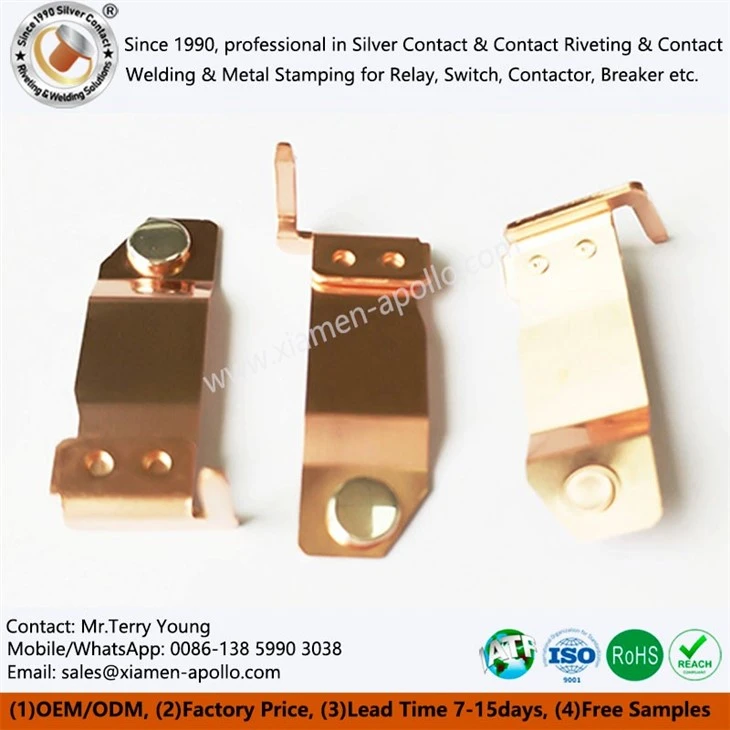

What is the Moving Contact for PCB Photovoltaic PV Relay?

Moving Contact for PCB Photovoltaic PV Relay addresses catastrophic contact welding and thermal runaway triggered by high DC switching surges, a common issue for engineers designing high-capacity photovoltaic inverters and smart energy storage systems. It reduces arc erosion and voltage drop in compact circuit layouts and demands precise metallurgical control for the spring blade and contact tip. As a primary direct manufacturer, we supply wholesale, custom-engineered moving contact assemblies with cold-headed silver alloy tips riveted to high-tensile stainless steel spring leaves.
Material Matching of Electric Contacts for PV Relay
Substrate Selection of Stainless Steel Spring Leaves
The foundation of any PCB relay moving blade relies on high-yield stainless steel grades such as SUS301 or SUS304. These materials offer exceptional fatigue resistance, withstanding over 100,000 continuous actuation cycles without mechanical deformation or loss of spring force.
Silver Alloy Tip Metallurgy for DC Arc Suppression
Contact tips utilize high-performance silver-tin oxide (AgSnO₂) or silver-nickel (AgNi) compositions. These alloys suppress arc erosion under high DC inductive loads typical of photovoltaic string inverters, preventing premature contact sticking during fault interruption.


Technical Specifications & Materials of Electrical Contacts for Photovoltaic Relay
| Technical Parameter | Specification Value / Range |
|---|---|
| Electrical Conductivity | >85% IACS (Spring base), >60% IACS (Alloy tip surface) |
| Shear / Bonding Strength | >180 MPa (Mechanical rivet interface) |
| Spring Hardness | HV 350 - HV 450 (Cold-worked stainless steel condition) |
| Contact Resistance | <5.0 mΩ at rated operational current |
| Applicable Standards | IATF 16949, RoHS, REACH, IEC 60947 |

Frequently Asked Questions about Electrical Contacts for Solar Panel Relay
Why is Stainless Steel selected for Electrical Contacts for Solar DC Relay?
+
-
Stainless steel provides exceptional tensile strength and fatigue resistance, maintaining consistent spring force over wide thermal fluctuations in compact solar inverters without permanent deformation.
How does in‑die riveting stand up against thermal shock?
+
-
In-die mechanical riveting locks the silver tip under high tonnage, creating a rigid metal-to-metal bond that withstands rapid thermal expansion coefficients between silver and steel during heavy DC switching.
What drawing files are needed for a custom Moving Contact for New Energy Relay?
+
-
We require 2D manufacturing drawings in PDF/DWG format detailing plating specs, along with 3D STEP files showing exact bending radii and silver tip positioning coordinates.
What is the standard lead time for custom tooling and initial sample submission?
+
-
Custom progressive stamping tooling and initial prototype sample delivery typically require 10 to 15 working days following drawing approval.
How do you prevent oxidation on the silver contact tips during ocean freight transit?
+
-
We package components in vacuum-sealed anti-static blister trays combined with desiccant packs to prevent atmospheric tarnishing before assembly.

contact us
If you are interested in our Moving Contact for PCB Photovoltaic PV Relay or have any questions, please feel free to contact us. We are very happy to provide you with detailed product information and professional technical support.

Hot Tags: PCB PV Relay Moving Contact Manufacturer, Wholesale Stainless Steel Relay Spring, Silver Alloy Bimetal Contact Rivet, Custom PV Relay Stamped Terminal, Solar Inverter Relay Contact Blade, High Conductivity Relay Moving Leaf, OEM Electrical Switch Contact Assembly, Low Resistance Photovoltaic Relay Part, Silver Rivet Electrical Connections, In Die Staking With Pure Silver Plate For Switch, In die Riveting Silver Contacts For PV Relay, Copper Stamping With Riveted Electrical Contacts, In Die Rivet Electrical Contacts, Electrical Contacts For Solar DC Relay


