


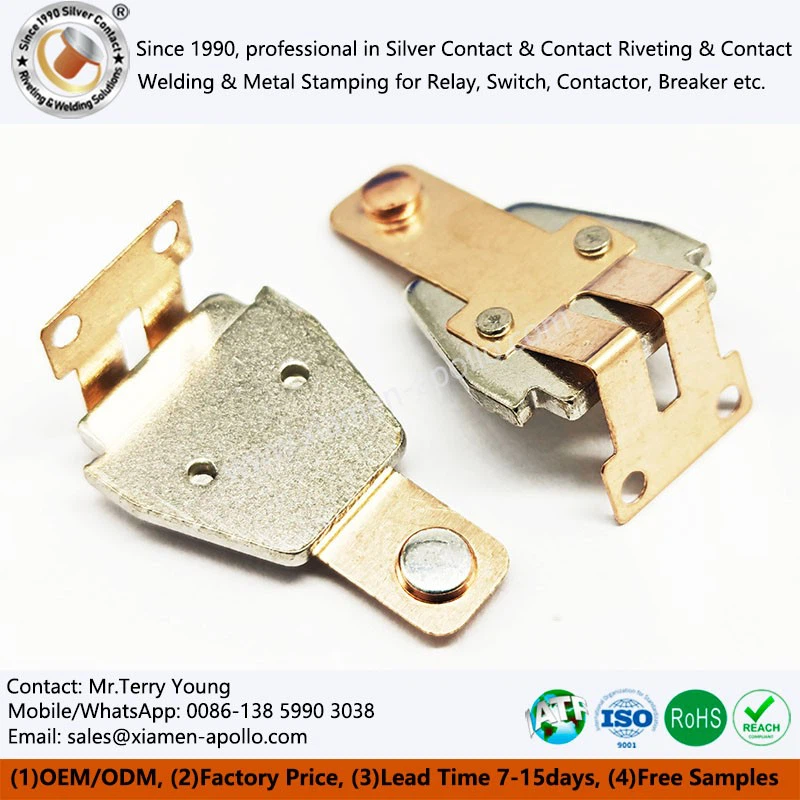


What are the Stamping Electrical Contacts?

Stamping Electrical Contacts serve as critical functional components inside modern smart meter latching relays, industrial MCCB circuit breakers, and automotive horn switches. Utilizing advanced micro‑stress stamping technology combined with precision riveting, these integrated units effectively eliminate welding-induced stress deformation and guarantee stable current transmission across high‑frequency operations. As a direct production source, we deliver tailored metal stamping solutions engineered to meet rigorous electrical durability and thermal management thresholds. Procurement teams and R&D engineers leverage our manufacturing capabilities to secure reliable, batch‑consistent electrical hardware for demanding low‑voltage applications.
Manufacturing Process of Beryllium Copper Punch Contact Riveted Terminals
Micro‑Stress Stamping Technology
Progressive die stamping configurations distribute mechanical forces evenly across the raw metal strip. This engineering approach controls material flow vectors during high‑speed shearing, preventing micro‑cracks in brittle copper alloys and maintaining uniform cross‑sectional profiles.
01
Multi‑Stage Progressive Tooling
Die stations are synchronized to perform piercing, bending, coining, and blanking within a single continuous stroke. This synchronized staging minimizes tool wear, eliminates secondary handling variations, and preserves edge squareness on terminal tabs.
02
Interfacial Cold‑Heading Integration
Contact tips are mechanically locked or cold‑welded onto the stamped carrier sheet under calculated tonnage. This mechanical consolidation avoids thermal distortion associated with flame or resistance welding, protecting the underlying grain structure.
03
Surface Integrity Protection System
Finished metal parts undergo automated deburring, ultrasonic degreasing, and chemical passivation. These treatments remove residual stamping lubricants and microscopic burrs, preventing particulate contamination inside sealed switching devices.
04

Applications & Custom Capability of Riveted Electrical Connection Components
Downstream Device Integration
Engineered explicitly for smart meter latching relays, automotive power distribution boxes, miniature circuit breakers, and industrial control contactors requiring consistent low‑resistance make‑and‑break cycles.
Flexible Terminal Geometries
Custom bending angles, selective silver inlay placements, and specialized electroplated finishes (such as matte tin or nickel underlayers) adapt directly to proprietary connector housing footprints.
Tailored Alloy Formulations
Our metallurgical laboratory adjusts silver alloy ratios (such as increasing tin‑oxide dispersion) to match unique DC or AC switching loads, ensuring optimal anti‑welding performance for specialized customer specs.

Frequently Asked Questions about Copper Beryllium Riveting Silver Contact
Does the silver contact need to be welded to the spring sheet?
+
-
No. The contact can be mechanically riveted to the stamped spring sheet. This joining method avoids the welding heat cycle and therefore removes a major source of welding-related thermal deformation in thin spring components.
Why use beryllium copper for Electrical Spring Contacts?
+
-
Beryllium copper can provide a combination of electrical conductivity and elastic behavior required by moving spring components.
Can contact resistance be specified for a Copper Beryllium Riveting Silver Contact?
+
-
Yes. Contact resistance can be included in the inspection specification when the customer defines the measurement method, test current, contact force, and acceptance limit.
Which dimensions are normally controlled on a stamped electrical contact?
+
-
Typical critical dimensions include spring thickness, overall length, contact center position, contact height, mounting-hole position, formed height, and rivet geometry.
What inspection is required after silver contact riveting?
+
-
Inspection can include contact position, rivet formation, spring geometry, burr condition, and critical dimensions.

contact us
If you have any demand for Stamping Electrical Contacts, silver contact riveted assemblies, and customized metal stamping parts, please feel free to contact us. We will provide professional technical solutions and competitive factory prices for you.

Hot Tags: Custom Electrical Contact Assembly, Stamped Contact Parts Wholesale, Electrical Switch Contact Manufacturer, Silver Alloy Contact Components, Relay Contact Stamping Parts, Copper Terminal Stamping Sheet, In Die Staking With Pure Silver Plate For Switch, Copper Stamping With Riveted Electrical Contacts, Silver Electrical Riveted Components, Armature Beryllium Copper Riveting Assembly, In Mold Riveting Electrical Contacts, In Die Rivet Electrical Contacts


