


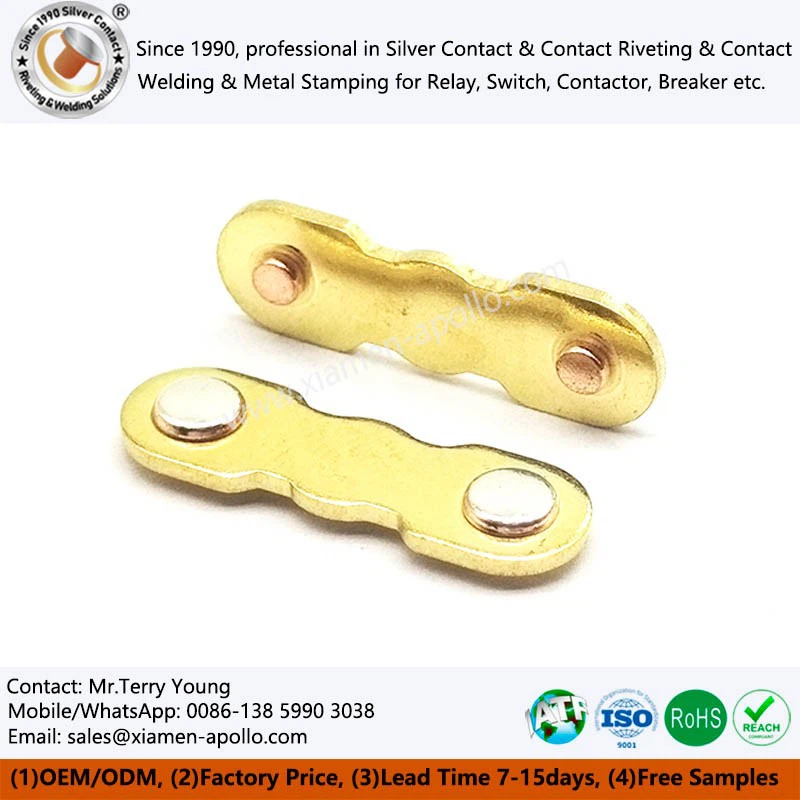

What are the Switch Brass Contact Terminals?
Switch Copper Contact Terminals are brass-based riveted contact components designed for switch and relay assemblies where the terminal must provide both mechanical mounting and an electrical current path. The component combines a formed brass terminal structure with a riveted copper contact element, with dimensions and riveting position produced according to the required assembly geometry. Factory production supports drawing-based customization, tooling development, sample approval, and subsequent batch supply for electrical component manufacturers.

Actual Applications and Scenarios of Brass Stamping Contact Connector Accessories
AC Contactor Switches
Switch brass contact terminals are widely used in AC contactor static contact brass riveting assemblies, forming the core contact points that control electrical circuits in industrial equipment.
Electrical Control Systems
These terminals are used in control panels, switchboards, and circuit breakers to ensure efficient and safe power distribution in commercial, residential, and industrial settings.
Power Distribution Units
These terminals are key components in power distribution units that handle significant electrical loads, ensuring consistent performance in high-demand applications like power plants and substations.

Packaging of Brass Stamping Parts Electronic Components
| Bulk Packaging | For large-volume orders, terminals may be packed in bulk with adequate cushioning to prevent abrasion or damage during transport. Each batch should be carefully separated to avoid surface contact between parts. |
| Anti-Static Packaging | Some components may require anti-static bags to protect the terminals from electrostatic discharge (ESD), particularly those intended for electronic applications. |
| Labeling and Traceability | Each package should be labeled with part numbers, batch numbers, and quality control certifications. This is important for inventory management and traceability in case of quality issues. |
| Environmentally Controlled Packaging | In some cases, vacuum-sealed or moisture-proof packaging is used to protect the terminals from exposure to humidity or air, which can lead to oxidation of the silver contact riveted areas. |

Frequently Asked Questions about Electrical Metal Brass Terminal Stamping Part
How is the silver tip attached to the terminal?
+
-
Silver contact tips are integrated using automated in‑die mechanical riveting technology, where the rivet cold‑forms inside the pre‑pierced copper hole to form a permanent, high‑strength electrical joint.
What is the typical lead time for a custom Electrical Switch Socket Contact Part?
+
-
Standard sample tooling and prototype delivery take approximately 10 to 15 days, while mass production orders are typically fulfilled within 10 to 15 days depending on volume.
What surface plating options are available to prevent oxidation?
+
-
We offer electroplated silver coatings for low‑contact‑resistance interfaces, tin plating for improved PCB solderability, and nickel barrier layers to prevent copper diffusion at elevated operating temperatures.
Do you provide material certificates and test reports with shipments?
+
-
Every outgoing shipment includes a complete Inspection Report covering dimensional accuracy, plating thickness, and material composition to satisfy QA requirements.

Send the drawing, annual quantity, and critical dimensional tolerances now for a factory quotation, tooling review, and sample production plan for your Switch Copper Contact Terminals.

Hot Tags: Brass Contact Terminals, Copper Contact Terminal Manufacturer, Riveted Switch Terminals, Brass Rivet Terminals, Custom Copper Terminals, Switch Contact Components, Electrical Contact Terminals, Stamped Brass Terminals, OEM Copper Contact Parts, Riveted Contact Copper Stamping Assembly, Switch Copper Contact Terminals, Silver Contacts For PV Power Relay Riveting Terminals, Contact Copper Stainless Steel Riveted Assembly For PV Relay, Electrical In Die Riveting Contacts, Silver Electrical Riveted Components


