


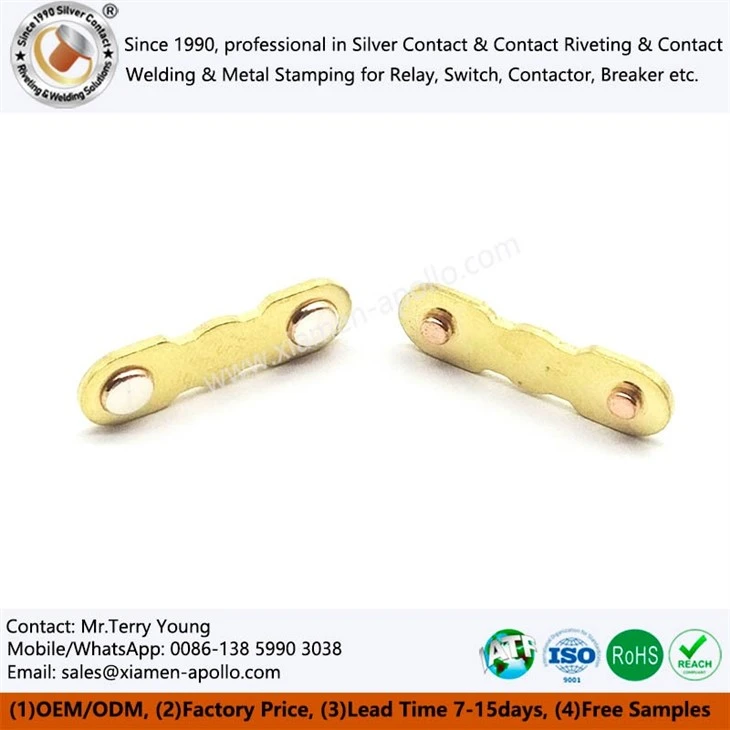
What are Transfer Switch Silver Rivet Contacts?

Transfer Switch Silver Rivet Contacts join silver rivet tips to stamped brass carriers via mechanical riveting for low‑voltage automatic transfer‑switch hardware. These assemblies undergo process monitoring for rivet embedment and stress dispersion to sustain repeated mechanical actuation within switch cabinets. Production runs follow documented process controls for OEM and volume‑order projects for smart‑home switch modules and low‑voltage electrical hardware.
Core Technical Advantages of Electrical Contact Rivets with Brass Stamping
Precision Riveting Process
Rivet embedding depth is locked via machine parameter setpoints. Each production lot samples rivet seating geometry to eliminate partial‑insertion defects. Process parameters adjust for brass carrier thickness variation across custom stamping profiles.
Premium Silver Contact Material
Silver rivet feedstock undergoes incoming batch verification for alloy composition. Impurity limits are controlled to keep consistent conductive performance under cyclic arcing events within transfer‑switch mechanisms.
Flexible Modular Structure
Base stamping outline, mounting hole layout, and contact rivet dimensions can be adjusted. Existing tooling subsets can be reused where geometry overlaps to shorten sample turnaround for modified transfer‑switch hardware.
Wide‑Range Environmental Adaptability
Assemblies are qualified for‑40 °C cold exposure and +85 °C continuous cabinet temperature. Anti‑oxidation passivation reduces surface degradation under high‑humidity and salt‑spray exposure inside sealed electrical enclosures.

Technical Specifications & Materials of electrical contact riveted brass
| Parameter | Value / Description |
|---|---|
| Contact Rivet Grade | AgSnO₂ 88/12 (standard option); alternate silver alloys available upon request |
| Carrier Base Material | H65 Brass stamping |
| Operating Temperature | ‑40 °C ~ +85 °C |
| Dimensional Tolerance | ±0.03 mm for stamping and rivet seating features |

Quality Control and Validation of Brass Stamping Electrical Silver Contact

Incoming Material Inspection
Brass and silver materials should be checked against the approved material specification before production. Where material certificates are required, they can form part of the incoming inspection documentation.
Stamping Inspection
Critical stamped dimensions should be checked for hole position, formed height, bend angle, profile, and other drawing-defined features. Inspection frequency should correspond to the customer's control plan.
Riveting Inspection
The finished rivet should be inspected for contact position, formed-head condition, visible deformation, and mechanical retention. Destructive testing can be defined where joint strength requires validation.
Electrical Verification
Where required, electrical tests can include contact resistance, continuity, and load-related validation. Test limits should be established from the complete transfer-switch design rather than applying an unsupported generic value to the component.

contact us
We are customer-centric and committed to providing quality service to every friend who contacts us. From your initial consultation to after-sales support after the purchase of Transfer Switch Silver Rivet Contacts, we will go all out. Here, you will experience warm, efficient, and thoughtful service, feel our attention to every detail, and have your needs fully met.

Hot Tags: Silver Contact Assembly Wholesale, Custom Electrical Switch Contacts, Brass Stamping Silver Rivets, Bimetal Contact Rivet Manufacturer, Dual Metal Contact Tips, AC Contactor Silver Points, Low Voltage Switchgear Parts, Silver Cadmium Oxide Rivets, Electrical Relay Contact Components, In Die Riveted Silver Contacts, Relay Moving Spring Terminal Beryllium Copper, Riveted Silver Contact, Electric Contacts For EV Charging Relay, Electric Contacts For PV Relay, Silver Contact Brass Terminal Riveting


