


What is the Yoke for Electromagnetic Relay?
High-volume manufacturing of smart energy meters, automotive control modules, and industrial latching relays requires absolute magnetic circuit consistency to avoid coil overheating and release failures. Material impurities, cold-work stress, and surface burrs in low-grade steel yokes degrade magnetic flux transfer, leading to variable pick-up voltage and erratic switching cycles. This precision Yoke for Electromagnetic Relay applications is manufactured from grain-oriented DT4C grade pure iron, utilizing high-speed progressive press tooling and vacuum magnetic annealing. Designed to maintain precise air-gap geometry under high mechanical shock, our production lines supply scalable volume orders to OEM assembly facilities globally.

Magnetic Circuit Performance & Material Metallurgy of Relay Steel Yoke
Optimized Flux Density in Compact Relay Frames
The magnetic yoke forms the primary low-reluctance return path for coil-generated flux. By specifying ultra-low carbon DT4C iron, the yoke prevents magnetic saturation at operating field strengths exceeding 1.5 tesla. This high saturation induction enables relay designers to reduce overall coil winding turns, minimizing copper loss and lowering internal operating temperatures in enclosed automotive or smart meter relays.
Elimination of Remanence and Armature Sticking
Residual magnetism after coil de-energization causes armature lag or permanent latching in non-latching relays. Our strict chemical controls limit carbon, nitrogen, and sulfur impurities to trace levels below 50 ppm. Coupled with specialized heat treatment, this keeps coercive force extremely low, ensuring instant armature release when coil power drops.
Mechanical Rigidity Under Dynamic Switching Impact
Repeated physical impacts from the armature can deform poorly supported yoke structures over millions of operations. Cold-rolled pure iron strip stock undergoes multi-stage die forming with reinforced rib geometries where required. The resulting frame holds strict spatial alignment between the hinge pivot point and core face, preserving calibrated air gaps throughout the mechanical service life.
Surface Passivation Without Magnetic Deterioration
Electroplating non-magnetic metallic layers like zinc or nickel can introduce hydrogen embrittlement or surface stress that alters soft magnetic characteristics. Our plating process incorporates a low-temperature post-plating baking stage to drive off occluded hydrogen, preserving the low-coercivity profile while providing long-term atmospheric corrosion protection.
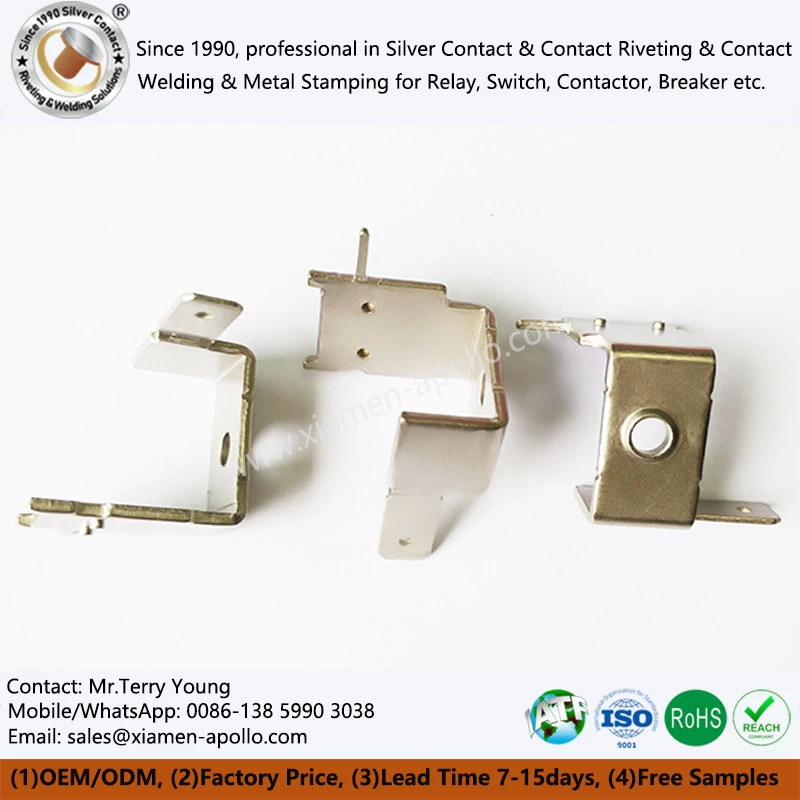
Packaging & Logistics Control of Relay Yoke Stamping
Anti-Corrosion VCI Packaging Options
Cleaned and plated yokes are packed into Volatile Corrosion Inhibitor sealed bags with desiccant packs. This prevents atmospheric oxidation during extended ocean freight transit through humid tropical maritime routes.
Custom Thermoformed Tray Packing for Automated Assembly
To accommodate robotic pick-and-place systems on automated relay assembly lines, yokes can be nested in custom anti-static thermoformed plastic trays. This eliminates mechanical tangling, scuffing, and edge damage during transit.
Bulk Cartoning with Reinforced Palletization
For high-volume bulk shipping, components are packed in heavy-duty double-wall corrugated cartons secured on heat-treated ISPM-15 compliant wooden or plastic pallets. Edge protectors and stretch-wrap film protect shipment integrity during multimodal transport.

Frequently Asked Questions about Sheet Metal Relay Yoke
What does a yoke do in an electromagnetic relay?
The yoke forms part of the magnetic circuit and provides a structural interface for related components. Its geometry influences how the magnetic assembly is positioned around the coil and armature.
Why is DT4C pure iron preferred over standard carbon steel for a yoke for electromagnetic relay applications?
DT4C grade pure iron contains ultra-low carbon, carbon less than or equal to 0.006%, which delivers significantly higher maximum magnetic permeability and lower coercive force than standard cold-rolled steel. This minimizes hysteresis energy losses and prevents unwanted residual magnetism that can cause the relay armature to stick after de-energization.
How does heat treatment alter the magnetic performance of Power Relay Yoke?
Stamping cold-works the iron lattice, introducing internal mechanical stress that increases coercivity and drops permeability. Vacuum hydrogen annealing at 850 degrees Celsius relieves lattice strain, encourages ferrite grain growth, and removes interstitial impurities, fully restoring soft magnetic performance to design specs.
What testing methods verify the coercive force of finished iron yokes?
Coercive force is measured using a DC hysteresis loop tracer or coercimeter on sample rings processed alongside component batches. This test verifies that post-annealing coercivity remains below the 40 ampere per meter threshold required for fast electromagnetic switching response.

Send your relay yoke drawing and target order quantity now for a factory quotation, with stamping-tool review, material verification and drawing-based inspection for your Yoke for Electromagnetic Relay program.

Hot Tags: Electromagnetic Relay Yoke Manufacturer, Custom Pure Iron Yoke, Relay Magnetic Frame, Stamped Iron Yoke, Relay Core Components, Custom Relay Yoke Wholesale, DT4 Pure Iron Stamping, Electrical Pure Iron Stamping For EV DC Contactor, Iron Shield Cap For EV Charging Contactor, Yoke For EV Charging Relay Contactor, EV Relay Coil Yoke, HVDC Relay Skeleton Pure Iron, Relay Yoke


