


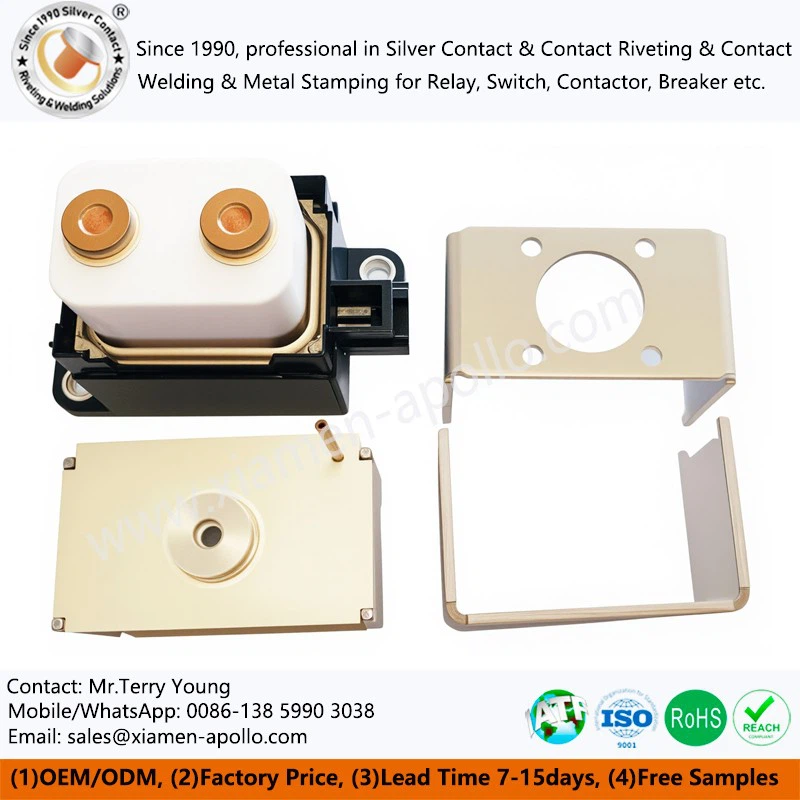


Important components of new energy high-voltage DC contactors
Our company focuses on the research, development, and production of New Energy Contactor Parts solutions: HVDC Metalized Ceramic, HVDC Copper Automatic Version Injection Molding Components; HVDC Copper Exhaust Pipe & Armature Cover Resistance Brazing Components; and HVDC Arc Extinguishing Chamber Parts. These New Energy Contactor Parts meet the needs of multiple fields, such as power, new energy, and industrial equipment.

New energy high-voltage DC contactors are usually composed of the following core components:
1. Moving Contact
Made of copper stamping, with silver alloy contacts welded on the surface to ensure excellent conductivity and arc resistance.
2. Fixed Contact
Machined from copper, with a venting hole structure, and connected to the ceramic metallization layer by vacuum brazing.
3. Metallized Ceramic
Made of high-purity alumina ceramic (Al₂O₃≥95%) to achieve high insulation withstand voltage and airtight sealing.
4. Electrical Pure Iron Armature & Yoke
Precision stamping, high magnetic permeability, and low hysteresis loss, to ensure fast pull-in and release performance.
5. Arc Chamber
The internal structure is precise and laser welding is used for assembly to ensure that the arc is extinguished quickly, safely, and reliably.
6. Coil Assembly
Low-power coil design takes into account energy efficiency and suction retention.
Process and technical requirements for metalized ceramics
The manufacturing process of high-reliability alumina metalized ceramics mainly includes the following steps:
1. Raw material preparation
Select high-purity alumina powder (Al₂O₃ content ≥ 95%) and strictly control the impurity content.
2. Molding process
Dry pressing or tape casting to ensure dimensional consistency and density.
3. Pre-sintering
Low-temperature pre-sintering (about 1300℃) is performed to improve the strength of the green body and facilitate subsequent processing.
4. Surface metallization treatment
Use molybdenum manganese slurry to print on the ceramic surface, and form a metallization layer through high-temperature sintering (about 1450℃).
5. Nickel plating treatment
Electroplating nickel (Ni thickness is about 3~5μm) on the metalized surface to improve the subsequent brazing performance.
6. Air tightness test
Use a helium mass spectrometer leak detector to ensure that the air tightness rate reaches <1×10⁻⁹Pa·m³/s.
7. Dimension detection and screening
Strictly test the flatness, thickness, and hole position accuracy, and the dimensional tolerance is usually controlled within ±0.05mm.
Tips: The surface roughness of the ceramic is controlled below Ra 0.8μm, which is helpful for the subsequent brazing quality.

Example of vacuum brazing parameter setting for copper exhaust hole
In the new energy high-voltage DC contactor, the static contact copper parts are connected to the metalized ceramic by vacuum brazing. The typical process parameters are as follows:
| Process steps | Parameter requirements |
| Solder type | Silver-based solder (Ag72Cu28) or AgCuInSn |
| Solder thickness | 30~50μm |
| Brazing furnace vacuum | ≤5×10⁻⁴Pa |
| Heating rate | 5~10℃/min |
| Brazing temperature | 780℃~820℃ |
| Insulation time | 5~10 minutes |
| Cooling method | Slowly cool to room temperature |
| Exhaust hole design | Diameter Φ1.0mm~Φ1.5mm |
| Post-weld inspection | Air tightness, shear strength ≥50MPa |
Tips: During the pretreatment stage, the copper parts need to be degreased and the oxide layer removed to improve wettability and brazing reliability.

Typical process window of the arc extinguishing chamber for laser welding
The connection of multi-metal parts inside the arc extinguishing chamber is usually carried out by laser welding. The following is a reference to the process window in the actual application:
| Project | Parameter range |
| Laser type | Continuous fiber laser |
| Laser wavelength | 1064nm (near-infrared band) |
| Laser power | 300W~1000W |
| Spot diameter | 0.2~0.6mm |
| Focus position offset | Focus slightly negative offset (about -0.5mm) |
| Welding speed | 3~10mm/s |
| Gas protection | High-purity argon (flow rate 10~20L/min) |
| Depth of penetration | >1.5mm |
| Typical weld appearance standard | No spatter, no pores, continuous bright weld |
Tips: You can use the coaxial visual monitoring system to observe the weld pool in real time to further improve welding consistency and yield.
Key points of laser welding technology for the arc extinguishing chamber
In new energy high-voltage DC contactors, the structural design of the arc extinguishing chamber is directly related to the extinguishing effect of the arc when disconnected. The multi-metal components in the arc extinguishing chamber are usually connected by the laser welding process. The main technical points include:
(1). Welding material: Generally stainless steel or alloy steel, requiring good laser absorption and thermal conductivity.
(2). Laser parameters:
Laser power: 300W~1000W (adjusted according to material and thickness)
Spot diameter: 0.2mm~0.6mm
Welding speed: 3mm/s~10mm/s
(3). Weld quality requirements:
The weld is continuous and uniform, without pores and cracks.
Welding depth-to-width ratio>1.5, sufficient penetration depth
(4). Welding process protection:
Use high-purity argon protection (purity ≥ 99.999%) to prevent weld oxidation.
(5). Post-weld inspection:
Use X-ray non-destructive testing to check the quality of internal welds.
Perform tensile and shear strength tests when necessary.
Tips: Through the high-precision laser welding process, the structural reliability and service life of the arc extinguishing chamber are guaranteed, which is the key guarantee of the quality of new energy high-voltage DC contactors.
Process synergy and system integration
The excellent performance of new energy high-voltage DC contactors depends not only on the high-quality manufacturing of each component but also on the system integration and coordinated optimization of each process link. As a long-term partner of Xiamen Hongfa Relay Group, we not only provide qualified parts but also participate in the customer's preliminary design, from material selection, and process adaptation to performance verification, to provide a full range of technical solutions.
In terms of material synergy, we pay special attention to the thermal expansion matching problem between different materials. For example, the thermal expansion coefficient of alumina ceramics (7.2×10^-6/℃) needs to be coordinated with the metallization layer (molybdenum-manganese alloy, about 5.5×10^-6/℃) and copper components (17×10^-6/℃). By adjusting the metallization formula (adding silicon oxide to adjust the expansion coefficient) and using a flexible transition structure in the brazing layer (such as a wavy copper exhaust pipe), thermal stress can be effectively relieved, allowing the components to withstand extreme temperature cycles of -40℃~+150℃.
In terms of process connection, we have established strict inter-process standards. Metalized ceramics need to be plasma cleaned (power 300W, time 5min) before brazing to remove organic pollutants on the surface; the arc extinguishing chamber after laser welding needs to be stress-relieved annealed at 250℃×2h before it can be assembled with the main shell. Each component has a complete process traceability record, including material batches, process parameters, and test data, to ensure that any quality problems can be quickly located.
Performance verification is the final test of process integration. We have designed a complete set of testing solutions for high-voltage DC contactor components:
Electrical testing: including contact resistance (≤0.5mΩ), insulation resistance (≥1000MΩ) and withstand voltage test (5000V AC/1min);
Mechanical testing: operating force (3-5N), mechanical life (≥100,000 times) and vibration test (20-2000Hz, 3 axes);
Environmental testing: temperature cycle (-40℃~+125℃, 50 times), damp heat (40℃/95%RH, 500h), and salt spray (5%NaCl, 96h).
Through these strict coordinated controls, the core components of new energy high-voltage DC contactors we provide help customers' products reach the industry-leading level: breaking capacity of 1500VDC/1000A, electrical life of more than 100,000 times, failure rate less than 0.3‰, full meeting the high-reliability requirements of new energy vehicles and photovoltaic energy storage systems.
As the market size of high-voltage DC contactors continues to expand (the global market size is expected to reach RMB 4.8 billion in 2025), we will continue to delve into core technologies such as alumina metalized ceramics, vacuum brazing, and laser welding, and provide customers with better quality and more reliable component solutions through process innovation and intelligent manufacturing, and jointly promote technological progress in the new energy electrical industry.

contact us

Hot Tags: new energy contactor parts, HVDC contactor parts, high voltage DC contactor components, new energy contactor components manufacturer, HVDC metalized ceramic, EV contactor parts, DC contactor components supplier, energy storage contactor parts


