


What is the Bimetal Electrical Silver Contact Point?

Engineering heavy‑load electrical components requires precise metallurgical bonding between precious contact metals and conductive substrates. The bimetal electrical silver contact point utilizes high‑purity silver composite layers cold‑headed onto high‑conductivity copper or steel shanks, securing superior arc erosion resistance during intensive switching cycles. Operating within a temperature window of ‑40°C to +150°C, this configuration prevents thermal runaway and contact welding in demanding automated environments.
Utilizing high‑speed multi‑station cold heading machinery paired with precision stamping lines, production capacities reach millions of custom‑engineered Electrical Contact tips monthly. Dimensional tolerances are held within tight ±0.01mm limits, ensuring seamless automated insertion into relay leaf springs and molded switch housings. Direct factory supply chains eliminate distributor markups while maintaining strict lot‑to‑lot traceability through spectrometer material testing and micro‑hardness profiling.
Technical Specifications & Materials of Bimetal Silver Contacts
| Item | Specification |
|---|---|
| Material Grade | AgSnO2 / AgCdO / AgNi composite bonded to Cu / Cu‑Ni base |
| Volume Resistivity | < 0.5 μΩ·cm |
| Max Carrying Current | 20 A |
| Operating Temperature | ‑40 °C to +150 °C |

Core Technical Features Of Electrical Contact
Low resistivity keeps stable current transmission. Signal loss stays low for high‑frequency switching tasks, suitable for Sliding Electrical Contact assemblies.
Wide operating temperature range. Contact surface resists oxidation and deformation under operating heat, applicable to Slip Ring Contacts working under continuous thermal load.
Composite interface is formed under controlled temperature and pressure. Bond strength is verified per batch, meeting mechanical requirements of Spring Electrical Contacts.
Mechanical wear reduces during frequent switching, lowering part replacement frequency for relay units.

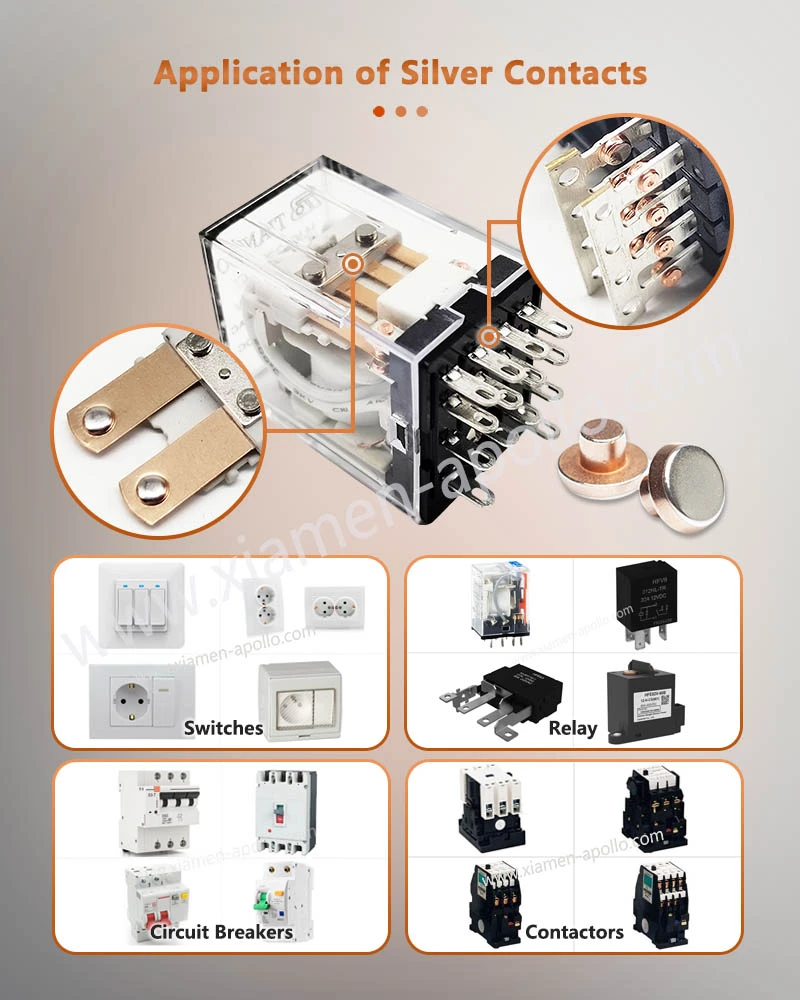
Typical Relay Applications of Spring Electrical Contacts
Heavy‑Load Power Relays
Engineered for industrial power control units where repeated high‑amperage make‑and‑break operations generate intense thermal stress. These Electrical Contacts adopt a silver composite layer to effectively quench electric arcs, minimizing contact cratering and extending the maintenance intervals of industrial motor controllers.
High‑Frequency Signal Relays
Optimized for telecommunication and smart grid switching where low electrical resistance is mandatory for accurate signal transmission. As a Fixed Silver Contact, its minimal volume resistivity prevents localized heating and signal attenuation across millions of rapid switching cycles.
Frequently Asked Questions about Silver Electrical Contacts
What is the minimum bonding strength of the bimetal interface?
+
-
The cold‑heading mechanical and thermal fusion process achieves an interfacial shear strength exceeding 180 MPa. This robust metallurgical bond prevents delamination or layer separation even under extreme mechanical shock and continuous thermal cycling up to 150°C.
Can the silver alloy ratio of Silver Electrical Contacts be modified for specific load conditions?
+
-
Yes, custom alloy ratios such as AgSnO2 85/15 or AgNi 15/85 can be engineered to match your specific arc‑suppression requirements and anti‑welding performance thresholds for specialized automotive or industrial relay applications.
What is the standard lead time for custom tooling and Sliding Electrical Contact sample production?
+
-
Initial tooling setup, sample cold‑heading, and dimensional verification typically require 10 to 15 business days. Full‑scale production runs are scheduled immediately upon engineering drawing approval and raw material lot verification.
Are these Slip Ring Contacts compliant with environmental directives?
+
-
All manufactured components strictly comply with RoHS and REACH regulations, utilizing conflict‑free raw materials backed by full material composition declarations and comprehensive factory test certificates.
How do I specify the exact silver layer thickness on my engineering drawings?
+
-
You can define the silver cap thickness as a fixed dimension in millimeters or specify a minimum effective wear depth based on your relay's expected operating lifecycle and maximum switching frequency.

contact us
We warmly welcome you to contact us at any time to learn more about our Bimetal Electrical Silver Contact Point. Our team will be happy to provide you with detailed product information, technical support, and professional advice. Whether you have any questions or needs, please contact us by phone, email, or visit our website. We look forward to providing you with quality service and helping you find the most suitable solution.
Hot Tags: Bimetal Electrical Silver Contact Point, Silver Contact Rivet Manufacturer, Silver Cadmium Oxide Contact, Electrical Relay Contacts Wholesale, Silver Composite Rivet, Bimetal Contact Tips, Custom Electrical Contacts China, Relay Contact Points Factory, AgSnO2 Contact Point, Low Voltage Switchgear Contacts, Silver Point Contact, Bimetal Electrical Silver Contact Point, Bimetal Silver Contacts, Moving Contact For New Energy Relay, bimetal silver contact, Stationary Electrical Contacts


