


What is the Bimetal Rivet Contact?
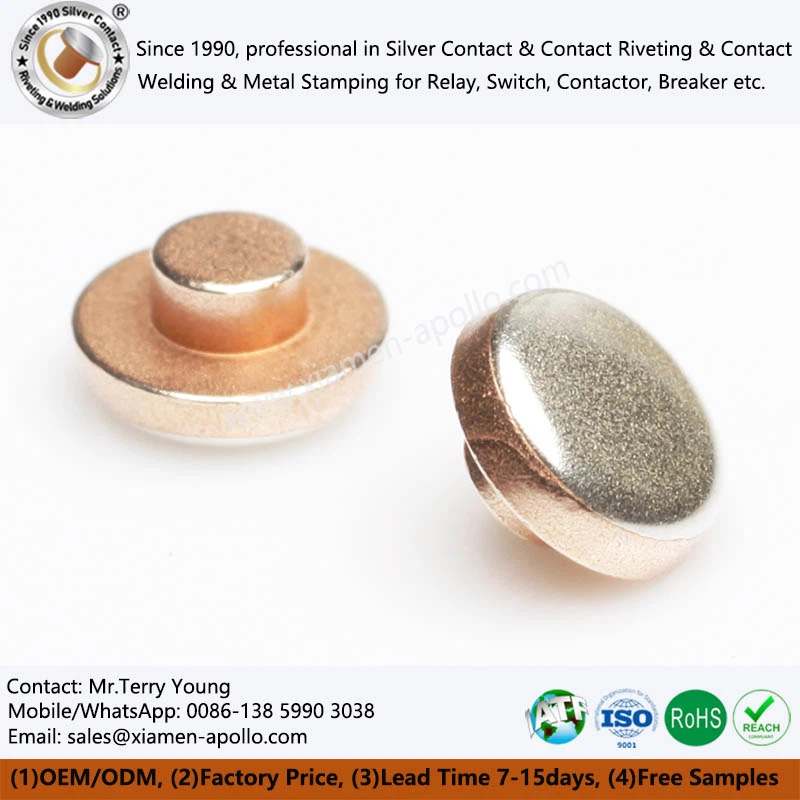
Engineering and procurement teams sourcing reliable switching components require stable electrical conductivity and robust mechanical longevity under severe thermal and electrical loads. These bimetal rivet contacts combine a noble metal functional tip (such as AgSnO2 88/12 or AgCdO 15) with an oxygen‑free copper or nickel backing shank through advanced cold heading and solid‑phase metallurgical bonding. This engineered dual‑layer structure optimizes precious metal consumption while delivering exceptional arc resistance, low contact resistance, and high mechanical shear strength for high‑frequency switching devices.
Technical Specifications Matrix of Bi-metal Silver Contact Point
| Parameter Metric | Technical Specification Value |
|---|---|
| Electrical Conductivity | Tip: ≥ 60% IACS; Shank: ≥ 100% IACS |
| Shear Strength | ≥ 180 MPa (Interfacial bonding zone) |
| Vickers Hardness | Tip: 80‑110 HV; Shank: 60‑90 HV |
| Contact Resistance | ≤ 0.5 mΩ (at 10A test current) |

Competitive Advantage of Bimetal Relay Contact Point
Stable Conductivity Maintenance
Bi‑metal Silver Contact Point keeps contact resistance below 0.5 mΩ across operational lifespans, minimizing Joule heating losses and preventing localized thermal runaway within high‑current switching modules during continuous load operation.
Anti‑Arc Erosion Characteristics
During high‑voltage circuit interruption, electric arcs generate intense localized temperatures. The uniform dispersion of tin dioxide (SnO₂) micro‑particles within the silver matrix effectively absorbs arc energy, restricting material transfer and preventing catastrophic contact welding.
Thermal Dissipation Efficiency
The high thermal conductivity of the copper shank of the Bimetal Relay Contact Point facilitates rapid heat dissipation away from the contact interface into the supporting brass or copper spring blades, stabilizing operating temperatures under continuous duty cycles.
Low Contact Bounce Dynamics
Precision head profiling and optimized crown radii of Bimetal Electrical Contact Points ensure uniform initial contact distribution, reducing mechanical bounce duration during high‑speed closure and mitigating micro‑welding risks in inductive load switching.

Manufacturing Workflow & Quality Assurance of Electrical Contacts
Precision Material Selection
Raw silver ingots and oxygen‑free copper rods undergo rigorous spectrometer analysis to verify chemical purity exceeding 99.95 %, eliminating trace impurities that could impair electrical performance or accelerate oxidation.
Composite Forming via Cold Heading
Multi‑station progressive cold heading machines apply calculated tonnage to weld and form the precious metal tip onto the copper base in a solid‑state process, avoiding casting defects and ensuring uniform density throughout the Electric Silver Bimetal Contact Rivet body.
Surface Finishing & Cleaning
Finished Moving Contact Rivets undergo ultrasonic degreasing, acid pickling, and passivation to remove residual lubricants and surface oxides, ensuring pristine contact interfaces and optimal shelf‑life stability before customer assembly.
Automated Optical Sorting
100 % of manufactured Bimetal Silver Contact Point lots pass through high‑speed optical vision inspection systems, automatically rejecting dimensional out‑of‑tolerance parts, surface cracks, or eccentric head‑to‑shank alignments.

Downstream Application Scenarios & Industrial Integration of Bimetallic Rivets
Smart Meter Latching Relays:
Optimized for single‑phase and three‑phase smart electricity meters requiring reliable 100A switching capacity with zero contact sticking over a 20‑year operational design life.
800V HVDC Electric Vehicle Contactors:
Silver Contact Rivet is utilized in primary battery disconnect relays within electric vehicle charging stations and high‑voltage DC distribution boxes where high arc suppression capability is mandatory.
Industrial Miniature Circuit Breakers (MCB):
Silver Point Contact is integrated into thermal‑magnetic trip units and auxiliary switches of industrial power distribution equipment to handle high fault‑current interruption cycles.
Automotive Horn and Window Switches
Bimetal Silver Contact is applied in high‑frequency automotive interior electromechanical switches requiring low electrical resistance and exceptional wear resistance against mechanical fretting.

contact us
Ready to secure high‑reliability Bimetal Rivet Contacts for your upcoming electrical manufacturing production run? Consult directly with our senior application metallurgists and factory engineering team to review your technical drawings, request material test reports, or obtain competitive factory‑direct wholesale quotations tailored to your annual volume requirements. Submit your engineering specifications today for a prompt technical evaluation.

Hot Tags: Bimetal Rivet Contact, Silver Contact Rivet Manufacturer, Wholesale Bimetal Electrical Contacts, AgSnO2 Contact Rivet, Copper Backed Silver Rivet, Electrical Relay Contact Components, Custom Silver Rivet Supplier, High Current Switching Rivet, Composite Electrical Contact, Relay Movable Spring Contact., Bimetal Silver Contacts, bimetal silver contact, Spring Loaded Electrical Contact, Contactor Electrical Silver Contacts, Electronic Contacts For Smart Meter Relay, Dry Contactor Electrical Silver Contacts


