


Products Description
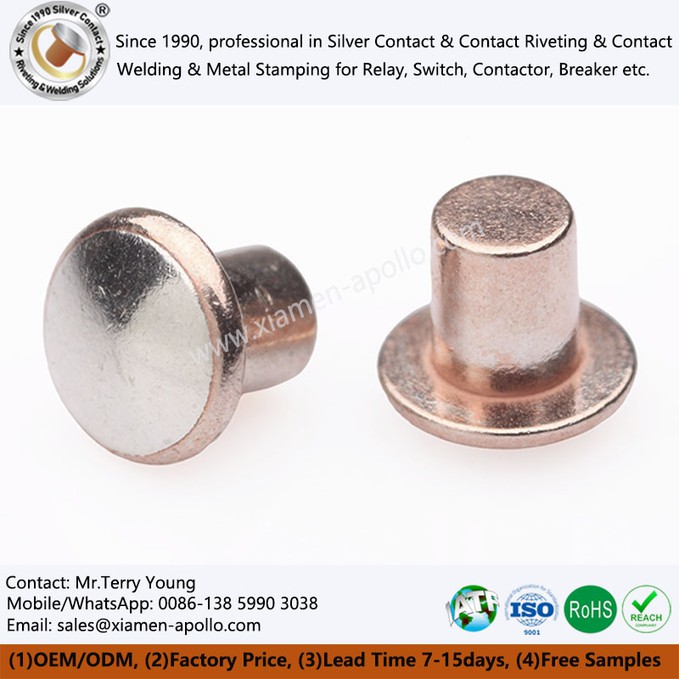
Silver contacts in breakers play a crucial role in electrical systems, ensuring reliable and efficient electrical connection. Cold-forming process contacts are used to create these contacts with precision and durability. The electrical silver contact point is the key element that makes contact with the circuit, while leaf spring electrical contacts provide the necessary spring-like action for proper contact and disconnection. Bimetal electronic contacts are designed to handle the mechanical and electrical requirements of the breaker.

Product Parameters
Electrical Conductivity
Silver contacts have high electrical conductivity, with a value of around 6.3 x 10^7 S/m. This high conductivity allows for efficient electrical current flow, reducing energy losses.
Contact Resistance
The Contactor Contacts resistance of silver contacts is low, typically around 0.0001 - 0.001 Ω. This low resistance ensures stable electrical performance and minimal power dissipation.
Mechanical strength
The bimetal contacts have a high mechanical strength, with a tensile strength of around 300 - 400 MPa. This allows them to withstand the mechanical forces during operation.
Temperature range
Silver Contact Points can operate in a wide temperature range, from - 40°C to 120°C. This adaptability makes them suitable for various electrical applications.
Moving contact production equipment
| Cold forming machines | Cold-forming machines are used to shape the contacts using the cold-forming process. These machines are capable of producing high-precision contacts with consistent quality. The cold-forming process allows for the creation of complex shapes and structures. |
| Electrical discharge machining equipment | EDM equipment is used to cut and shape the Dry Contactor Electrical Silver Contacts using electrical discharge. This process is highly precise and can be used to create complex shapes and structures. EDM equipment is also used to remove any excess material from the silver contact in circuit breakers. |
| Assembly equipment | Assembly equipment is used to assemble the moving contacts onto the breaker. This includes the use of mechanical tools and fixtures to ensure proper alignment and connection. The assembly process is carefully controlled to ensure the quality and reliability of the contacts. |
| Testing equipment | Testing equipment is used to test the electrical properties of the contacts. This includes the measurement of electrical conductivity, contact resistance, and other electrical parameters. Testing equipment is also used to verify the mechanical properties of the Cold Headed Electrical Contacts, such as the tensile strength and hardness. |

Moving contact inspection links
Inspection of raw materials
The raw materials used for the moving contacts are inspected for quality and purity before production. This ensures that the contacts are made from high-quality materials.
Process inspection
During the manufacturing process, the Bimetallic Rivets are inspected at various stages to ensure proper formation and assembly. This includes inspection of the cold forming process, electrical discharge machining, and assembly process.
Final product inspection
The final product is inspected for quality and performance. This includes testing the electrical properties, mechanical properties, and other parameters. The inspection process is carried out using advanced testing equipment and techniques.
Quality control
Quality control measures are implemented to ensure the reliability and performance of the moving contacts. This includes inspection of the contacts during the manufacturing process, testing of the electrical properties, and verification of the mechanical properties.

contact us

Hot Tags: silver contacts in breakers, China silver contacts in breakers manufacturers, suppliers, factory, Spring Loaded Electrical Contact, Bimetal Contact Rivets, Bimetallic Silver Contacts, Moving Contact For New Energy Relay, Silver Coated Electrical Contacts, Bimetal Electronic Contacts


