


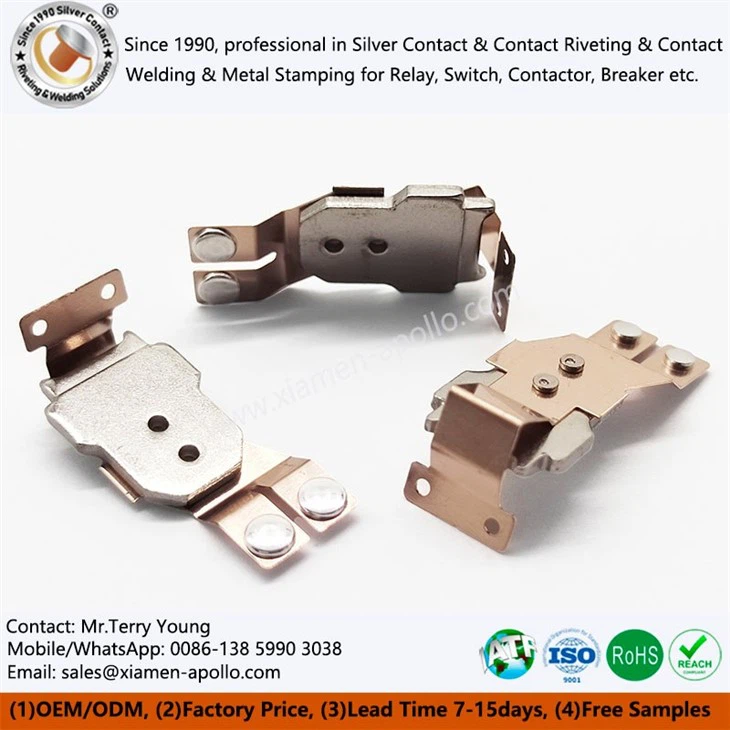

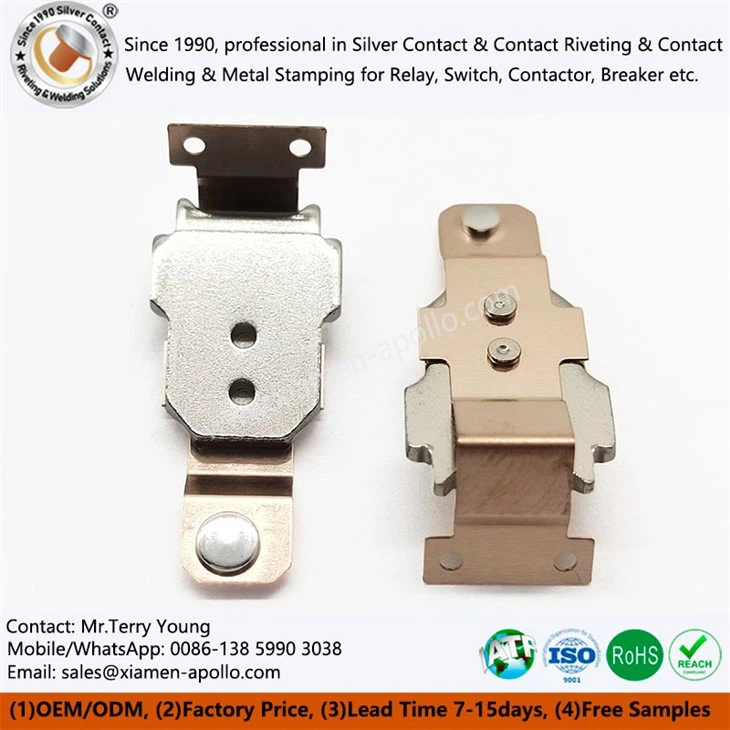
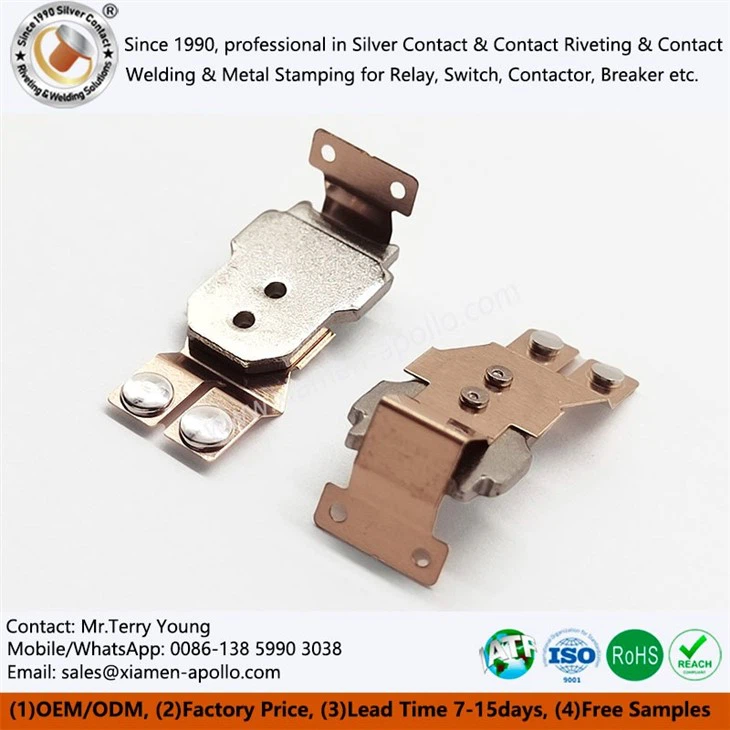
What are In-Die Electrical Riveting Contacts?

In-Die Electrical Riveting Contacts combine highly conductive base materials with durable precious metal contacts and are specifically designed for low-voltage switchgear applications. The continuous stamping process ensures dimensional consistency and excellent coplanarity for every component on the carrier strip. By performing the riveting operation directly within the die during the stamping process, the assembly achieves superior structural integrity compared to traditional post-stamping assembly methods; this ensures reliable, continuous long-term operation without the risk of rivet joint failure. Engineers can confidently specify this product, knowing that the performance of the riveted joints will not degrade under long-term cyclic operation.
Core In‑Die Riveting Advantages
One‑step forming, no secondary deformation
The entire riveting and shaping sequence occurs sequentially inside the progressive die, eliminating the need for independent secondary rework operations and preventing structural stress cracking.
01
High concentricity & tight tolerance
Automated optical feeding systems position the silver tips with precise centering accuracy, maintaining positional tolerances within ±0.015 mm across multi-million production batches.
02
Stable resistance against vibration
Mechanical interlocking and cold-flow deformation create a high-strength metallurgical and mechanical bond that resists loosening under severe industrial vibration profiles.
03
Consistent mass production
Continuous coil feeding and multi-station progressive tooling enable high-speed output while maintaining uniform contact depth and predictable mechanical properties.
04

Process & Quality Control of Electrical In-Die Riveted Connections
Progressive die positioning
Advanced sensor-monitored progressive dies verify material feed length and tip placement before every press stroke, halting production instantly upon detecting any anomaly.
Durability validation test
Random samples undergo accelerated mechanical endurance testing, simulating millions of continuous actuation cycles to evaluate contact bounce and mechanical fatigue life.
Rivet strength batch inspection
Destructive shear force testing is performed on every production lot to measure the exact push-out load required to dislodge the silver tip from the base metal.

Customization Options of In-Die Rivet Electrical Contacts
Base material selection:
Options include high-purity electrolytic copper (C1100), beryllium copper (C17200), and brass, selected based on elasticity and heat dissipation requirements.
Silver alloy contacts:
Contact materials such as AgSnO2 (Silver Tin Oxide), AgCdO (Silver Cadmium Oxide), AgZnO (Silver Zinc Oxide), and AgNi (Silver Nickel) are available to suit inductive or resistive load switching requirements.
Tolerances and surface treatment:
Strip thickness can be customized; options include selective silver plating or anti-oxidation passivation to suit various assembly processes.

contact us
Submit your engineering drawings or material specifications to our technical team today to receive a comprehensive quotation, material data sheet, and sample evaluation plan within 24 hours. Partner with an experienced direct manufacturer of In-Die Electrical Riveting Contacts dedicated to strict tolerance control and reliable global supply chain execution.

Hot Tags: Wholesale Electrical Contacts, Custom Riveting Contact Assembly, China Electrical Contact Manufacturer, Silver Alloy Riveting Contacts, Progressive Die Stamping Parts, Electrical Switch Contact Components, BeCu Riveted Armature Silver Contacts, Copper Stamping Parts With Riveted Silver Contacts, In Die Riveting With Silver Plating For Switch Part, Riveted Contact Copper Stamping Assembly, Silver Contact Riveted Onto Copper Stampings, Electrical Silver Contact Rivets


