


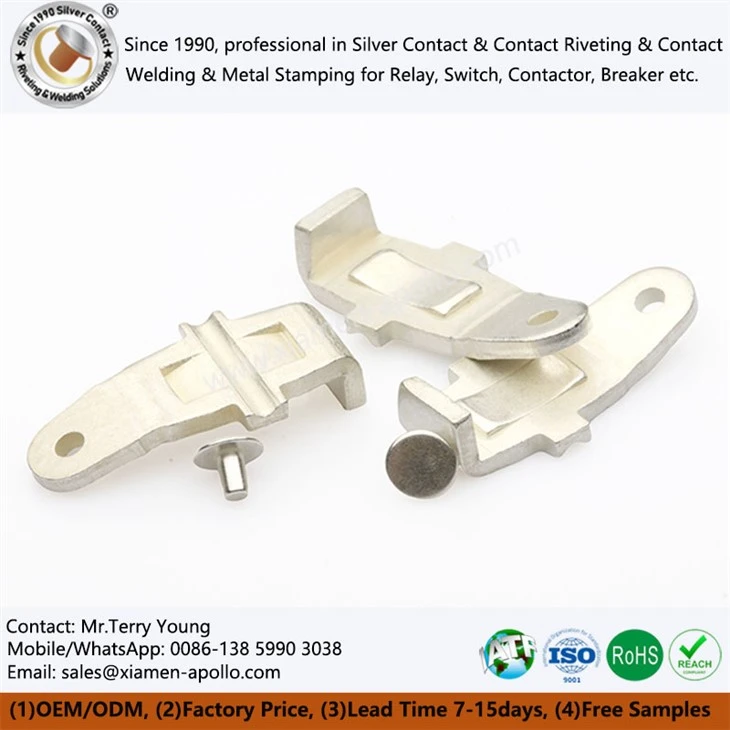


What is In-Die Riveting With Pure Silver Plate?

In-Die Riveting With Pure Silver Plate addresses core design targets for R&D electrical engineers developing high-reliability power switches and industrial control relays, lowering contact resistance and stopping thermal runaway under repeated electrical loads. This process creates a metallurgically stable contact interface that greatly surpasses traditional spot-welded assemblies. As an established direct factory manufacturer based in China, we deliver custom-engineered, wholesale silver plate riveting components tailored for demanding low-voltage apparatus. Our integrated progressive stamping and inline riveting technology guarantees precise positioning and exceptional mechanical pull-off strength, ensuring long-term operational stability for global industrial procurement programs.
Manufacturing & Precision Quality Control of Silver Rivet Electrical Connections
Silver-plate incoming purity verification
Raw silver material undergoes rigorous spectroscopic analysis to verify 99.99% purity levels prior to plating deposition, preventing trace impurities from causing premature electrical arc erosion.
01
In-die staking positioning control
Advanced optical sensor feedback systems integrated into our high-speed stamping presses maintain rivet placement tolerances within ±0.01 mm during continuous production runs.
02
Metallurgical interface integrity
Cross-sectional metallographic examination is performed on every production batch to verify zero micro-voids and secure mechanical interlock at the rivet-to-substrate boundary.
03
Multi-condition environmental verification
Finished stamped assemblies undergo salt spray corrosion testing and thermal cycling endurance checks to validate long-term contact stability in harsh operating environments.
04

Typical Application Scenarios of Riveted Silver Connectors
Electromechanical Relay Fixed Contacts
The structure is suitable for stationary contacts inside electromechanical relays where the silver contact plate forms the electrical interface with the corresponding moving contact.
Wall Switch Mechanisms
For household wall switches, the stamped terminal provides the mechanical mounting structure while the pure silver contact plate forms the switching interface. Contact geometry is developed around the switch mechanism and required mounting dimensions.
Household Control Switches
The component can be configured for household control mechanisms where compact stamped terminals and defined contact positioning are required. Material and geometry are selected according to the electrical and mechanical requirements of the finished switch.
Low-Voltage Relay Assemblies
Low-voltage relay assemblies can use the fixed-contact structure where the contact location, terminal profile, and rivet formation must remain compatible with the relay housing and moving-contact mechanism.

Frequently Asked Questions about Embedded Silver Contacts In Die
What is the primary engineering advantage of In-Die Electrical Riveting Contacts over traditional spot welding?
+
-
In-die riveting integrates the rivet insertion directly into the progressive stamping sequence, eliminating thermal distortion, reducing contact resistance inconsistency, and delivering superior mechanical bond strength compared to manual or secondary spot welding operations.
What base metal substrates are compatible with this In-Die Riveting process?
+
-
The process is fully compatible with various conductive base materials including C1100 electrolytic copper, brass, and beryllium copper alloys, balancing electrical conductivity with necessary spring resilience.
What international quality management and environmental standards do these Riveted Components meet?
+
-
All manufacturing processes are strictly certified under IATF 16949 automotive quality standards, and supplied components fully comply with RoHS and REACH environmental material directives.
How are the finished stamped components packaged to prevent oxidation during international shipping?
+
-
Parts are vacuum-sealed in anti-static, moisture-barrier packaging infused with vapor corrosion inhibitors (VCI) to protect the pure silver surfaces from atmospheric sulfur and oxidation during transit.
What is the standard lead time for tooling development and initial sample submission (PPAP)?
+
-
Tooling design, progressive die fabrication, and initial sample submission typically require 10 to 15 days, with full dimensional inspection reports and material test certificates included in the PPAP package.

contact us
Contact our engineering team today to submit your technical drawings or request custom samples for evaluation of In-Die Riveting With Pure Silver Plate. Partner with our advanced manufacturing facility for reliable, factory-direct volume production.

Hot Tags: Pure Silver Riveted Contacts, In-Die Silver Contact Riveting, Pure Silver Relay Contacts, Stamped Terminal Silver Contacts, Fixed Relay Silver Contacts, Wall Switch Silver Contacts, Custom Silver Contact Assembly, Silver Contact Stamping Parts, Contact Terminals With Silver Electroplating, Electrical Stamping Contact For Relay, Movable Contact For Photovoltaic PV Inverter Relay, In Mold Riveting Electrical Contacts, Electrical Silver Contact Rivets, Silver Contact Riveting Components


