


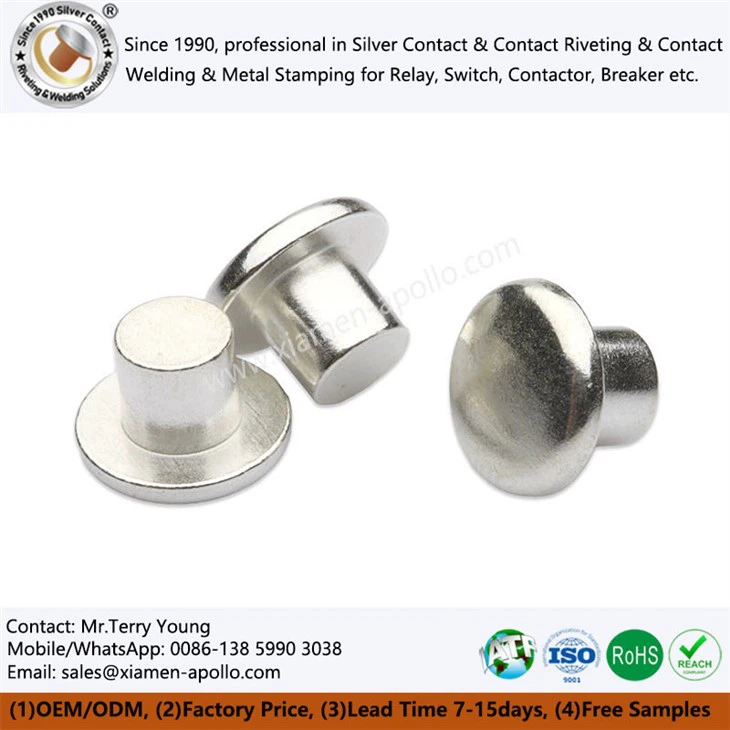

What are the Silver Alloy Contacts?

Silver Alloy Contacts are primarily used in electrical equipment requiring a balance between electrical conductivity, arc resistance, mechanical wear resistance, and switching performance. Material options include 99.99% pure silver, AgNi10, AgSnO(10), AgSnO2In2O3(12), and AgCdO(10). Solid contact configurations are suitable for relay contacts, low-voltage switchgear, molded case circuit breakers, contactors, and other electrical control components.
Contact diameter, thickness, contact profile, and special geometries can be customized based on engineering drawings or approved samples.
Material Selection for Switching Applications of pure Silver solid contact
99.99% Pure Silver: Prioritizing Electrical Conductivity
99.99% pure silver contacts are selected when the design focus is on low electrical resistance and high current-carrying capacity.
Compared to silver alloys containing oxides, pure silver emphasizes electrical conductivity and material purity rather than utilizing oxide components to improve arc control. Pure silver is a suitable contact material option for switching applications that do not require the enhanced arc-control characteristics provided by AgNi or AgSnO series materials.
AgNi10: Suitable for Wear and Arcing Conditions
AgNi10 is a silver-nickel alloy with a nickel content of approximately 10%, depending on the specific grade.
Compared to pure silver, the addition of the nickel phase alters the material's mechanical properties and switching behavior. AgNi10 is a suitable choice for contact designs involving frequent switching operations that require a balance between electrical conductivity, resistance to mechanical wear, and arc-handling performance.
AgSnO(10) and AgSnO2In2O3(12)
AgSnO(10) and AgSnO2In2O3(12) are silver-based electrical contact materials containing oxides.
These materials are primarily used in switching applications that demand specific arc-handling characteristics and resistance to contact welding. Material selection should not be based solely on the alloy designation; factors such as load type, voltage, current, switching frequency, inrush current, and contact geometry must also be considered.
AgCdO(10): For Specific Legacy Designs
AgCdO(10) remains a viable option for existing product designs that specifically require this established contact material.
However, as cadmium-containing materials may be subject to environmental regulations, it is essential to verify the target market, applicable regulations, and the customer's material compliance requirements prior to production. If necessary, alternative silver-oxide-based materials can be evaluated while maintaining the same electrical performance specifications.

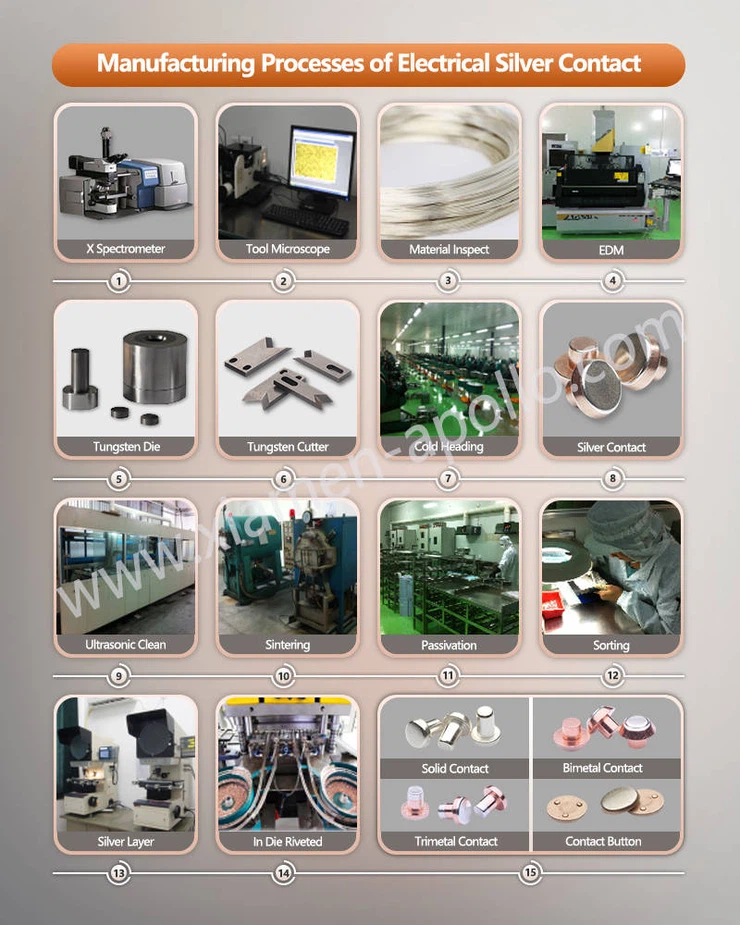
Precision Manufacturing Workflow of Silver electrical contacts
Frequently Asked Questions about Electrical Silver Contact Points
How do AgSnO2 alloy components prevent contact welding compared to pure silver?
+
-
AgSnO2 incorporates evenly distributed tin dioxide particles that act as physical barriers against molten metal fusion. When high inrush currents pass through, these oxide particles prevent the contact faces from sticking together during circuit closure.
What dimensional tolerances can be achieved for custom Monometal Contact Rivet configurations?
+
-
Modern cold heading and progressive stamping tools achieve dimensional tolerances within plus‑minus 0.01 mm. This precision ensures seamless drop‑in assembly into automated relay and circuit breaker manufacturing lines without manual adjustment.
Why is material hardness critical for relay and switch applications?
+
-
Sufficient surface hardness, typically ranging between 85 and 130 HV, resists mechanical deformation and pitting caused by millions of repetitive actuation impacts, extending the operational lifecycle of low‑voltage switching devices.
Can these components be supplied as bimetallic rivets or Silver Electrical Contacts?
+
-
Manufacturing capabilities support both solid alloy tips and bimetallic configurations with copper or brass backing shanks, optimizing precious metal usage and reducing total assembly costs for high‑volume OEMs.
Are these contact materials fully compliant with environmental regulations?
+
-
All manufactured alloy formulations comply strictly with RoHS and REACH directives, ensuring total absence of restricted hazardous substances such as unregulated heavy metals within global electronics supply chains.

Contact Us
If you have any requirements concerning the procurement, selection, sample request, or customization of Silver Alloy Contacts, or if you wish to obtain further information regarding product details, please do not hesitate to contact us. We will deploy a professional team to provide personalized one-on-one service, develop customized adaptation solutions, and guarantee stable supply, precise selection, and efficient procurement processes.

Hot Tags: Solid Silver Contacts, AgSnO2 Contact Tips, Electrical Relay Contacts, Custom Silver Contact Rivets, Silver Cadmium Oxide Contacts, Low Voltage Switch Contacts, Electrical Contact Manufacturer, Factory Direct Silver Contacts, AgNi Bimetal Contact Points, Red Copper Contacts For Electrical, Electric Copper Contacts, Silver Solid Contact Rivets, Silver Alloy Rivets, silver contact, Copper Electrical Contacts


