


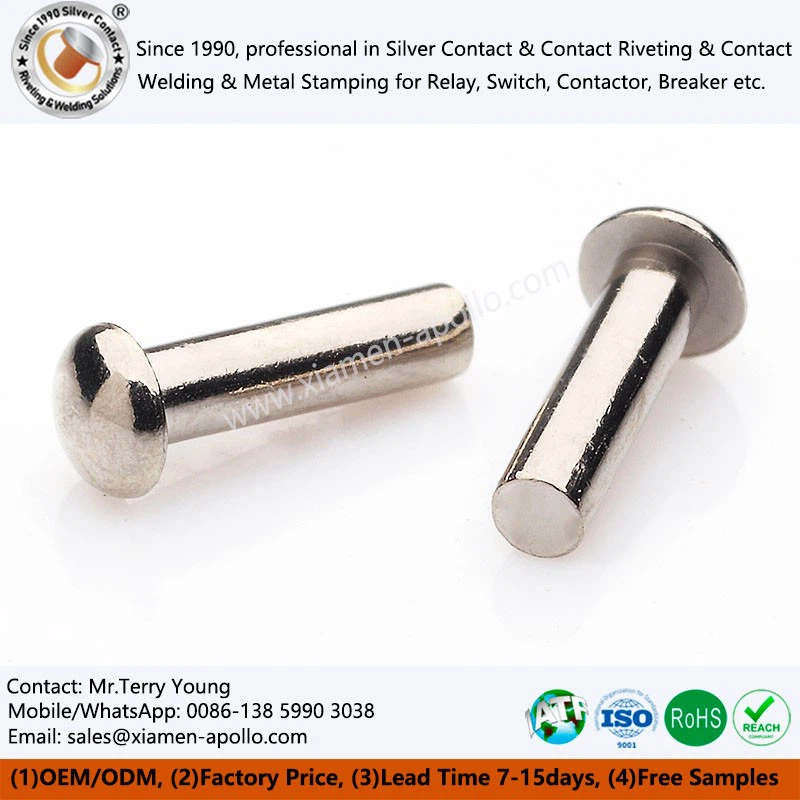


What are Nickel Plated Copper Switch Contacts?
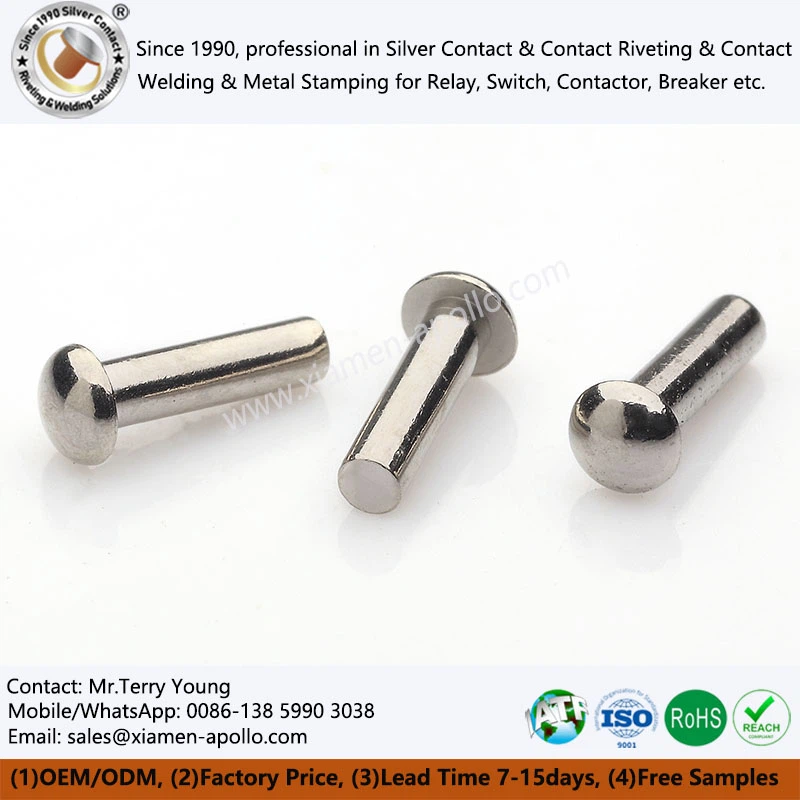
Nickel Plated Copper Switch Contacts are formed from a copper substrate and finished with a controlled nickel layer for applications where copper oxidation, surface wear, and BOM cost must be managed at the component level. The cold-heading process forms the contact geometry before nickel plating, allowing the conductive copper path and contact interface to be specified separately. Production supports custom switch contacts, relay moving contacts, and small electromechanical contact parts according to customer drawings, material requirements, and inspection plans.
Application Areas of Nickel-plated Contact
Household Appliance Control Switches
Electroplated nickel‑plated copper contacts are used in main and auxiliary switch circuits of air‑conditioners, electric water heaters, washing machines, and kitchen appliances. The nickel plating resists copper oxidation in high‑humidity conditions and maintains stable conductivity for appliance service cycles for home appliance OEM projects.
General-Purpose Power Relays
Cold‑formed nickel‑plated copper rivets are used for control relays in household distribution panels, small industrial equipment, and energy‑storage auxiliary modules. Designed for signal and auxiliary contact loops rather than main power interruption paths, available for volume procurement by relay manufacturers.
Low-Voltage Power Distribution and Power Modules
Nickel‑plated copper contacts are adopted for circuit‑breaker auxiliary contacts, power switch units, and internal conductive parts of plug‑in power modules. This lowers BOM cost while satisfying electrical conductivity requirements for low‑voltage auxiliary conduction.

Manufacturing Process of Nickel-Plated Electrical Contacts
1. Copper Substrate Selection
Industrial‑grade pure copper is used as base material. Each batch comes with mill certificates and composition reports. Incoming conductivity and mechanical strength are tested; non‑conforming raw material is rejected to secure baseline performance of Nickel Plated Electrical Contacts and control material cost.
2. Substrate Pretreatment
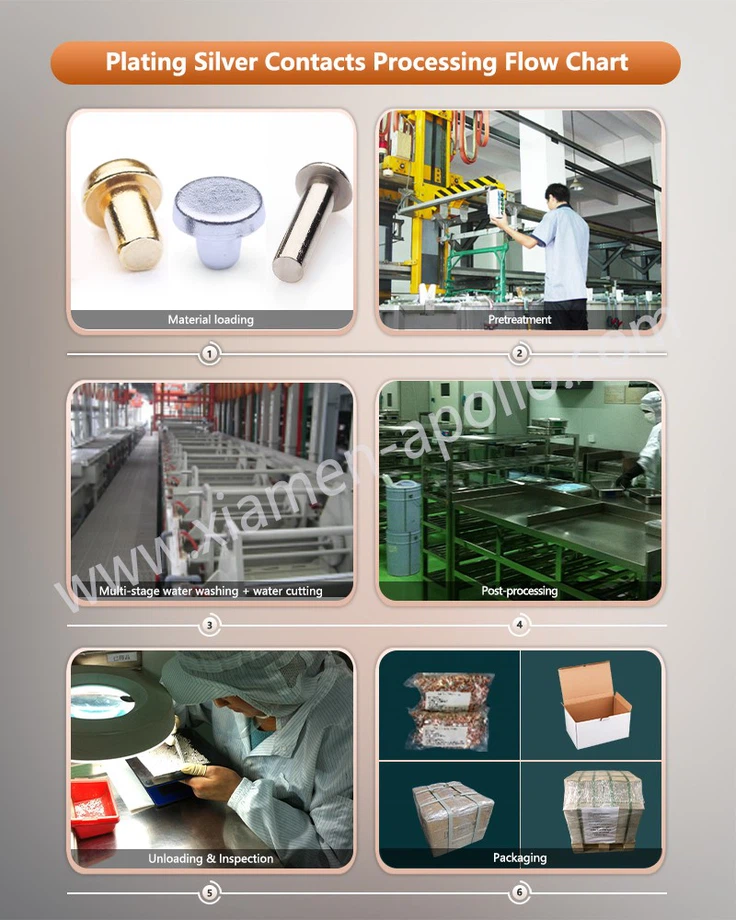
Cleaning, grinding, and annealing remove surface oil, oxides, and contaminants and relieve internal stress. Activation treatment improves bonding strength between the copper substrate and nickel layer to support subsequent electroplating, balancing process efficiency and production cost for nickel plating for electrical contacts.
3. Nickel Electroplating
Precision electroplating equipment processes electroless nickel plating rivets. Process parameters are tightly controlled to produce uniform, compact, blister‑free nickel deposits. Real‑time thickness monitoring prevents over‑plating to balance oxidation resistance and cost.
4. Coating inspection
Finished parts are inspected for plating thickness, adhesion, and surface quality. Defects including missing plating, blisters, and scratches are checked. Non‑conforming items are reworked or scrapped to verify coating oxidation‑resistance performance and maintain inspection efficiency.
Frequently Asked Questions about Nickel plating for electrical contacts
What load levels are Custom Nickel Plated Contacts suitable for?
+
-
These components are optimized for low‑to‑medium power control circuits, typically handling operational currents from 1A to 30A at voltages up to 250VAC/DC, where minimizing contact resistance and preventing base metal oxidation are critical for thermal management.
Can these Nickel Plated Electrical Contacts be used for main power circuits of switches?
+
-
While suitable for auxiliary circuits, control paths, and disconnect terminals, main power interrupting paths carrying high fault currents typically require specialized silver‑alloy tips or bimetal rivet weld assemblies to resist electric arc erosion.
How does the nickel plating affect the electrical conductivity of the copper substrate?
+
-
Although pure nickel has a lower electrical conductivity than copper (~25% IACS), the ultra‑thin 3–8μm coating introduces negligible skin‑effect resistance penalty while protecting the 100% IACS copper core from insulating oxide accumulation.
What tooling lead time is required for custom‑designed switch contact profiles?
+
-
Sample trial runs typically require 10 to 15 business days, followed by dimensional approval sampling before full‑scale volume manufacturing runs commence.
How do you prevent hydrogen embrittlement during the nickel electroplating process?
+
-
We utilize proprietary non‑embrittlement electroplating chemistry combined with immediate post‑plating thermal baking cycles for spring‑tempered copper alloys, relieving internal stress and eliminating hydrogen absorption risks.

contact us
If you are looking for an economical and reliable anti‑oxidation contact solution for low‑to‑medium load switches or general‑purpose relays, our Nickel Plated Copper Switch Contacts can be supported with material selection and coating design optimization by our engineering team. Please contact us for a customized quote and technical support.

Hot Tags: Nickel Plated Copper Switch Contacts, Nickel Plated Copper Contacts Manufacturer, Customized Nickel Contacts, China Nickel Plated Contacts Factory, Copper Electrical Contacts, Cold Headed Copper Contacts, Nickel Plating Electrical Contacts, Relay Moving Contacts, Nickel Plated Contact Rivets, Electroless Nickel Plating Rivets, Silver Plating Electrical Contacts, Silver Plated Contacts, Nickel Plated Contacts, Gold Plating Contacts, Contacts Silver Plated


