

Hex nuts are among the most basic and widely used fasteners in mechanical connections, typically used in conjunction with bolts or threaded rods. Through the axial preload generated during tightening and the friction of the contact surfaces, hex nuts reliably connect two or more components, ensuring the stability and safety of the structure under static or dynamic loads.
As a typical metal fastener, hex nuts play an irreplaceable role in construction engineering, machinery manufacturing, power equipment, rail transportation, and automated equipment.
Structurally, hex nuts are often called hexagonal nuts. Their regular hexagonal shape facilitates installation and removal using wrenches or sockets. Depending on different design standards and application scenarios, hex nuts can be further subdivided into several types.
For example, Standard Hex Nuts are the most common standard specification, suitable for most routine assembly needs; while Heavy Hex Nuts are thicker and have larger opposite flats, capable of withstanding higher preloads, and are often used in high-strength or heavy-duty structures. Finished Hex Nut typically refers to products with treated surfaces and high dimensional accuracy, suitable for applications requiring both aesthetics and assembly precision.

In terms of material selection, carbon steel, stainless steel, and alloy steel are the most commonly used categories. Among them, Stainless Steel Hex Nuts, due to their excellent corrosion resistance, are widely used in outdoor environments, chemical equipment, and food machinery. The related Stainless Steel Nuts for Screw Bolts emphasize their overall compatibility with bolt systems and long-term reliability.
For applications requiring both corrosion resistance and cost-effectiveness, Hot-Dip Galvanized Hex Nuts, through hot-dip galvanizing, form a protective layer on the surface, significantly improving weather resistance and service life.
With the diversification of engineering needs, hex nuts have gradually evolved into various functional products. Hex Lock Nuts and Prevailing Torque Nuts, through structural or material properties, generate continuous resistance after tightening, effectively preventing loosening caused by vibration.
Hex Jam Nuts and Jam Nuts are typically thinner and are often used in double-nut anti-loosening structures or in space-constrained locations. Hex Flange Nuts and Flange Nuts integrate a flange face on the bottom, increasing the stress area and reducing damage to the surfaces of the connected parts. Slotted nuts, with their slotted design and use with cotter pins, offer significant advantages in critical safety areas.
Besides hexagonal nuts, other nut shapes also play important roles in specific fields. Wing nuts can be installed by hand tightening, suitable for parts requiring frequent disassembly and assembly; Square nuts, due to their larger contact area, are often used in wooden structures or older machinery; Round nuts are commonly used for axial fixing of shaft parts; T-nuts and Cage nuts are widely used in profile frames, cabinets, and thin-plate structures, solving the problem of inaccessible back-side operation. Although these different types of nuts vary in appearance, their core function remains the same: to achieve a reliable connection when used with a metal screw or bolt.
In practical engineering, the performance of hexagonal nuts depends not only on their structure and materials but also on thread precision, surface condition, and installation process. Proper preload control can prevent failures caused by excessive looseness and prevent thread damage or fatigue failure caused by excessive tightness.
Therefore, when selecting Hex nuts and their variations, it is necessary to comprehensively consider load conditions, environmental factors, and assembly requirements.
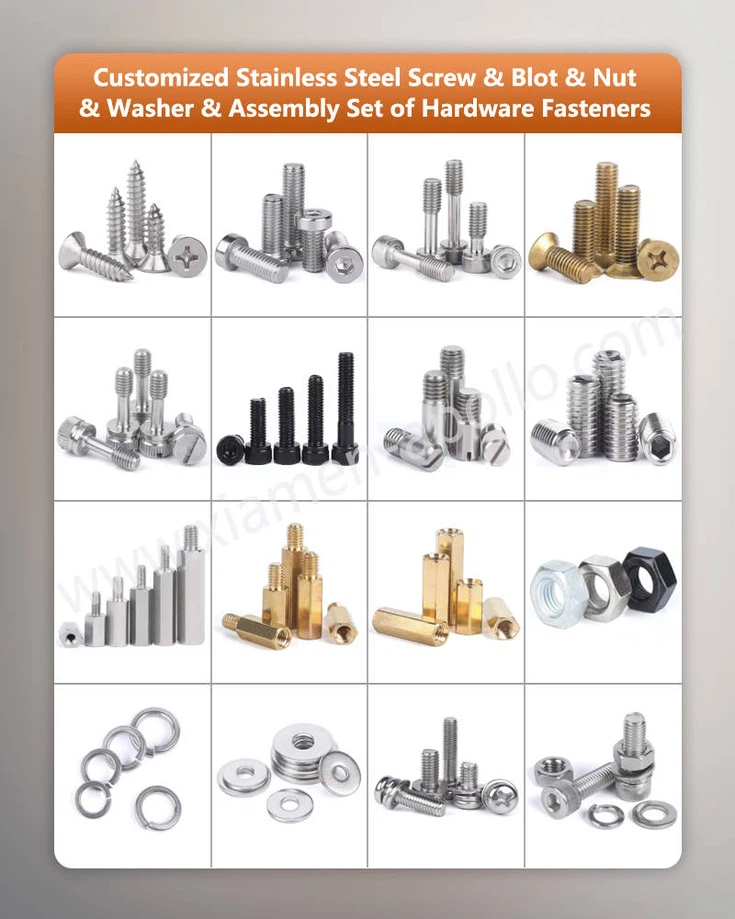
The correct selection and use of nuts is a rigorous applied science. Engineers must comprehensively evaluate the nature of the loads the connection will bear (static, dynamic, impact), the operating environment (temperature, corrosiveness), assembly conditions (space, wrench accessibility), and anti-loosening requirements.
For example, in connections requiring frequent adjustments but not allowing complete disengagement, the combination of Hex Lock Nuts or Hex Jam Nuts is a classic solution. In pipe flanges or thin-plate connections requiring pressure distribution, Flange Nuts with integrated washers provide more even clamping force.
In short, from the most common Standard Hex Nut to Hex Lock Nuts with special locking functions, and then to various shapes such as Square Nuts and T-Nuts, the world of nuts embodies both the versatility and interchangeability brought by standardization, and the diversity and specialization born to meet specific needs.
Behind their design and application lies a deep integration of materials mechanics, mechanical principles, and engineering practice. Understanding the characteristics of each type of nut and applying it precisely to the appropriate scenario is an indispensable part of ensuring the long-term safe and stable operation of every mechanical connection and the entire structural system.
contact us
