


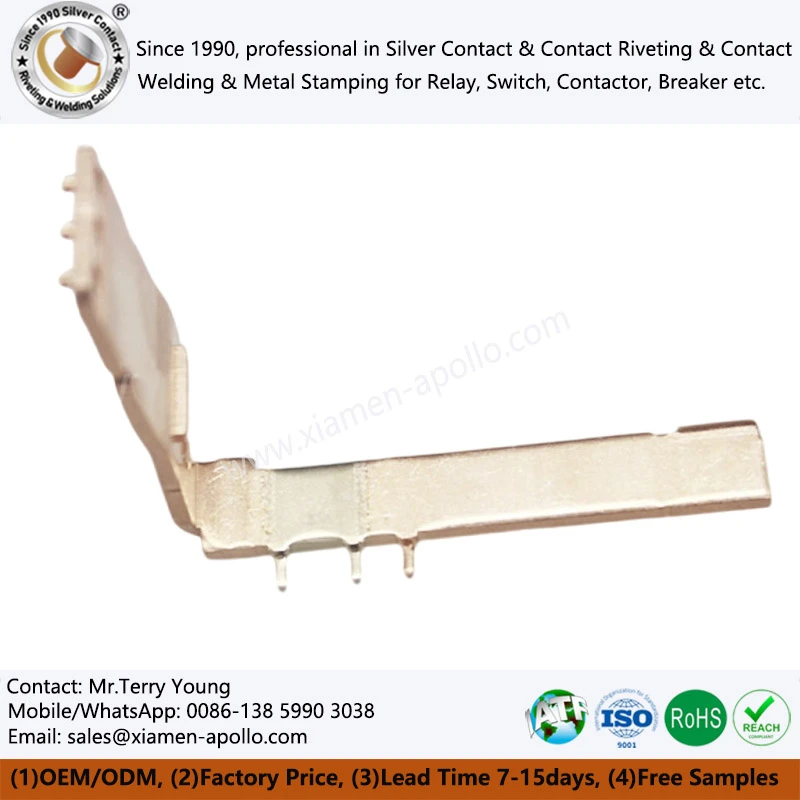

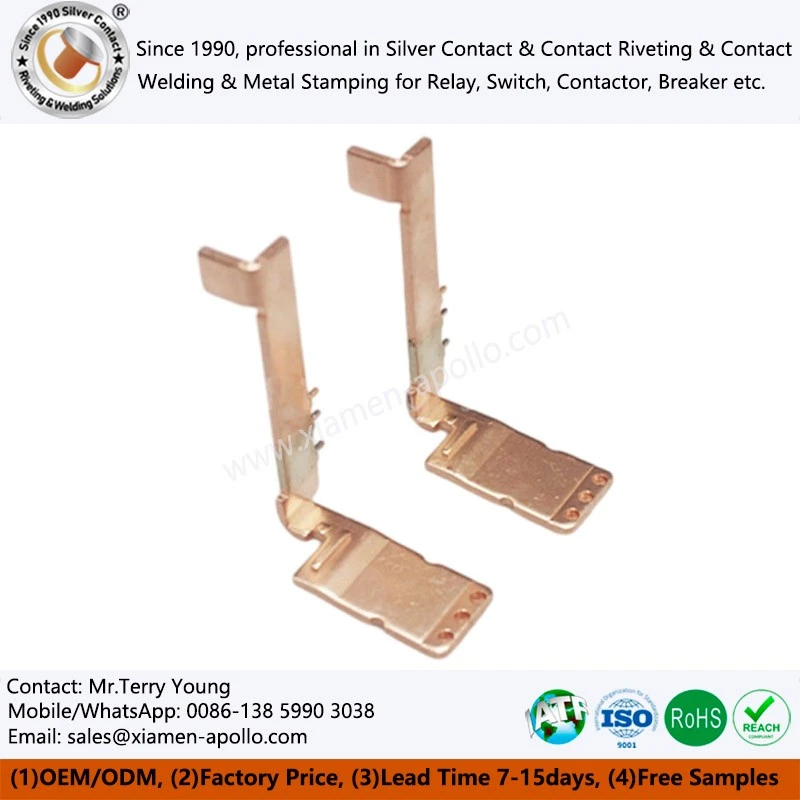


What is the Manganin Copper Shunt?

In modern smart grid meters and heavy-duty magnetic latching relays, internal current sensing requires components that deliver exceptional stability under continuous thermal stress. Generic copper components often suffer from severe thermal drift, resulting in inaccurate energy metering and erratic relay tripping thresholds. As an experienced direct manufacturer, we engineer precision-stamped manganin copper shunts designed specifically for high-reliability electrical switching environments. Utilizing advanced progressive die stamping and strict metallurgical calibration, our components provide electrical engineers with stable resistance values, minimal power loss, and robust mechanical integration for seamless automated PCB assembly.
Key Specifications Of Electronics Energy Meter
| Technical Dimension | Specification Parameter |
|---|---|
| Resistivity | 0.48 × 10⁻⁶ Ω·m (Manganin zone) |
| Temperature Coefficient (TCR) | ±20 × 10⁻⁶/K (Operating range) |
| Tensile Strength | > 450 MPa |
| Dimensional Tolerance | ±0.02 mm (Stamping & Bending) |

Stamping Manufacturing Process of Shunt Copper for Energy Meter
Material Grade Selection (6J13 Manganin Alloy)
We utilize certified 6J13 manganese‑copper‑nickel alloy strip stock paired with electrolytic tough pitch (ETP) copper for Maganin Copper Shunt for Electronics Energy Meter. This combination ensures high mechanical ductility for forming operations while maintaining exceptional electrical stability across fluctuating ambient temperatures.
Precision Stamping & Tolerance Control
Our automated progressive stamping lines integrate multi‑station bending, piercing, and coining dies for the Shunt Resistor of Electricity Meter. This setup shapes complex multi‑step geometries in a single pass, eliminating secondary handling errors and holding critical mounting hole pitches within ±0.02 mm.
Calibration & Batch‑wise Performance Testing
Every production lot of Shunt Copper for Energy Meter undergoes automated 4‑wire resistance measurement and thermal aging treatment. This internal stress relief stabilizes the crystalline structure, preventing post‑stamping resistance drift during long‑term field deployment.

Frequently Asked Questions about Manganese Copper Resistance Shunt
What material is normally used for a Manganese Copper Resistance Shunt?
+
-
6J13 Manganin is used as the resistance element, while copper provides the conductive sections. 6J13 is a Cu-Mn-Ni resistance alloy with volume resistivity around 0.44 μΩ·m. The final alloy condition and copper grade should be confirmed against the approved material specification before production.
Why is Manganin used instead of pure copper for the sensing section of the Manganin Shunt Resistor Shunt?
+
-
Pure copper has very low resistance, making a compact current-sensing element difficult to measure accurately. 6J13 Manganin provides substantially higher resistivity and controlled resistance-temperature behavior, allowing the sensing section to generate a measurable voltage while copper handles the low-resistance current path.
How is the resistance value controlled during stamping production?
+
-
Resistance depends on Manganin resistivity, strip thickness, sensing-section width, and effective current-path length. After stamping, finished parts are electrically measured and compared with the specified resistance. Calibration and batch inspection help identify dimensional or material variation before shipment.
Does stamping change the resistance of a Maganin Shunt for Electronics Meter?
+
-
Forming can influence electrical and mechanical characteristics through dimensional changes and work hardening. For this reason, resistance should be verified after stamping rather than calculated only from incoming strip data. Final inspection should use the same measurement method and temperature defined in the product specification.
How is resistance stability checked between production batches?
+
-
Batch control should compare measured resistance against the approved nominal value and tolerance using a defined test method. Where required by the application, thermal cycling and load testing can also be incorporated.

contact us
Request a technical quotation for a customized Manganin Copper Shunt with your drawing, sample, or electrical specification.

Hot Tags: Manganin Copper Shunt, 6J13 Manganin Shunt, Manganin Shunt Resistor, Latching Relay Shunt, Relay Current Shunt, Manganese Copper Shunt, Custom Shunt Resistor, Stamped Manganin Shunt, Copper Manganin Shunt Manufacturer, China Manganin Shunt Factory, Copper Manganin Shunt Resistor for Latching Relay, Electric Meters Manganin Shunt, ETP Copper Shunt Terminal For Power Magnetic Latching Relay, Latching Relay Manganin Shunt, Magnetic Shunt for Latching Relay, Prepayment Meter Shunts


