

H62 and H65 brass feature balanced strength, excellent processability and reliable electrical conductivity, widely adopted for manufacturing Precision Brass Stamping Parts. H62 delivers high strength and cost advantages for structural components, while H65 provides superior ductility and bright surface finish suitable for deep drawing and cold forging. These two grades cover most forming requirements for precision metal processing.

Why H62 and H65 Brass Are Widely Used for Electrical Brass Terminal Contact Accessories
For electronic connectors, precision fasteners, bathroom hardware, clock components, contact springs, and other metal products, material formability, dimensional stability, surface quality and electrical performance directly affect finished part accuracy. Pure copper is soft and prone to deformation, while stainless steel brings high processing difficulty. Brass stands out with moderate strength, great cold workability, attractive appearance and stable conductivity, making it a preferred alloy for producing Stamped Brass Brackets.
Among standard brasses, H62 and H65 are the most widely applied grades. H62 offers high mechanical strength and economical pricing for structural components and basic forming work. H65 has better ductility and a cleaner surface, fitting deep drawing, cold forging and other precision forming operations. The two grades complement each other and satisfy most production demands for precision brass stamping.
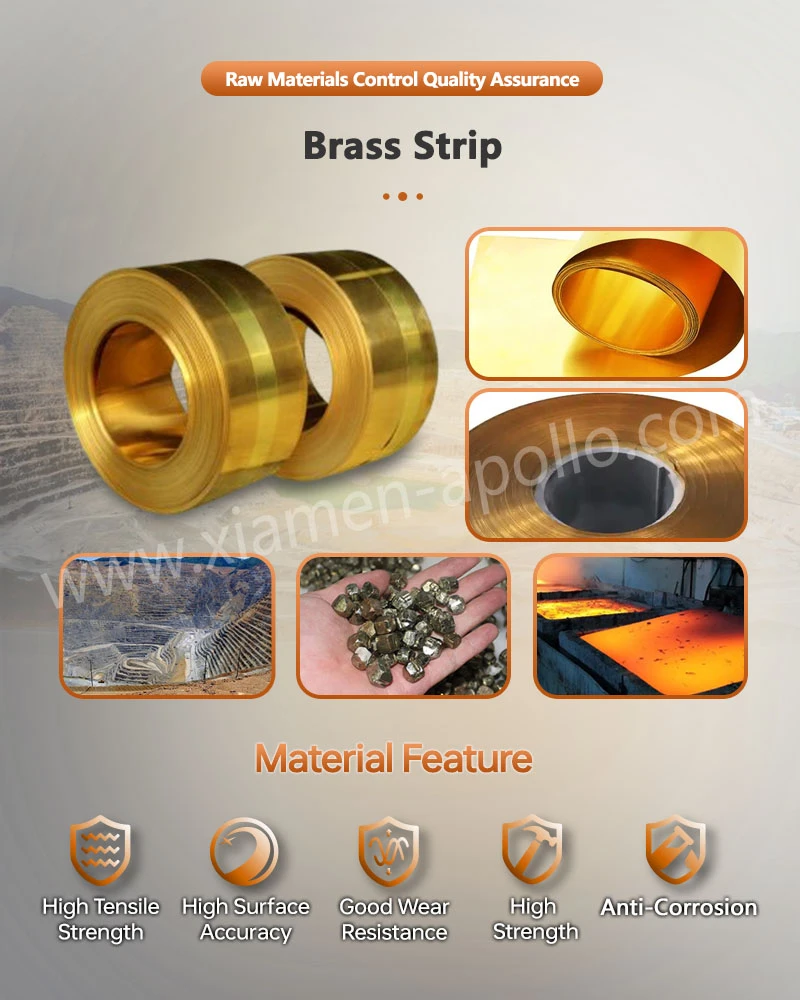
Grade Definition & Cross-Standard Equivalents
Chinese brass grades follow the naming format "H + numeric value".
- "H" stands for brass in Chinese nomenclature
- The number refers to the average copper mass percentage
H62: ordinary brass with roughly 62% copper content H65: ordinary brass with roughly 65% copper content
| China GB | US ASTM | Japan JIS | Europe EN | Germany DIN | Description |
|---|---|---|---|---|---|
| H62 | C28000 | C2800 | CuZn40 | 2.0360 | 62 brass, high strength |
| H65 | C26800 | C2680 | CuZn35 | 2.0335 | 65 brass, good ductility |
| H68 | C26200 | C2620 | CuZn30 | 2.0280 | 68 brass, for deep drawing |
| H70 | C26000 | C2600 | CuZn30 | 2.0265 | 70 brass, for spring components |
Chemical Composition
H62 Brass Chemical Composition (wt%)
| Element | Content Range | Function Note |
|---|---|---|
| Cu | 60.5 - 63.5% | Matrix element, governs conductivity, corrosion resistance and surface appearance |
| Zn | Remainder (36.5-39.5%) | Primary alloying element to raise strength and hardness |
| Pb | ≤ 0.08% | Impurity, improves machinability with controlled limit |
| Fe | ≤ 0.15% | Impurity; excessive content reduces corrosion resistance |
| Sb | ≤ 0.005% | Harmful impurity with strict control |
| Bi | ≤ 0.002% | Harmful impurity with strict control |
| P | ≤ 0.01% | Impurity, deoxidizing element |
| Total Impurities | ≤ 0.5% | - |
H65 Brass Chemical Composition (wt%)
| Element | Content Range | Function Note |
|---|---|---|
| Cu | 63.5 - 68.5% | Matrix element; higher copper content brings better ductility |
| Zn | Remainder (31.5-36.5%) | Primary alloying element for strength |
| Pb | ≤ 0.05% | Impurity; tighter limits for precision applications |
| Fe | ≤ 0.10% | Impurity with stricter specification |
| Sb | ≤ 0.005% | Harmful impurity with strict control |
| Bi | ≤ 0.002% | Harmful impurity with strict control |
| P | ≤ 0.01% | Impurity, deoxidizing element |
| Total Impurities | ≤ 0.3% | - |
The core difference between H62 and H65 lies in copper content, which differentiates their mechanical performance and application scope.
- Higher copper content: better ductility, brighter surface, higher conductivity, higher material cost
- Higher zinc content: higher strength and hardness, lower cost, slightly weaker corrosion resistance
From a metallographic perspective, H65 sits close to single-phase α brass, delivering outstanding cold forming ductility. H62 has higher zinc content near the α+β two-phase boundary, with greater strength yet slightly poorer cold forming performance.

Recommended Applications
Recommended Applications for H65
- Deep drawing & stretching parts: housings, covers, cup-shaped components, low cracking risk during forming
- Cold-forged fasteners: screws, rivets, reduced splitting on formed heads
- Complex stamped components for progressive dies
- Parts requiring polishing or plating for decorative finish
- Spring contact components with stable fatigue performance
- Electrical Switch Socket Brass Copper Terminals and conductive sheets requiring good electrical performance
Recommended Applications for H62
- Machined parts: bushings, joints, valve fittings with good cutting property
- Load-bearing structural parts requiring higher strength
- Cost-sensitive production batches
- Simple-shape stamped parts with small forming deformation
- Components needing moderate wear resistance
Material selection directly affects yield and service life when manufacturing Multi-Bend Brass Stamping Terminal. Engineers should match brass grades according to forming method, mechanical load, conductivity requirement and surface treatment plan. Proper grade selection stabilizes quality and controls total production cost for the parts.

contact us
Share your drawings and technical specs today for fast sample validation and factory pricing of Precision Brass Stamping Parts backed by our in-house mold making and full-process quality inspection.
