

The evolution of CNC machining technology has significantly expanded the boundaries of what is possible in the structural machining of precision parts, accommodating complex forming requirements for materials ranging from metals to plastics. Undercuts-specialized recessed features-are common elements in the design and manufacture of precision components. Mastering brass CNC machining involves not only standard planar and contoured machining but also the capability to precisely machine undercut structures in brass; this expertise is fundamental to producing high-quality, complex-shaped precision parts. Due to their lateral recesses-which prevent standard cutting tools from directly accessing the machining zone-undercuts are far more challenging to machine than standard features, requiring specialized tooling and customized processes to ensure dimensional accuracy and structural integrity.
Undercuts are a classic example of "hidden" structural features in machining, specifically referring to recessed, sunken, or laterally inward-curving geometries on a workpiece surface that cannot be cut directly by standard tools like conventional end mills. When machining brass parts with undercuts, the process must account for the material's relative softness and susceptibility to deformation by optimizing cutting parameters and tool paths to prevent defects such as edge chipping, warping, and dimensional inaccuracies. Because these features cannot be formed via standard direct cutting, they require specialized, non-standard tooling and optimized process logic-factors that make undercut machining significantly more complex and demanding in terms of precision control compared to standard machining operations.
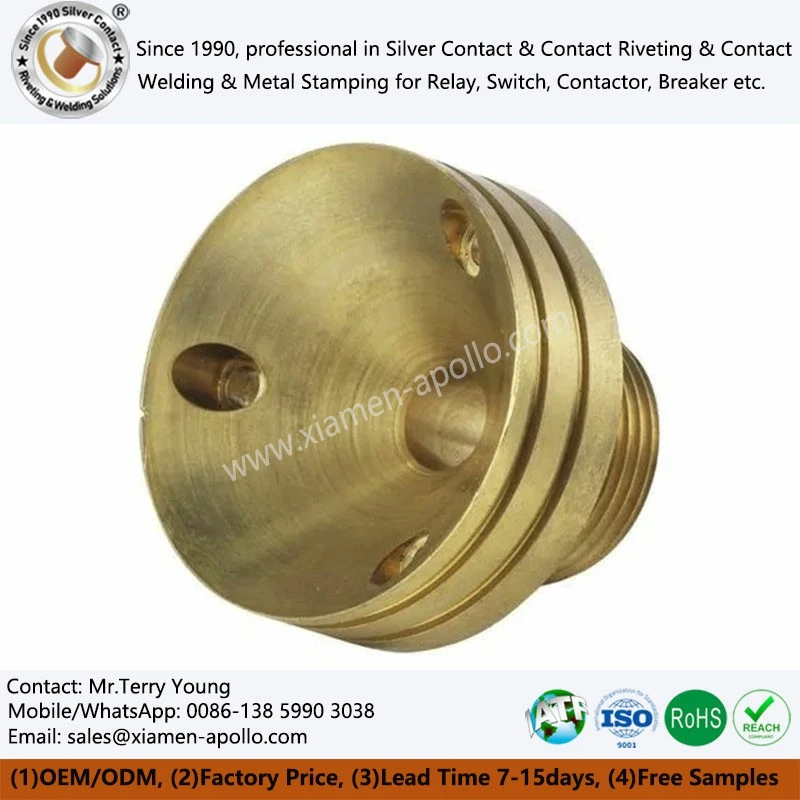
Undercutting methods vary significantly depending on the CNC machining process; the two mainstream categories-CNC turning undercuts and CNC milling undercuts-are suited to different structural designs for brass CNC parts. CNC turning undercuts are typically applied to shaft-like or threaded components, specifically at the internal diameter. Industry standards dictate that undercut dimensions (length and diameter) must align with thread parameters and provide adequate tool retraction clearance, making them ideal for machining transition structures at the ends of threads. In contrast, CNC milling undercuts are used for complex cavities and recessed side structures; these require the tool to engage the material laterally or from the rear, overcoming the limitations of conventional vertical spindle cutting.
Complex lateral and recessed undercut structures are critical design features that enable interlocking assemblies, embedded installations, and functional connections in brass CNC-machined parts. Turning undercuts primarily support threaded connections and shaft positioning components; precise internal recess designs optimize cutting clearance and improve the fit of threaded assemblies. Milling undercuts facilitate the creation of specialized features such as T-slots, dovetail slots, and single-sided blind cuts. Widely used in embedded precision equipment components, side ports for electronics, and irregular connectors, these undercuts balance part functionality with assembly compatibility.
Given the specific properties of brass, machining undercuts requires specialized tooling rather than conventional cutting tools. The primary tools used are slot mills and lollipop mills; both feature a design with a narrow shank and a wide cutting head, allowing them to reach deep into recesses to perform cutting operations. Slot mills, with their flat tips, are suited for machining standard right-angled undercuts. Lollipop mills, featuring smooth, arc-shaped tips, are better suited for curved or contoured undercuts and can simultaneously handle edge deburring and precision trimming, perfectly meeting the machining requirements for precision brass components.
The use of specialized tooling enables a variety of high-precision undercut machining processes, satisfying the structural design requirements of diverse precision brass components. Mainstream cutting methods in the industry include T-slot cutting, dovetail slot cutting, and single-sided blind cutting, with each process corresponding to a specific type of undercut geometry. T-slot cutting utilizes a combination of a horizontal flat cutter and a vertical tool shank to form a standard T-shaped undercut; dovetail slot cutting employs 45-degree or 60-degree inclined cutters to machine trapezoidal undercuts that are narrower at the top and wider at the bottom; and single-sided blind cutting enables the machining of asymmetrical lateral recesses, meeting the customization requirements for non-standard, complex-shaped parts.

To ensure efficiency and high yield rates in the fast CNC machining of brass parts, undercut machining requires adherence to standardized operational techniques to avoid process errors. During the design phase, undercut structures should be simplified-minimizing complex, deep recessed geometries and avoiding over-reliance on custom tooling-to reduce costs and lead times. Prioritizing standard-sized undercut features eliminates the need for non-standard custom tools, significantly boosting batch processing efficiency, meeting mass production demands, and balancing machining precision with production costs.
Precise control of cutting parameters is crucial for ensuring the accuracy of undercut structures in machined brass parts. Given the high ductility and deformation-prone nature of brass, undercut machining requires a shallow, multi-pass cutting strategy; strictly controlling the depth of cut per pass prevents tool overload and excessive pressure, which could otherwise cause workpiece deformation or rough surface finishes. Additionally, sufficient clearance must be maintained to accommodate lateral and back-cutting tool paths, preventing issues such as over-cutting or residual burrs, thereby ensuring dimensional consistency and smooth surfaces for the undercut features.
Expertise in process coordination and quality control represents the core strength of a high-quality brass parts manufacturer. Forming complex undercut structures is challenging; deviations in parameter matching, tool selection, or toolpath design can lead to scrapped parts. A skilled machining team tailors specific processing strategies based on brass material properties, undercut geometry, and the part's intended operating conditions, precisely controlling every cutting step to guarantee the precision and stability of complex undercut components.

Although snap-fit structures present greater manufacturing challenges, they offer irreplaceable value in industrial precision components. They enable specialized functions such as interlocking assemblies, embedded mounting, and secure, anti-detachment connections, finding wide application in fields ranging from electronic devices and medical components to hydraulic piping and precision connectors. Effectively utilizing snap-fit manufacturing processes-while balancing design practicality with production feasibility-is key to enhancing the compatibility and market competitiveness of brass turned parts.
If you require custom brass CNC turned parts, process optimization, or consultation on specification matching, please feel free to contact us. Leveraging our mature manufacturing expertise, we provide high-precision, cost-effective CNC machining solutions tailored to your needs.
contact us
