

In the maintenance of industrial electrical systems, machining equipment, and control cabinets, three main types of faults are most common: contactor faults, voltage circuit breaker faults, and thermal relay faults. These faults not only affect equipment operating efficiency but can also damage critical components such as Spring Electrical Contacts, Contactor Contacts, and Electric Contacts. The following is a systematic overview from a professional perspective.
Common Contactor Faults and Troubleshooting Methods
Contactors are the core components controlling the start and stop of motors. Their contact structures often use materials such as Electrical Silver Contacts, Silver Nickel Electrical Contacts for Contactors, and Silver Electrical Contact Rivets. Therefore, any poor contact can cause systemic failures.
1. Phase Loss in Contacts
Symptoms:
The motor runs with one phase lost but still rotates.
A heavy humming sound is emitted.
Current imbalance.
Causes:
Poor contact at the contacts.
Loose terminal screws.
Contact oxidation or wear (related to aging of silver electrical contacts or Electrical Contact Points).
Solutions:
Stop the machine immediately.
Tighten the terminal screws.
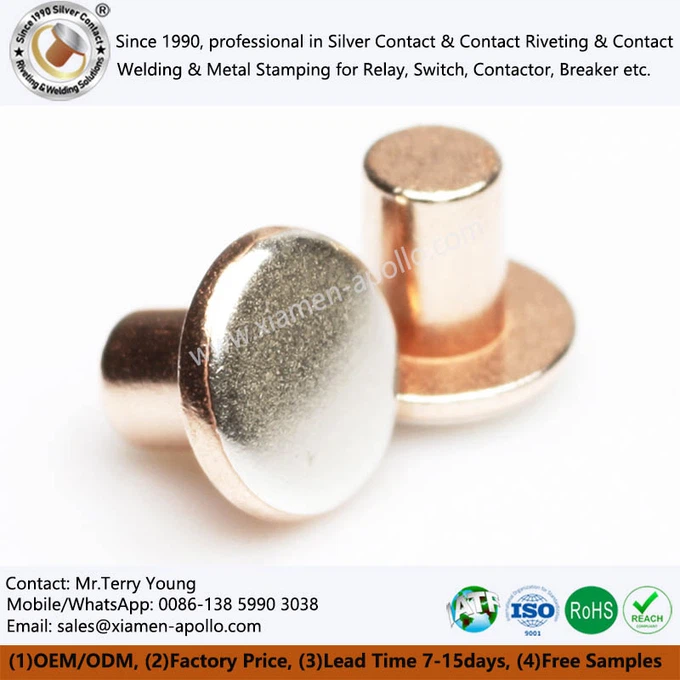
Inspect and replace the contacts (using Composite Rivet Contacts or Bi-metal Contact Point Rivets for Switches).
2. Contact Welding
Symptoms:
The motor continues to run after the stop button is pressed.
The contactor cannot disconnect.
A humming sound or a slight burning smell is heard.
Causes:
Overload current causes contact welding.
Contact material fatigue (e.g., long-term overcurrent carrying of Spring Loaded Electrical Contacts or Electric Contacts).
Solutions:
Disconnect the power immediately.
Check for abnormal loads.
Replace the contactor or contact assembly (e.g., Cu AgSnO2 Bimetal Silver Contact Rivets).
3. Armature fails to engage when the coil is energized
Symptoms:
No engaging sound
Contactor remains stationary
No vibration or noise
Causes:
Coil open circuit
Armature mechanical jamming
Decreased precision of cold-formed parts (involving the application of Cold Forming Metal and Cold Forming Technology in contact structure components)
Solutions:
Correct the armature movement mechanism
Rewind the coil according to the original parameters and impregnate and dry it
Check for abnormal wear of mating parts

Typical Faults and Troubleshooting Guidelines for Voltage Circuit Breakers
Circuit breakers are often equipped with Silver Contacts In Breakers or Silver Alloy Rotating Electric Contactors to improve conductivity and arc resistance. Faults are often related to mechanical pressure, contact position, and thermal effects.
1. Overheating of Contacts
Symptoms:
Burning smell
Significant temperature rise of contacts
Localized hot spots appear inside the control cabinet
Causes:
The moving contact is not fully inserted into the stationary contact
Insufficient contact pressure
Oxidation of silver contact surface (Electrical Silver Contacts and Silver Contacts in Breakers require regular maintenance)
Solutions:
Adjust the operating mechanism to ensure the moving contact is fully inserted into the stationary contact
Check contact pressure
Clean or replace the contact assembly
2. Arcing and Popping During Power-On
Symptoms:
An obvious electric arc
Instantaneous popping sound of the switch
Difficulty starting the load
Causes:
Prolonged excessive load
Loose contacts are causing increased contact resistance
Intensified arc erosion (related to performance degradation of Electric Contacts and Spring Electrical Contacts)
Solutions:
Inspection must be performed after the power is off
Replace worn contacts (e.g., Custom Electric Bimetal Rivet)
Ensure no-load power-on is normal before applying a load.
Common Faults and Adjustment Methods of Thermal Relays
The thermal relay is responsible for motor overload protection. Its internal structure is often equipped with highly sensitive materials such as silver electrical contacts, electric contacts, and precision spring components.
1. Thermal Element Burnout
Symptoms:
The motor cannot start
Obvious humming sound
Frequent operation
Causes:
The thermal relay operating frequency is too high
Downstream overload
Setting the value too low
Solutions:
Replace the thermal relay
Readjust the current setting
Check for abnormal motor load
2. Thermal Relay "False Trip"
Causes include:
The setting value is too low
Motor starting time is too long
Operating frequency too high, thermal element is frequently subjected to impact
Solutions:
Increase the setting value
Check the motor starting method (e.g., starting delay)
Replace with a more suitable thermal relay or contact (e.g., Silver Cadmium Oxide Electrical Contact Rivet) if necessary
3. Thermal Relay "Not Tripping"
Causes:
Setting the value too high
Bimetallic strip fatigue
Contact not reset
Abnormal current not detected
Solutions:
Reset the setting value according to the load current
Regularly check the operating sensitivity
Reset after the bimetallic strip cools down
Check if Are electrical contact points, contact springs, etc., are deformed due to metal cold forming (or cold forming of metals)?
Professional Inspection Methods for Contact Components
Contact components are widely used in slip ring contacts, spring electrical contacts, electrical fittings, bi-metal silver contact points, and other devices. Their reliability directly affects the entire system.
1. Inspect Contact Oxidation and Contamination
Silver contact oxide layers generally remain conductive and do not require treatment.
Copper contact oxide requires light filing; do not use sandpaper (to avoid embedded sand particles causing poor contact).
2. Repairing Burns or Scorching
Minor scorching of copper contacts can be repaired.
Minor burning of silver contacts usually does not affect performance.
Severe welding should result in complete replacement (Electrical Bi-metal Contact Rivets, Composite Rivet Contacts are options).
3. Checking Contact Pressure
Use the "paper strip method" to determine if the initial and final pressures are appropriate:
Initial pressure: The paper strip should be compressed but can be pulled out.
Final pressure: In high-capacity electrical appliances, a slight tear when the paper strip is pulled out is ideal.
Insufficient contact pressure may lead to contact vibration, increased arcing, and reduced electrical life.
Causes and Prevention of Single-Phase Operation of Motors
1. Fuse Blowing
(1) Non-fault-related fuse blowing
Causes:
Insufficient fuse capacity
The starting current surge is causing the fuse to blow
Solution:
Select the correct fuse according to the motor load
Fuses are not overload protection tools; only used for short-circuit protection
(2) Fault-related fuse blowing
Causes:
Single-phase grounding in the main circuit
Phase-to-phase short circuit
Prevention:
Select motors and low-voltage electrical appliances suitable for the environment
Strengthen inspection and daily maintenance
2. Method for selecting fuse capacity
Common formula: Rated fuse current = K × Motor Rated Current
Fuses with small heat resistance capacity: K=4~6
Fuses with large heat resistance capacity: K=1.5~2.5
Precautions:
The fuse element and fuse holder must have good contact.
Wiring should be appropriate, and spring washers should be added.
Copper-aluminum connections require copper-aluminum transition joints.
For large-capacity plug-in fuses, a thin copper strip can be added to improve contact reliability.
Conclusion
The above content covers the three most common core faults and troubleshooting techniques in practical electrical work, and provides professional explanations based on the characteristics of key components such as Spring Loaded Electrical Contacts, Electric Contacts, Cold Forming Technology, and Silver Contacts in Breakers.

contact us
