

Energy Efficiency Innovation Needs
In industrial applications, Cold Forging Relay Core is widely used for electrical control, and its energy consumption has long been a concern. With rising energy costs and increasing environmental regulations, industrial contractors demand higher energy efficiency from Relay Pin. New-generation contactor relays must significantly reduce coil power consumption by 10 to 15 times compared to traditional models. This requires cores to generate sufficient magnetic force at lower currents to drive contactor operation.
Additionally, industrial contactors must operate stably across a wide voltage range, typically 70% to 130% of the rated voltage (US). This imposes higher demands on the Relay Pin's magnetic properties, requiring stable magnetism under varying voltages to avoid saturation or insufficient magnetic force.

Noise Control Requirements
In industrial environments, noise pollution is a significant concern. During operation, collisions and vibrations between the Cold Forging Relay Core and armature generate noise, affecting workplace conditions and operator health. Thus, noise reduction in relay cores has become a critical requirement for industrial contactors.
Optimizing the lamination process of silicon steel sheets and magnetic gap design can effectively reduce vibration and noise. A well-designed lamination process ensures tighter bonding between sheets, minimizing vibration, while optimized gap design allows smoother engagement between the Soft Magnetic Iron Cores for Relay and armature, reducing impact noise.
Miniaturization and Integration Needs
With the advancement of industrial automation, there is a growing demand for compact and integrated electrical equipment. Industrial contractors must deliver more functionality in limited space, requiring smaller Soft Magnetic Iron Cores for the Relay with equal or better performance.
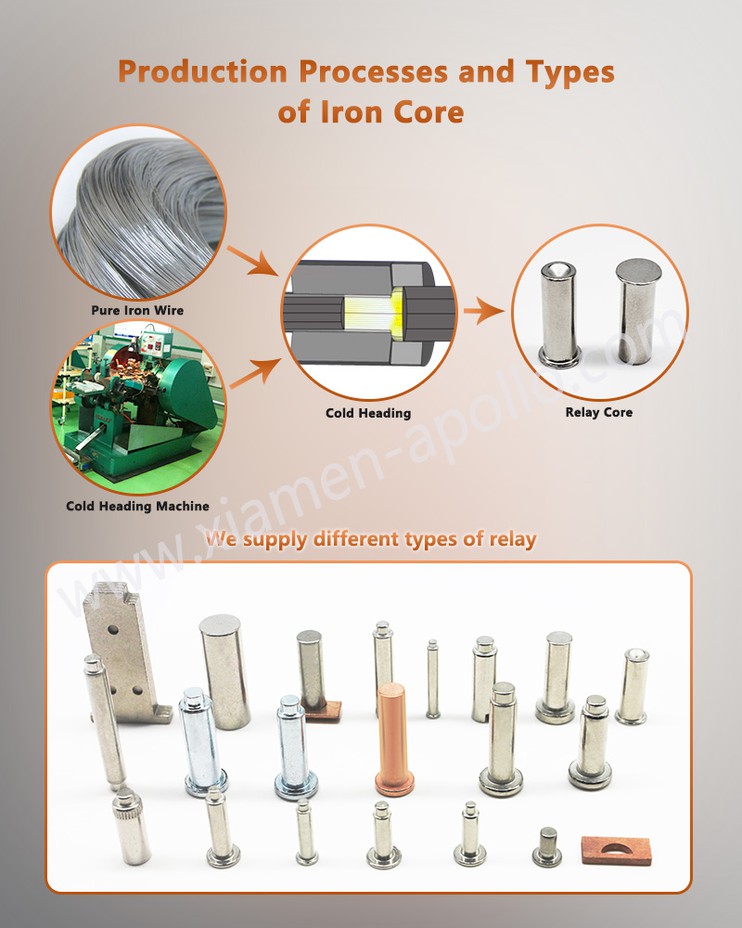
Some modern industrial contactors feature three-pole main contact designs, necessitating cores that achieve comparable or superior performance in smaller sizes. By optimizing DT4C Relay Iron core Cold forging structure and materials, and reducing volume and weight, manufacturers can meet miniaturization demands while lowering production costs and enhancing competitiveness.

Technological Trends
To address these needs, industrial contractors are shifting toward advanced materials and optimized designs for Cold Forging Relay Cores. Nanocrystalline alloy cores, with their high permeability and low coercivity, can generate strong magnetic force in compact sizes while reducing energy consumption and noise, making them increasingly popular with high-end contractors.
Contact Us
