

Cold heading and extrusion constitute a core branch of precision plastic bulk forming technology. Widely applied in the mass production of components such as fasteners, precision hardware, and electrical connectors, this technique stands as one of the pivotal processes within the realm of modern precision manufacturing. The entire process involves the plastic deformation of metal at ambient temperature; a metal blank is placed into the cavity of a specialized die and, driven by high-pressure, high-velocity external forces, is compelled to undergo controlled plastic flow. This results in the formation of finished workpieces characterized by precise dimensions and superior performance. The technique is frequently employed to manufacture various precision screw terminal accessories-such as Terminal Block Hand Screws-thereby meeting the high-precision production demands associated with a wide array of electrical connection components.
In terms of fundamental forming principles, cold heading and extrusion processing distinguishes itself from traditional cutting operations; it requires no removal of the base metal material, relying instead entirely on the die structure to precisely govern the trajectory of metal flow. Part formation is achieved through the transfer and reshaping of the metal's entire volume, yielding workpieces of exceptional dimensional accuracy and structural integrity. In the production of fasteners and precision terminal products, the forming process is rarely limited to a singular upsetting deformation; rather, it integrates a variety of plastic deformation modes-including forward extrusion, backward extrusion, compound extrusion, punching/shearing, and rolling. This combination of multi-dimensional deformations enables the efficient formation of workpieces with complex geometries, thereby fulfilling the requirements for the standardized, mass-scale production of components such as Pre-Fitted Screw Terminal Clamps.
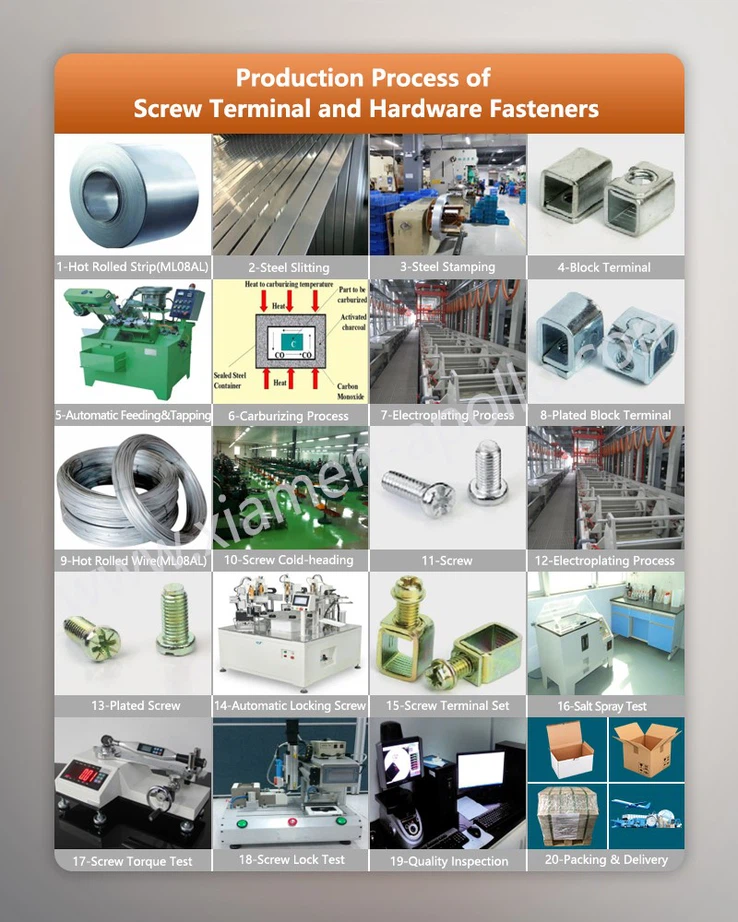
As an advanced plastic forming process characterized by high precision, high efficiency, and low energy consumption, cold heading and extrusion technology holds a dominant position in the mass production of small-to-medium-sized forgings and precision hardware components. Compared to traditional cutting and forging processes, it offers multiple core advantages. Relying on the plastic deformation of metals, this process significantly reduces material loss from cutting-achieving material utilization rates exceeding 80%-thereby effectively mitigating raw material waste. Furthermore, thanks to its exceptional forming stability, it enables the mass production of standardized electrical connection accessories, such as Electrical Connection Cage Clamps with Screws.
A substantial increase in production efficiency is a standout advantage of the cold heading and extrusion process. Compared to traditional cutting methods, production efficiency can be boosted anywhere from several-fold to a hundred-fold, making it perfectly suited for the demands of large-scale industrial mass production. Concurrently, workpieces formed via this process exhibit extremely high dimensional accuracy and surface quality; finished product precision can reach IT7–IT8 grades, with surface roughness controlled within the R0.2–R0.6 range. Most workpieces require no secondary precision cutting, while only products intended for high-end applications may require simple precision grinding, thereby meeting the high-precision assembly standards required for components such as Contactor Screw Wire Clamp Terminals.
The cold heading and extrusion process effectively optimizes the mechanical properties of components. Through the effects of cold work hardening, the internal metal grain flow lines within the workpiece are distributed more optimally, significantly enhancing the overall structural strength of the part-far exceeding the baseline strength of the raw material. Additionally, the processing induces compressive stress on the part's surface, notably improving the product's fatigue resistance. For certain components, subsequent heat treatment steps can be eliminated; furthermore, lower-strength base materials can often be substituted for high-grade steels during production, thereby reducing material costs while maintaining quality-a capability that meets the requirements for the long-term, stable operation of components such as Fuse Holder Screw Clamp Terminals.
This process possesses exceptional capability for forming complex structures. It can effortlessly shape components featuring special geometries-such as irregular cross-sections, enclosed internal cavities, integrated gear slots, and concealed internal grooves-that are difficult to produce using traditional cutting methods, thereby vastly expanding the boundaries of precision component design and manufacturing. Leveraging its inherent characteristics of integrated plastic forming, the resulting workpieces exhibit high structural integrity and stability, avoiding the defects and flaws often associated with multi-part assembly or segmented processing. This ensures the consistent production of complex-structured terminal accessories-such as Galvanized Steel Screw Terminal Clamps-that are compatible with a wide variety of electrical equipment.

By combining multiple advantages-including material utilization, production efficiency, processing techniques, and material selection-the cold heading and extrusion process can significantly reduce the overall production costs of components. The cumulative benefits of enhanced raw material utilization, doubled production efficiency, streamlined secondary processing steps, and the substitution of premium base materials with standard alternatives result in a substantial optimization of mass-production costs for precision hardware and electrical terminal products. Consequently, this method has emerged as a highly cost-effective and mainstream process within the field of industrial precision forming, widely utilized for the large-scale production of common electrical accessories such as Cage Clamp Screw Terminals.
If you would like to learn more about selecting the appropriate cold heading and extrusion process, or require customized processing and production solutions for Contactor Screw Wire Clamp Terminals, please feel free to contact us at any time. Our professional team is ready to provide you with precise technical expertise and practical, implementable solutions.
contact us
