Introduction: The Strategic Value of Bimetallic Silver Contacts
Against the backdrop of accelerated iteration of global electrical connection technologies by 2025, Bimetallic Silver Contacts, as a key branch of Precision Electrical Contacts, are profoundly impacting the development of new energy vehicles, the low-altitude economy, and AI computing infrastructure. This composite contact, which metallurgically combines silver alloys with a copper matrix, retains the excellent conductivity of Silver Electrical Contacts while also possessing the cost advantages and mechanical strength of copper, making it an irreplaceable core component in high-end switches, relays, controllers, and other equipment. This article systematically analyses the technical principles, manufacturing processes, and cutting-edge applications of Bimetallic Silver Contacts.

Technical Definition and Material System
1.1 The Structural Essence of Bimetallic Contacts Ag/Cu
Bimetallic Silver Contacts specifically refer to layered composite materials formed by metallurgically bonding silver alloys (AgCdO, AgSnO₂, AgNi, etc.) as the working layer and electrolytic copper or oxygen-free copper as the support layer. This Bimetal Contacts Ag/Cu structure achieves functional zoning: the silver alloy layer handles arc resistance and weld resistance during switching, while the copper layer provides mechanical support and current-carrying channels. Overall current-carrying efficiency is 20%-35% higher than pure silver contacts, while costs are reduced by 40%-60%.
1.2 Precise Application of Noble Precious Metals
In the Noble Precious Metals system, although silver is a precious metal, its cost is far lower than gold and platinum group metals. The Noble Metal Contact design philosophy emphasizes "using the best steel where it matters"-using silver alloy only in the contact area, with the rest of the structure using copper. This design allows Noble Metals Contacts to meet performance requirements in high-end applications while effectively controlling the amount of precious metals used, aligning with the core demands of cost reduction and efficiency improvement in the current supply chain.
Advanced Manufacturing Process Analysis
2.1 The Forming Revolution of Cold Headed Bimetal Contacts
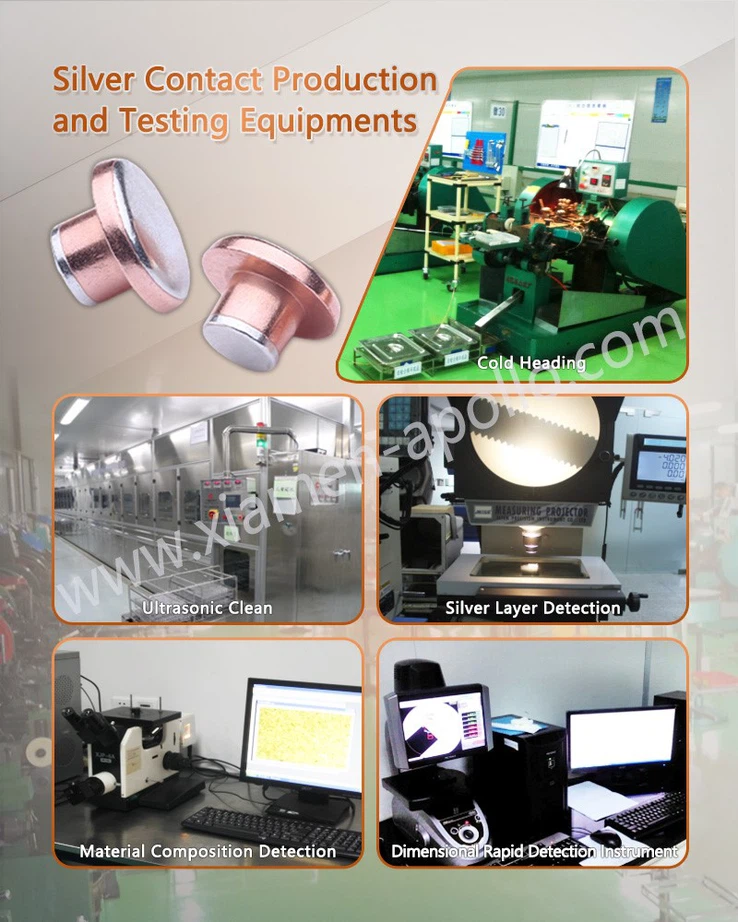
Cold Headed Bimetal Contacts use a precision cold heading machine to form composite strips into a rivet shape in one step, achieving a material utilization rate of over 95%. This process is completed at room temperature, avoiding the problem of excessively thick interfacial diffusion layers caused by hot processing, and ensuring that the bonding strength between the copper and silver layers remains stable within the range of 180-220 MPa. By 2025, mainstream production lines will have achieved a molding speed of 120-150 pieces per minute, with dimensional accuracy controlled within ±0.01 mm, fully meeting the stringent requirements of automotive-grade Bimetal Rivet For Relays.
2.2 Composite Technology Path of Bimetal Contact Rivets
The manufacturing of Bimetal Contact Rivets involves three main technological approaches:
Clad Rolling Method: Silver alloy plates and copper plates are rolled simultaneously, achieving mechanical interlocking through large deformation. This method has the lowest cost but relatively weaker bonding strength.
Explosive Bonding Method: Utilizing instantaneous high temperature and pressure to achieve metallurgical bonding, resulting in the highest interface strength. Suitable for high-reliability applications such as aerospace.
Electroplating-Sintering Method: Silver powder is electroplated onto the copper rivet head, followed by sintering. This method produces the most uniform metallographic structure and is the mainstream process for Bimetallic Contact Rivets.
2.3 Precision Post-Processing of Bimetallic Rivet Contacts
The formed Bimetallic Rivet Contacts undergo multiple precision machining processes: centerless grinding to ensure cylindricity ≤0.005mm, vibration finishing to eliminate surface micro-cracks, and plasma cleaning to remove organic contaminants. Finally, an eddy current separator is used to 100% inspect the integrity of the bonding layer, ensuring that each Switch Silver Contact meets the quality level of Precision Electrical Contacts.
Core Performance Advantages and Application Value
3.1 Current Carrying Capacity and Temperature Rise Control
Bimetal Silver Contacts offer a current carrying capacity of up to 25A/mm², with a temperature rise 15-20℃ lower than pure copper contacts of the same specifications. In the OBC (On-Board Charger) of new energy vehicles, relays using Bimetal Rivet Contacts can control the operating temperature below 85℃, significantly improving system reliability.
3.2 Arc Resistance and Weld Resistance
The silver alloy working layer increases the breaking capacity of Electrical Contacts by 3-5 times. Experimental data shows that under a DC 400V/80A load, the arc erosion rate of Bimetal Electronic Contacts is only 1/8 that of copper contacts, and the probability of welding is reduced by 90%. This characteristic makes it a standard solution for DC contactors in charging piles.
3.3 Revolutionary Optimization of Cost Structure
Compared to all-silver contacts, the introduction of the Copper Electrical substrate reduces material costs by more than 50%. Meanwhile, due to copper's higher mechanical strength, contact seats can be designed to be thinner and lighter, reducing overall weight by 20%. This is particularly valuable for Slip Ring Contacts and Spring Electrical Contacts used in drones, eVTOL, and other aircraft applications.

In-depth Analysis of Hot Application Scenarios
4.1 New Energy Vehicle Three-Electric System
In motor controllers and battery management systems, Bimetal Rivet For Relays plays a crucial role in high-voltage safe switching. 800V platform vehicles require contact life exceeding 300,000 cycles. Bimetallic Contact Rivet, through optimized AgSnO₂ alloy composition, increases electrical life to 350,000 cycles and mechanical life to over 1 million cycles, fully meeting the GB/T 18487.1-2025 fast charging standard.
4.2 Low-Altitude Economic Aircraft Power Distribution System
eVTOL flight control power distribution boxes need to strike a balance between weight reduction and reliability. Sliding Electrical Contact components made from Bimetal Silver Contacts weigh only 0.8 grams per piece, yet can carry a continuous current of 50A. Airworthiness tests conducted by a leading OEM showed that the contact resistance change rate of this solution was less than 8% after 100,000 switching cycles, providing crucial data support for aircraft airworthiness certification.
4.3 AI Computing Center Power Distribution
The PDU (Power Distribution Unit) of the AIGC server cluster adopts a hybrid design of Fixed Silver Contact and Bimetallic Contact Rivets. Gold-plated fingers and silver-copper composite contacts work together, increasing power density to 15kW/3U while reducing size by 30%. This Composite Contacts architecture has become the recommended solution of the OCP (Open Computing Project).
4.4 Smart Home and Industry 4.0
The Contact Electrical module of high-end smart switches uses Bimetallic Rivet Contact, combined with wireless power supply technology, to achieve zero-wire carrier communication. The stability of its contact resistance directly affects signal transmission quality. Tests show that after 50,000 consecutive operations, signal attenuation can still be controlled within 3dB.
Comparison and Selection with Related Technologies
5.1 vs Composite Contacts
Compared to monolithically sintered composite contacts such as silver-graphite (AgC) and silver-tin oxide (AgSnO₂), the biggest advantage of Bimetal Silver Contacts lies in their high design flexibility. Engineers can flexibly adjust the silver layer thickness (0.1-1.5mm) and copper layer ratio according to the priorities of current carrying capacity, breaking capacity, and cost, achieving true "on-demand customization."
5.2 vs Sliding Electrical Contacts
Sliding contacts such as Slip Ring Contacts need to withstand friction and wear over a long period of time, and typically employ silver or gold plating. Cold Headed Bimetal Contacts are mainly used for static switching applications. Their silver layer hardness can be adjusted to HV80-120 through alloying, achieving a better balance between mechanical wear resistance and arc resistance, making them unsuitable for rotating sliding scenarios.
Quality Control and Supply Chain System
6.1 Precious Metal Suppliers' Certification Standards
Mainstream Precious Metal Suppliers implement a three-tiered quality gate system for Bimetal Electronic Contacts:
Raw Material Level: Oxygen content of silver alloy ingots ≤10ppm, conductivity of copper ≥58MS/m
Process Level: Online XRF testing of silver layer thickness, ultrasonic flaw detection to screen for interface pores
Finished Product Level: 100% continuity testing, sampling for 100,000-cycle life verification
6.2 Noble Precious Metals' Traceability Management
To meet the supply chain due diligence requirements of the new EU battery regulations (EU 2023/1542), Noble Precious Metals' application in bimetallic contacts requires establishing a fully digital traceability system from silver ingot procurement to finished product delivery. The introduction of blockchain technology gives each Bimetal Rivet Contact a unique "material passport," meeting ESG compliance audit requirements.
Market Trends and Technological Challenges
7.1 Miniaturization and Integration Trends
With PCBA board area shrinking by 50%, Bimetallic Contact Rivets are evolving towards miniaturization to Φ1.2mm. Micro-precision cold heading technology needs to address the delamination problem at the copper-silver interface under severe deformation. Currently, through gradient temperature field control and ultrasonic vibration-assisted forming, the smallest specification has been successfully pushed down to Φ0.8mm.
7.2 Development of Environmentally Friendly Silver Alloy Systems
The trend towards cadmium-free materials is driving the adoption of environmentally friendly systems such as AgSnO₂ and AgZnO in Bimetallic Silver Contacts. However, the high work hardening rate of these new materials leads to a 40% decrease in mold life for Cold Headed Bimetallic Contacts, posing new challenges to mold steel selection and coating technology.
Conclusion
From material innovation in Bimetal Rivet Contacts to technological breakthroughs in Cold Headed Bimetal Contacts, the bimetallic silver contact industry is undergoing a leap from "functional replacement" to "performance leadership." In 2025, with the penetration rate of new energy vehicles exceeding 45% and the low-altitude economy being included in the government work report, Bimetal Silver Contacts, with their unique cost-performance balance advantages, have become a key force driving the upgrade of electrical connection technology. In the future, with the deep integration of materials genome technology and intelligent manufacturing, Bimetallic Contact Rivets will unleash greater value in the broader Electrical Contacts market.
contact us