

As a crucial component of a vehicle's active safety system, the stability of a car horn directly impacts driving safety. In modern automotive electrical systems, the horn relies on high-frequency electromagnetic action to output sound waves. The performance of core conductive components, such as Tungsten Contacts, under conditions of high current surges and frequent switching on/off cycles becomes a key factor determining product lifespan and performance.
From a working principle perspective, the horn system consists of a power supply, a relay, an electromagnetic coil, and a diaphragm. When the driver triggers a signal, current flows through the relay contacts, forming a closed circuit. The Tungsten Contact Rivet, as the critical connecting medium, performs both current conduction and mechanical fixation, ensuring the electromagnetic system stably drives the diaphragm to vibrate and produce sound.
In practical applications, horn failures mainly fall into two categories: wiring problems and structural failure. Deterioration of contact materials is particularly common. For example, using ordinary materials, prolonged switching on and off can lead to arc erosion. High-performance Tungsten Contact Rivets, due to their high melting point and arc resistance, can significantly reduce contact wear and improve system reliability.
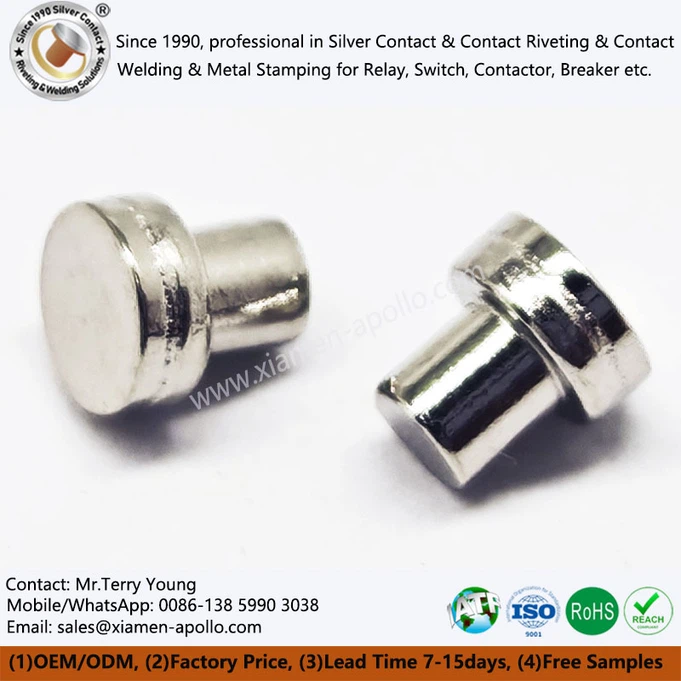
The first type of typical failure is contact erosion. In high-frequency applications, current passing through the contacts generates an electric arc, causing the contact surface to gradually carbonize or oxidize, increasing contact resistance. In contrast, Motorcycle Horn Tungsten Rivets possess stronger high-temperature resistance and corrosion resistance, effectively slowing down the contact degradation process.
The second type of problem stems from environmental influences, especially humid environments. Insufficient horn sealing allows moisture intrusion, leading to contact oxidation and even short circuits. Electrical Tungsten Contact Rivets, employing a high-density structure, can improve corrosion resistance to a certain extent, enhancing environmental adaptability at the material level.
The third common failure is loose connection at the terminals. Some horns use riveting processes internally; if the crimping is weak or the materials are not properly matched, it can lead to unstable conductivity. Using Tungsten Contacts for Electrical Appliances can improve connection stability and reduce contact problems caused by thermal expansion and contraction.
From a material properties perspective, Tungsten Contact Rivets possess extremely high melting points and excellent conductivity, allowing them to maintain structural stability even under high current density environments. In particular, the precisely designed Tungsten Point Contact effectively reduces contact resistance and improves conductivity, optimizing speaker response performance.
Furthermore, the internal contacts of the speaker must withstand mechanical shock and vibration loads. Traditional materials are prone to fatigue cracking, while Horn Contact Wolfram, due to its high strength and wear resistance, exhibits superior fatigue resistance over long-term use, making it suitable for high-frequency applications. In terms of manufacturing processes, the connection method between the contacts and the substrate is equally crucial. For example, using a Tungsten Steel Contact structure ensures mechanical strength while achieving a good conductive path, reducing performance degradation caused by instability at the contact interface.
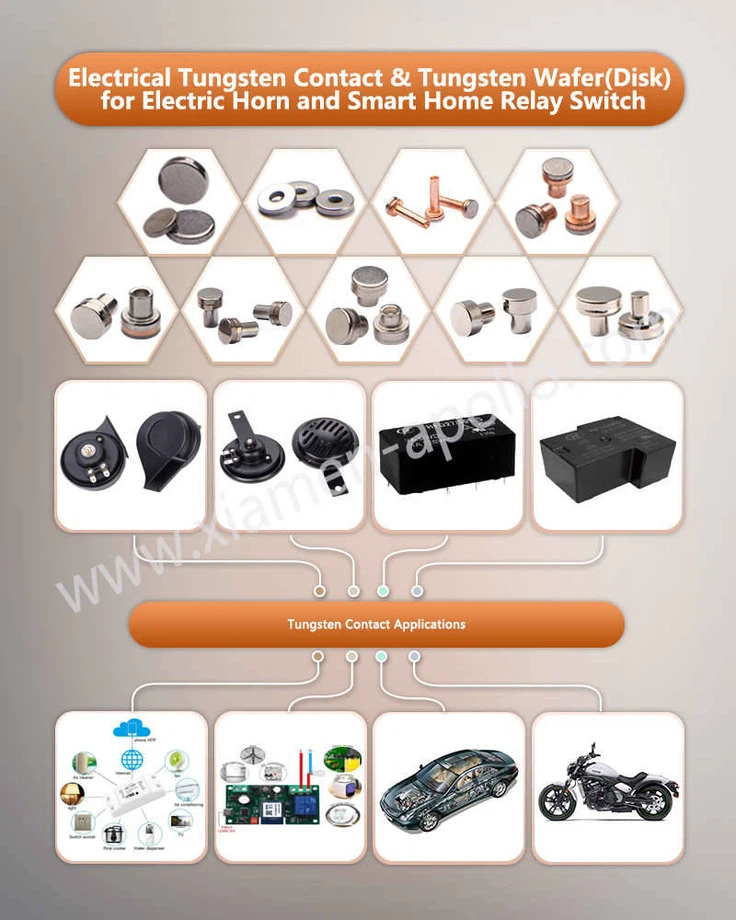
Furthermore, advanced welding technologies such as Furnace Brazing Tungsten Contact can enhance the bonding strength between the contacts and the carrier, avoiding loosening issues that may occur in traditional riveting processes, thereby improving overall product consistency and reliability.
Against the backdrop of rapid development in automotive electronics, horn systems are evolving towards higher reliability and longer lifespan. By optimizing material systems, such as introducing Car Horn Tungsten Contact Rivets, not only can arc resistance be improved, but stable performance can also be maintained in complex environments such as high temperature and high humidity.
In the future, with the development of new energy vehicles and intelligent driving, the requirements for horn systems will further increase. High-purity materials such as Pure Tungsten Discs will play a greater role in high-end applications, achieving synergistic optimization of the vehicle's electrical system performance by improving conductivity and durability.
Frequently Asked Questions
Q: Why do Horn Contact Wolfram burn out?
A: Frequent switching generates electrical arcs that gradually erode the contact surface.
Q: What material is best for horn contacts?
A: Tungsten Steel Contacts are widely used because they combine excellent conductivity with strong arc resistance.
Q: How long do Furnace Brazing Tungsten Contacts last?
A: Service life depends on current load and switching frequency, but tungsten-based contacts generally last significantly longer than conventional copper contacts.
contact us
For more information on the application solutions of Tungsten Brazed Rivets in automotive electrical systems or to obtain customised product support, please contact our technical team. We will provide you with professional selection and solution services.
