

Contact adhesion is one of the most common fault types in the actual operation of AC Contactor Silver Contact Welding Assemblies, directly affecting the contactor's switching reliability and service life. Stains or corrosion on the contact surface significantly increase contact resistance, causing a rapid rise in contact temperature and leading to adhesion. Loose riveting, poor welding, and other processing defects can also cause abnormal increases in local resistance, becoming a significant contributing factor to contact adhesion. An unreasonable contact assembly design, with an insufficient effective contact area, can also cause adhesion due to excessive resistance. Insufficient contact or separation force due to mechanical structure design, as well as excessively high operating current, can also significantly increase the probability of adhesion. In new product development and application, in addition to avoiding the above problems, it is also necessary to ensure reasonable contact dimensions, precise material selection, and priority use of high thermal conductivity materials to prevent contact overheating. These are the core points for ensuring stable component operation.
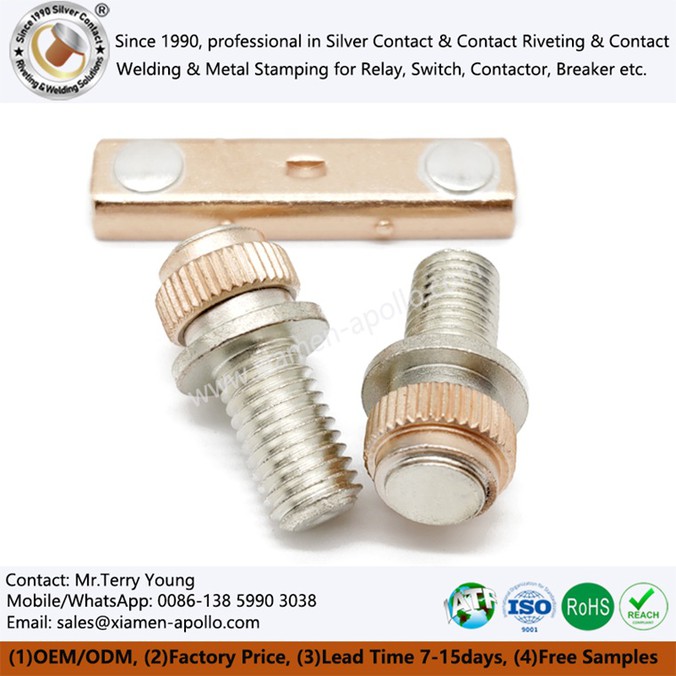
Excessive contact corrosion rates significantly shorten the service life of Custom Silver Contact Stamping Assemblies and increase the failure risk of low-voltage electrical appliances. Factors inducing rapid corrosion are highly similar to those causing contact adhesion; even without adhesion, these conditions accelerate contact corrosion. Contact chatter is also a key contributing factor; vibrations and noises generated when the switch closes significantly accelerate corrosion. In AC circuits, the contact disconnection speed must be controlled within a reasonable range to reduce sparking and control arc length. Ensuring sufficient disconnection distance near zero voltage avoids sparking. In DC circuits, a faster disconnection speed reduces sparking. Regardless of AC or DC circuits, faster closing speed and reduced contact chatter effectively suppress corrosion. Appropriately reducing contact force within a reasonable range reduces mechanical wear, but excessively low contact force exacerbates galvanic corrosion and shortens contact life. Reducing the duration and intensity of the arc also effectively reduces the degree of contact corrosion.
Material transfer at contact points directly affects the electrical contact performance and structural integrity of Resistive Welding Silver Contacts, and is particularly common in DC circuits. Material transfer is primarily caused by DC polarity. In the absence of an electric arc, a metal-bridge transfer occurs, causing material to migrate from the anode contact to the cathode contact. In an arc environment, arc transfer also occurs, where material is ejected from the cathode to the anode under the influence of the arc. The intensity of both transfer methods jointly determines the final direction of material transfer. In DC circuit applications, the selection of contact materials is crucial for suppressing transfer defects. Materials with high melting points, high boiling points, excellent weldability, good electrical and thermal conductivity, and high hardness can effectively reduce material transfer and ensure long-term stable operation of the contact assembly.

High contact resistance is a significant problem in the operation of AC Resistance Welding Silver Contacts, triggering a series of cascading failures. Stains, oxides, or corrosion layers adhering to the contact surface are the main causes of increased contact resistance, leading to contact overheating, welding, accelerated corrosion, and even circuit failure. To address this issue, contact materials can be selected specifically for the actual operating environment to reduce corrosion at its source. A sealed working environment effectively isolates contaminants and reduces the probability of impurity adhesion. Contacts must be thoroughly cleaned before assembly to maintain surface cleanliness. Simultaneously, minimizing sliding structures in the product design effectively prevents contaminant generation and accumulation, maintaining stable contact resistance.
about us
Addressing the pain points of welded components in practical use, such as adhesion, corrosion, material migration, and high contact resistance, our professionally designed AC Contactor Silver Contact Welding Assemblies utilize superior materials and precision resistance welding technology. They feature a stable structure, reliable contact, arc resistance, and anti-adhesion properties, significantly improving contactor lifespan and operational safety. We welcome customers from all sectors to contact us for product selection and bulk purchase inquiries. We will provide you with high-quality products and comprehensive services!
contact us
