

In the manufacturing process of Electrical Tungsten Contact Rivets, high-temperature sintering is a key link and plays a decisive role in its final performance and quality. However, many defects often occur in this process, which greatly affects the application effect of tungsten contacts in electrical equipment. In-depth exploration of the causes of these defects and the formulation of effective preventive measures are important ways to improve the quality of tungsten contacts.
From the perspective of the causes of defects, the following aspects are mainly involved. In terms of temperature control, if the sintering temperature is too high, the atomic diffusion rate inside the Iron Tungsten Contact Rivets will accelerate, resulting in abnormal grain growth. This abnormally grown grain structure is uneven, which greatly reduces the mechanical properties of the tungsten contact, such as hardness and toughness, and also affects its conductivity and reduces electrical performance. At the same time, excessively high temperatures can cause excessive shrinkage of the tungsten contact, resulting in internal stress concentration, and even cracks in severe cases. On the contrary, if the sintering temperature is too low, the atomic diffusion between the powder particles is insufficient, and sufficient metallurgical bonding cannot be formed, resulting in the density of the tungsten contact failing to meet the requirements and a large number of pores inside. These pores will not only reduce the strength of the tungsten contact but also become areas of current concentration during use, which can easily cause local overheating and eventually damage the contact.

The sintering atmosphere is also an important factor. When the sintering atmosphere contains too many impurity gases such as oxygen and water vapor, the surface of the Tungsten Contact Rivet is very prone to oxidation. The generated tungsten oxide layer will not only increase the resistance of the contact and affect the conductive performance but also destroy the surface finish of the contact and reduce its resistance to arc erosion. In addition, if the content of some reducing gases is not appropriate, they may also react with the alloy elements in the tungsten contact, change its chemical composition and organizational structure, and thus affect performance.
For the above defects, preventive measures should also be taken from multiple dimensions. In terms of temperature control, high-precision temperature control equipment should be equipped, such as advanced PID control systems, which can be accurately adjusted according to the preset temperature and real-time feedback temperature to ensure that the temperature fluctuation during the sintering process is controlled within a very small range. At the same time, it is necessary to formulate scientific and reasonable heating, insulation, and cooling curves according to the specific composition and process requirements of Solid Tungsten Contact Rivets. For example, for some tungsten contacts with special alloy compositions, it may be necessary to adopt a segmented heating method to avoid excessive internal stress due to rapid temperature changes.
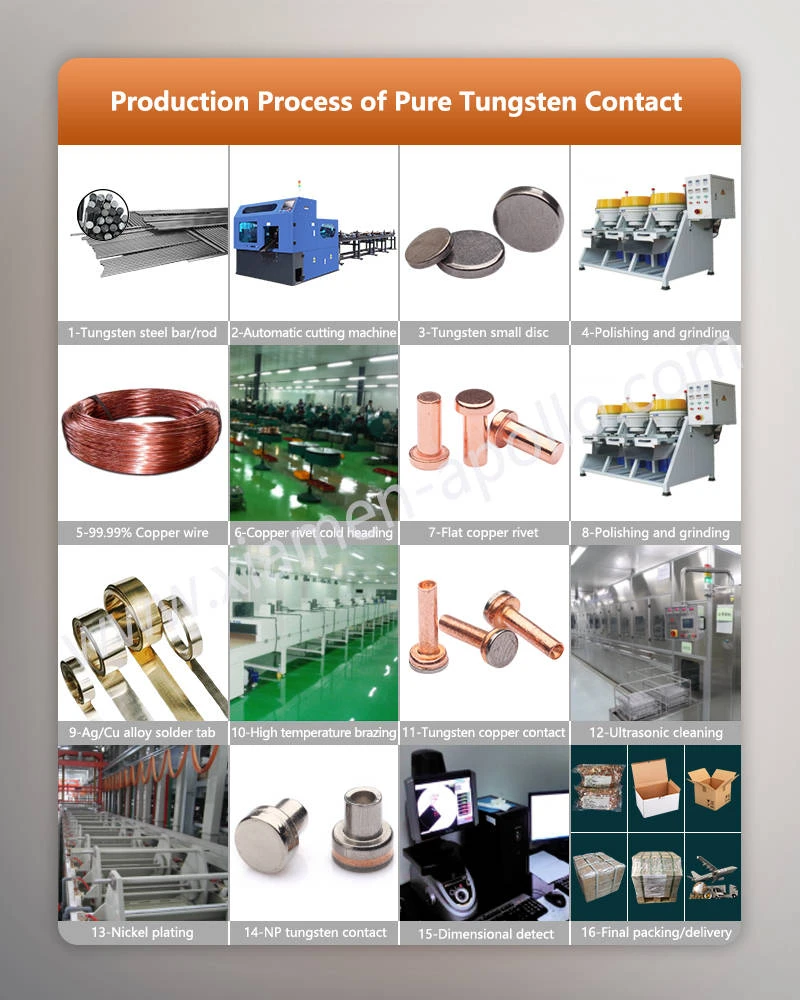
In terms of sintering atmosphere control, high-purity protective gas should be used, such as argon with a purity of more than 99.99%, and the furnace should be fully replaced before sintering to exhaust air and other impurity gases. At the same time, impurities such as trace moisture and oxygen in the protective gas can be further removed by installing a gas purification device. In addition, the sintering equipment should be maintained and inspected regularly to ensure its good sealing and prevent outside air from entering the furnace to affect the sintering atmosphere of Electrical Contact Of Tungsten Copper.
