

The primary function of a high-voltage DC contactor is to control the switching of circuits. In a DC circuit, the contactor accomplishes this task through its internal contacts when it needs to disconnect or connect the circuit. Unlike AC contactors, DC contactors must overcome the lack of a natural zero-crossing point for DC current when disconnecting, necessitating a more sophisticated arc-extinguishing design.
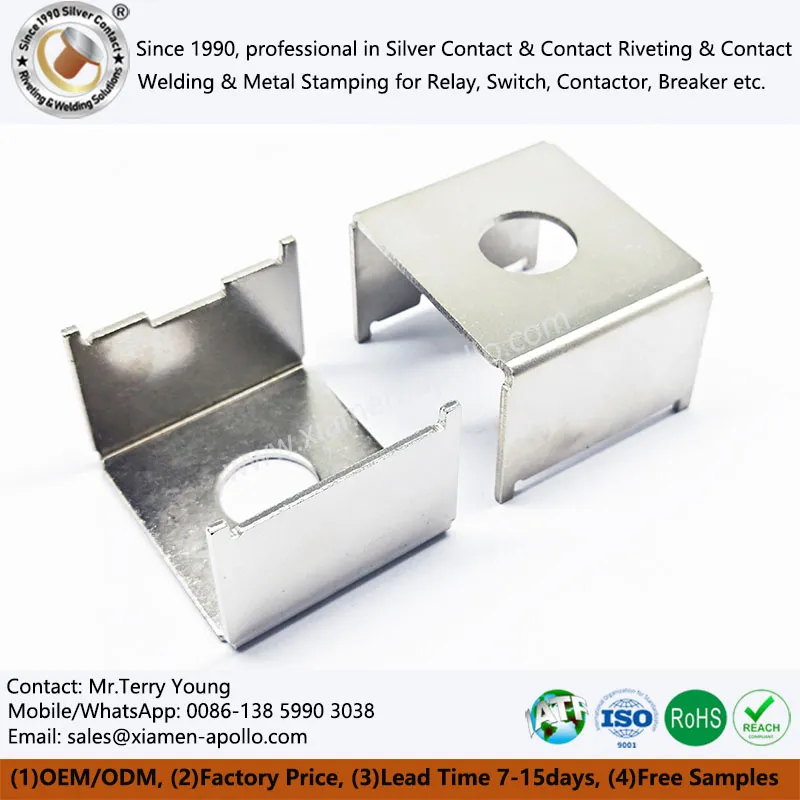
The core components of a high-voltage DC contactor include an electromagnet, a contact system, and a mechanical structure. When the contactor connects the circuit, the electromagnet generates a magnetic field through which current flows, attracting the contacts to close, thus completing the circuit. When it is necessary to disconnect the circuit, the electromagnet is de-energized, and the contacts separate under the action of springs, interrupting the current. In this process, the pure iron in the EV relay bracket serves as a key structural support component of the electromagnetic system, and its permeability and mechanical strength directly affect the electromagnet's response speed and the stability of its attraction force.
In a high-voltage DC environment, the electric arc generated during contact breaking is a major factor affecting the contactor's lifespan. To effectively control the arc, modern high-voltage DC contactors typically employ a sealed cavity combined with magnetic arc blowing or hydrogen arc extinguishing technology. In this case, the performance of the Electrical Pure Iron Stamping for the EV DC Contactor directly affects the consistency of the electromagnetic drive mechanism's operation. High-purity pure iron stampings can provide lower magnetic reluctance and higher saturation magnetic flux density, thereby improving the contactor's breaking capacity.
The design of high-voltage DC contactors requires careful consideration of the following aspects:
First, insulation performance. Since high-voltage DC contactors must withstand high voltages (common specifications range from 450V to 1000V or even higher), the design of their insulation system is crucial. Typically, high-quality insulation materials are used internally, and creepage distances and clearances are rationally designed to ensure safety and reliability under high-voltage conditions.
Second, arc resistance. Arc generation is a major technical challenge in high-voltage DC circuits. Optimizing contact materials (such as using silver-based alloys or tungsten copper contacts) and the arc-extinguishing chamber structure can effectively reduce the erosion of contacts by arc energy, extending service life. Meanwhile, the iron bracket for EV DC Relay, as a key structural component connecting the electromagnetic system and the contact assembly, significantly affects the stability of the arc-extinguishing gap due to its dimensional accuracy and mechanical strength.
Third, heat dissipation and thermal management. Under high voltage and high current conditions, contactors may generate a large amount of Joule heat. The design typically includes effective heat conduction paths and a heat dissipation structure in the casing to ensure long-term operational stability. The HVDC Relay skeleton, made of pure iron, not only performs the magnetic circuit function but also participates in the heat conduction path design. The high-quality pure iron skeleton helps reduce local temperature rise.
Fourth, compact structure and vibration resistance. Automotive applications place stringent requirements on the contactor's size and vibration resistance. The EV HVDC Contactor Pure Iron Bracket, through precision stamping, provides sufficient mechanical strength within a limited space while ensuring stable air gap in the electromagnetic system. High-precision stamping avoids reliability issues such as core jamming or inadequate engagement.

In power systems, high-voltage DC contactors are used to control high-voltage DC circuits in the power grid, helping to achieve safe circuit switching and overload protection, and improving grid stability. Especially in flexible DC transmission and energy storage systems, the reliable operation of the contactor is directly related to the safe operation of the entire power station.
In electric vehicles, the battery management system is one of the core safety components. High-voltage DC contactors are used to control the connection and disconnection between the battery pack and the motor controller, ensuring safety during charging and discharging. Pure iron stamping parts for EV relays are widely used in main circuit contactors and pre-charge relays. Their material purity and stamping precision directly affect the contactor's load breaking capacity and reliability under vibration. With the increasing prevalence of 800V high-voltage platforms in the electric vehicle field, higher requirements are placed on the dimensional tolerances and magnetic performance consistency of pure iron stamping parts.
contact us
Thank you for reading this article. For more information on the technical specifications or customization options for Iron brackets for EV DC Relays, please feel free to contact us. We will provide you with professional material selection advice and engineering support.
