

A latching relay is a specialized type of electromagnetic relay distinguished by its core feature: the utilization of permanent magnets or residual magnetism to achieve a self-holding function for its contact states. Unlike conventional relays-which require continuous power supply to maintain their operational status-a latching relay requires only a momentary current pulse to switch its contact position, and it retains this current state even after the power supply is disconnected. Within this intricate magnetic circuit system, the Latching Relay Iron Core plays a pivotal role; serving as the central hub for magnetic field conduction and conversion, it directly determines the relay's operational sensitivity and overall energy efficiency.
The fundamental innovation of the latching relay lies in the integration of permanent magnets into its magnetic circuit system, and a high-quality Core for Latching Relays serves as the cornerstone of this system. Its internal structure typically comprises a coil, a permanent magnet, an armature, and a contact assembly. When a forward current pulse is applied to the coil, the iron core rapidly conducts the magnetic flux; the resulting magnetic field superimposes upon that of the permanent magnet, driving the armature to actuate and close the contacts. Conversely, when a reverse pulse is applied, the direction of the magnetic field within the iron core reverses to counteract the permanent magnet's field; under the force of a return spring, the armature resets to its original position, thereby opening the contacts. This entire process imposes extremely rigorous demands on the iron core material regarding both its magnetic permeability and its response speed.

In the field of smart grids-particularly regarding the remote tariff control functions of smart meters-there are stringent standards for the power consumption and stability of relays. Consequently, the industry frequently employs Pure Iron Cores for Electric Meter Relays. This high-purity soft magnetic material features extremely low coercivity and exceptionally high magnetic induction, ensuring that the relay actuates precisely even under microamp-level pulse currents. Simultaneously, it effectively minimizes hysteresis loss, making it perfectly suited for smart meter applications that require long-term operation and maximum energy efficiency.
To meet the demand for component consistency inherent in large-scale industrial production, advanced Cold Heading Pure Iron Core manufacturing processes are widely utilized. The cold heading process applies pressure to metal materials at room temperature using high-precision dies, inducing plastic deformation. This method not only drastically reduces material waste from machining but also preserves the internal grain flow of the metal, thereby significantly enhancing the mechanical strength and surface finish of the iron core. Iron cores produced via this process exhibit extremely tight dimensional tolerances, ensuring precise control over the magnetic circuit gap.
As a critical Relay Core within the overall electromagnetic system, the choice of material directly impacts the device's heat generation and operational lifespan. High-quality pure iron or electrical pure iron (such as the DT4 series) is preferred due to its extremely low impurity content, which effectively minimizes eddy current losses. In new energy applications-such as photovoltaic inverters or energy storage systems-where latching relays frequently switch high currents, low-loss iron cores effectively suppress self-heating. This resolves the common issue of coil overheating found in traditional relays, thereby ensuring the device operates stably across a wide temperature range of -40°C to +85°C.
When designing Coil Cores for Electromagnetic Relays intended for high-power or high-frequency response applications, engineers typically optimize their geometric structure and magnetic circuit distribution. Through judicious design, the magnetic flux generated by the coil can be channeled more efficiently through the armature and contact system, thereby enhancing the relay's pull-in force and resistance to vibration interference. A case study involving the retrofitting of an automotive production line demonstrated that, following the adoption of latching relays featuring optimized iron core designs, the internal temperature of the PLC output module control cabinet dropped significantly, and the overall fault rate was drastically reduced.
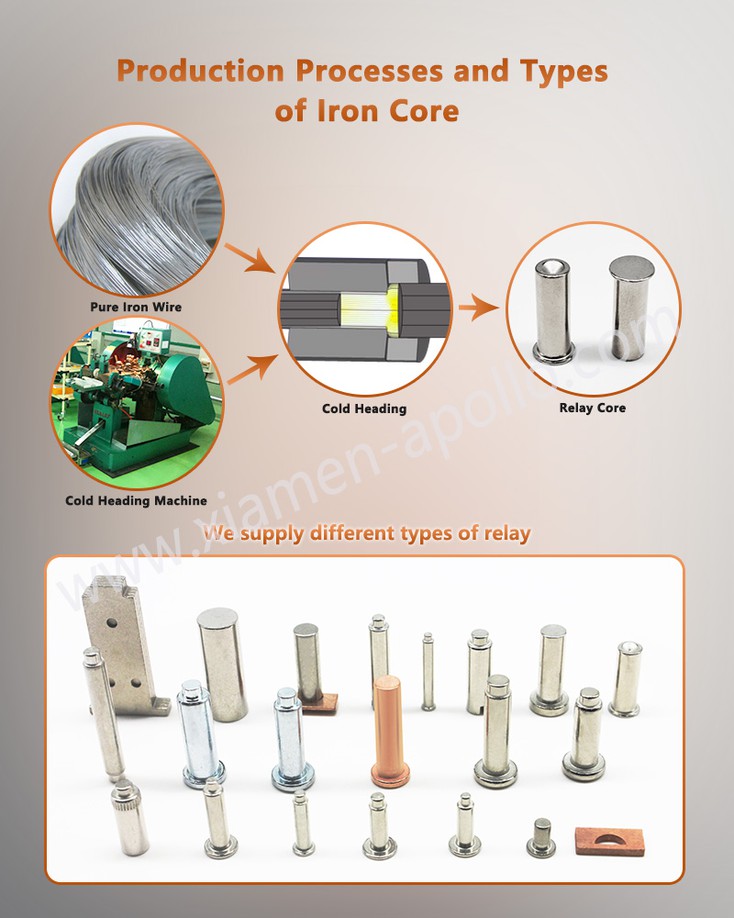
Overall, latching relays-distinguished by their low power consumption, high reliability, intelligent capabilities, and resistance to extreme temperatures-have effectively overcome the limitations inherent in traditional electromagnetic relays. Their application scope continues to expand across diverse sectors-ranging from smart grids and new energy systems to industrial automation and smart homes. When paired with a compatible Iron Core Relay Part, these devices deliver maximized performance, serving as critical components for the energy-efficient and intelligent upgrading of electrical control systems.
If you require precise selection assistance to identify a latching relay and accompanying Pure Iron Core best suited to your specific operating conditions, please contact us. We provide professional selection solutions and technical support tailored to meet the requirements of a wide variety of electrical control scenarios.
Contact Us
If you require assistance with product selection and compatibility, or have technical inquiries regarding Iron Cores for Relays (Soft Iron Cores), please feel free to contact us for professional support.
