

Over the past few years, the global supply chain has experienced multiple rounds of shortages, with resources ranging from energy and semiconductors to lithium and helium facing critical shortages. While some of these shortages have eased with capacity adjustments, copper, an ancient and fundamental metal, is gradually coming into the industry's focus. Unlike rare earth elements, which are favored by policymakers, or chips, which are the focus of media attention, copper's scarcity stems more from long-standing structural contradictions on both the supply and demand sides.
As the world's third most used metal after iron and aluminum, copper holds an irreplaceable position in electrical engineering: its resistivity is the lowest among all non-precious metals, and its conductivity is second only to silver. For manufacturers of basic electronic components such as connectors, switches, and relays, the stability of copper supply directly affects product design and cost control. Against this backdrop, the importance of high-performance electrical contact materials such as Solid Copper Contacts is increasingly prominent, becoming a key variable that engineers must consider in advance during the material selection phase.

Demand Surges: Electrification Drives Continued Growth in Copper Consumption
The core driver of expected copper demand growth comes from electrification across multiple sectors. The most obvious application is electric vehicles, which use significantly more copper per vehicle than traditional internal combustion engine vehicles. In hybrid and pure electric vehicles, copper usage covers multiple stages, from battery systems to high-voltage wiring harnesses; standard calculations show that the amount used per vehicle can be 3 to 4 times that of internal combustion engine vehicles. Furthermore, the expansion of charging infrastructure, upgrades to high-voltage transmission lines, and the accelerated implementation of renewable energy facilities such as offshore wind power all contribute to the incremental growth of copper consumption.
Statistics from major global mineral trading organizations show that although global copper production has doubled over the past thirty years, it still falls short of the steep demand curve brought about by the new energy transition. Against this backdrop, switches and connection components manufactured using Electrical Copper Rivets are facing the dual pressures of fluctuating upstream material costs and extended delivery times. For supply chain managers, securing contact component suppliers with stable copper sources in advance has become a crucial strategy for mitigating shortage risks.
Supply-Side Constraints: Long Development Cycles, High Costs, and Rising Environmental Barriers for New Mines
Despite continued strong market demand, copper supply is facing significant growth bottlenecks. Global copper resources are highly concentrated, with Chile, Peru, the Democratic Republic of Congo, and China accounting for the majority of production. While a large new mine recently opened in the Gobi Desert of Mongolia, its impact on the global supply-demand balance remains to be seen. More critically, the ore grades at existing mines are declining, leading to rising extraction costs. The construction and commissioning of a new copper mine typically takes at least ten years, requiring capital investments ranging from $500 million to $10 billion-a time and financial barrier even exceeding that of an advanced semiconductor factory.
Meanwhile, the infrastructure development required for mines-including roads, power plants, airports, and worker living quarters-further amplifies the scale of investment and environmental impact. While copper recycling is considered a potential supplementary channel, practical constraints remain significant: the source of recyclable copper scrap is limited, and the recycling process itself is costly and complex. This supply bottleneck directly impacts the manufacturing costs of basic electrical components such as Electrical Solid Copper Contacts. With raw material prices tightening over a long period, copper contact products with stable supply chains will gain a more significant competitive advantage in the market.
Price Signals and Future Outlook: Shortage Expectations Partially Reflected in Market Data
The tightness in the copper market is also reflected in prices. Over the past two decades, copper prices have experienced a significant surge, and although they have fluctuated with economic cycles since then, the overall price level has clearly shifted upward. This trend has not yet fully accounted for the increased demand brought about by the energy transition over the next decade. Different institutions have varying forecasts, ranging from 5% to 35% growth, but the consensus is that copper demand growth will far exceed supply elasticity. For electrical engineers and procurement decision-makers, this means that product lines using Copper Rivets or Electrical Copper Contacts will face higher material cost pressures over a longer period. This change is not short-term speculation, but a long-term structural shift based on mine development cycles, resource geographic distribution, and environmental constraints.
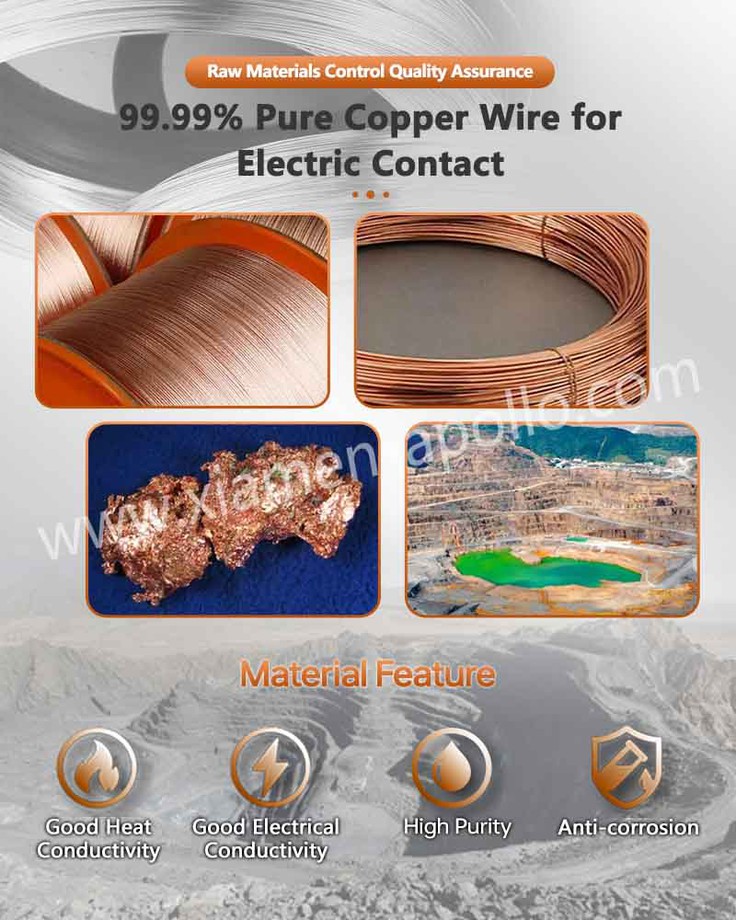
From Materials to Components: High-Performance Copper Contacts Become a Key Node in the Supply Chain
Faced with a persistently tight copper market, the selection logic for contacts and switch components is quietly changing. Traditional decentralized procurement models are gradually giving way to more systematic supply chain collaborations. Electrical Copper Rivet Contacts and Solid Copper Rivet products, with their high conductivity and reliability, are gaining popularity among power equipment and industrial control manufacturers due to their advantages in electrical life and temperature rise control. Especially in high-current switches, circuit breakers, and high-voltage connectors for electric vehicles, the composite structure of Copper Silver Contact Rivets can save copper usage while maintaining contact performance, becoming one of the technological paths to cope with rising copper prices. These products, through a multilayer design of silver and copper, utilize both the conductivity of copper and the low contact resistance of silver at the contact interface, achieving a better balance between material cost and electrical performance.
Quality and Stability First: Integrated Copper Contacts Help Ensure Long-Cycle Supply
Against the backdrop of increasingly tight copper resources, the structural design and manufacturing processes of contact products also face room for optimization. Traditional split-type contact structures often rely on multiple assembly processes, resulting in low material utilization. Copper Electrical Contacts, however, utilize a one-piece molding process, significantly improving copper utilization efficiency. Furthermore, Electric Copper Contacts are machined directly from a single piece of copper, avoiding additional resistance at the internal contact interface and reducing manufacturing waste.
For switch manufacturers, choosing the integrated solution of Copper Switch Contacts not only improves product consistency but also aligns with the engineering principle of maximizing resource utilization efficiency in an environment of material scarcity. High Conductivity Copper Contacts, through material purity control and optimized heat treatment processes, achieve superior current-carrying capacity with the same amount of copper. Ultimately, the integrated structure represented by One-piece Solid Copper Contacts is both a proactive adaptation to the trend of copper resource scarcity and a viable direction for product upgrades in the high-end electrical connection field.
Frequently Asked Questions
Q: What are the advantages of Electrical Copper Rivet Contacts?
A: Pure copper contacts offer high electrical conductivity, low resistance, and excellent thermal conductivity; they effectively reduce temperature rise and enhance the operational efficiency and reliability of electrical equipment.
Q: For which types of electrical equipment are Solid Copper Rivets suitable?
A: Pure copper contacts are widely used in switches, relays, contactors, circuit breakers, and other low-voltage electrical devices, thanks to their superior electrical and thermal conductivity.
Q: What factors should be considered when selecting a supplier for Copper Silver Contact Rivet?
A: It is advisable to focus on raw material quality, electrical conductivity, manufacturing consistency, customization capabilities, and long-term supply stability to ensure product reliability and supply security.
Contact Us
If you are interested in the technical specifications, sample requests, or long-term supply options for the Solid Copper Contacts mentioned above, please contact our engineering team for selection advice and the latest inventory information.
