

In-mold riveting (IMR) is an innovative connection technology that combines the advantages of injection molding and riveting. It is widely used in the automotive, electronics and home appliance industries. This article will explore its process flow and key elements in depth.
Process flow
The process of in-mold riveting is mainly divided into the following steps:
Mold preparation: Design a special mold to accommodate rivets and plastic parts. There must be a precise riveting position in the mold to ensure the accuracy and firmness of the connection.
Rivet selection: Select suitable rivets according to the connection requirements, usually metal materials to ensure sufficient strength and durability.
Injection molding: Heat the plastic pellets to a molten state, and inject the melt into the mold through an injection molding machine to fill the space around the rivet.
Riveting process: At the same time or later as the plastic is injected, the mold applies pressure to deform the rivet. At this time, the head of the rivet will expand and embed into the molten plastic.
Cooling and solidification: After the injection molding is completed, the mold cools, the plastic solidifies, and the rivet forms a firm connection with the plastic. This stage is the key to ensure the strength of the connection.

Key technical parameters
Temperature control: The injection molding temperature needs to be strictly controlled to ensure the fluidity of the plastic and the deformation ability of the rivet. Too high or too low temperature may affect the connection effect.
Pressure application: The riveting pressure needs to be moderate to prevent excessive deformation of the rivet or rupture of the plastic matrix. Reasonable pressure can ensure effective connection.
Time control: The timing of the riveting process is critical and needs to be carried out when the plastic is still in a molten state to ensure a good embedding effect.

Advantages and challenges
Advantages:
Reducing subsequent processes: By implementing riveting during the injection molding process, the production process is simplified and assembly time is saved.
Increasing connection strength: In-mold riveting provides strength superior to traditional connection methods and is suitable for parts that bear large loads.
Challenges:
Complexity of mold design: High-precision mold design is required to ensure the accuracy of the riveting position and the reliability of the connection.
Restrictions on material selection: Different thermal expansion coefficients of materials may cause connection problems, so the substrate and rivet materials need to be carefully selected.
Application Examples
In-mold riveting is commonly used in automotive manufacturing to connect components of doors and dashboards; in electronic products, it is common in the combination of housings and internal supports. These applications fully demonstrate its advantages in strength, reliability and production efficiency.

Conclusion
The in-mold riveting process has promoted manufacturing progress in many industries through efficient connection methods. With the development of technology, this process will achieve wider applications and innovations in the future and become an important part of modern manufacturing.
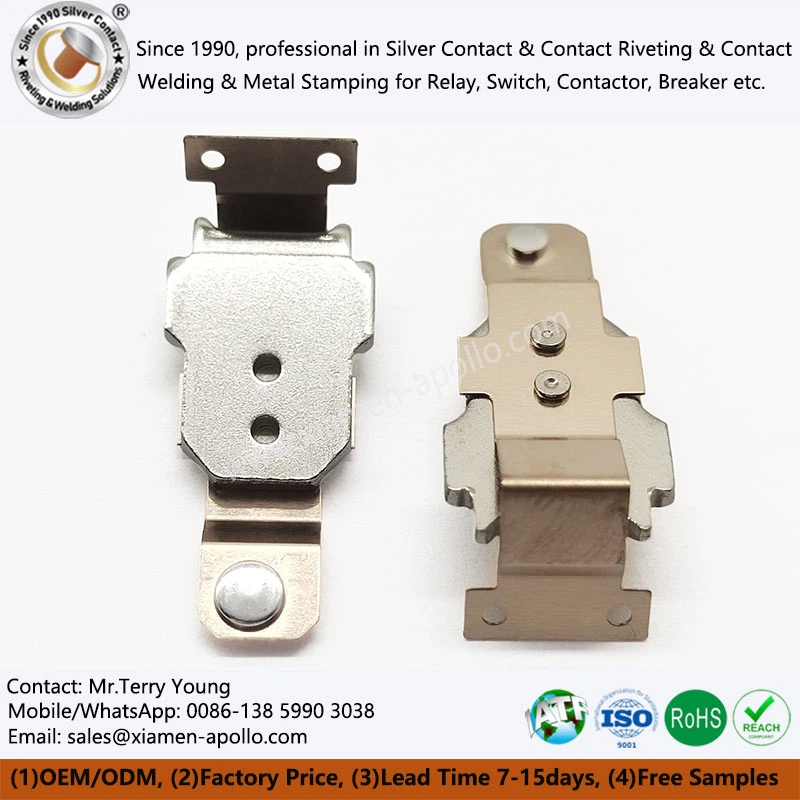
Electrical Rivet Connection Solutions
Our In-Die Electrical Riveting Contacts are a high-performance electrical connection solution designed to meet the needs of modern automobiles and electronic devices. These contacts use advanced in-mold riveting technology to ensure excellent conductivity and mechanical strength, and can work stably in extreme temperature and high load environments. Through rigorous durability testing, In-Die Electrical Riveting Contacts have demonstrated excellent reliability in automotive relays, autonomous driving systems and other key electronic components. In addition, our environmentally friendly production process and efficient automated production line ensure the quality and sustainability of the product, providing customers with a more competitive choice.
