

In the field of metal processing, Metal Stamping Electrical Contacts are widely used in many industries due to their unique properties. In-depth exploration of the influence of copper material properties on stamping process is of vital importance for optimizing production processes and improving product quality.
Copper has good electrical conductivity, which is one of the important reasons for its wide application in the electrical field. From the perspective of stamping process, this high conductivity affects the energy transfer in the stamping process to a certain extent. During high-speed stamping, due to the conductivity of copper, a small current may be generated between the die and the material, which requires the die material to have good insulation or electrical corrosion resistance, otherwise it will accelerate die wear and affect the dimensional accuracy and surface quality of Copper Metal Stamping for Contacts.

Copper has excellent thermal conductivity. During the stamping process, the heat generated by material deformation can be rapidly diffused. On the one hand, this is conducive to preventing local overheating, avoiding softening and excessive deformation of the material due to overheating, and ensuring the shape stability of the stamped parts. But on the other hand, it also poses a challenge to the stamping speed. If the stamping speed is too fast, the heat will not be able to dissipate in time, which may still cause the local temperature to be too high, affecting the mechanical properties and stamping quality of the material. Therefore, it is necessary to reasonably adjust the stamping speed and stamping interval time according to the thermal conductivity of copper.
The ductility of copper is a key factor in its material properties. It has good elongation and cross-sectional shrinkage, which enables copper to withstand large deformation without breaking during the stamping process. However, excessive ductility may also cause problems. For example, in the production of stamping parts with complex shapes, copper may be overstretched under the action of the die, resulting in uneven thickness and local thinning of the copper stamped electrical contacts. This requires the precise calculation of the die pressure and stroke in the stamping process design, and the reasonable selection of parameters such as the fillet radius of the stamping die to control the deformation degree of copper.
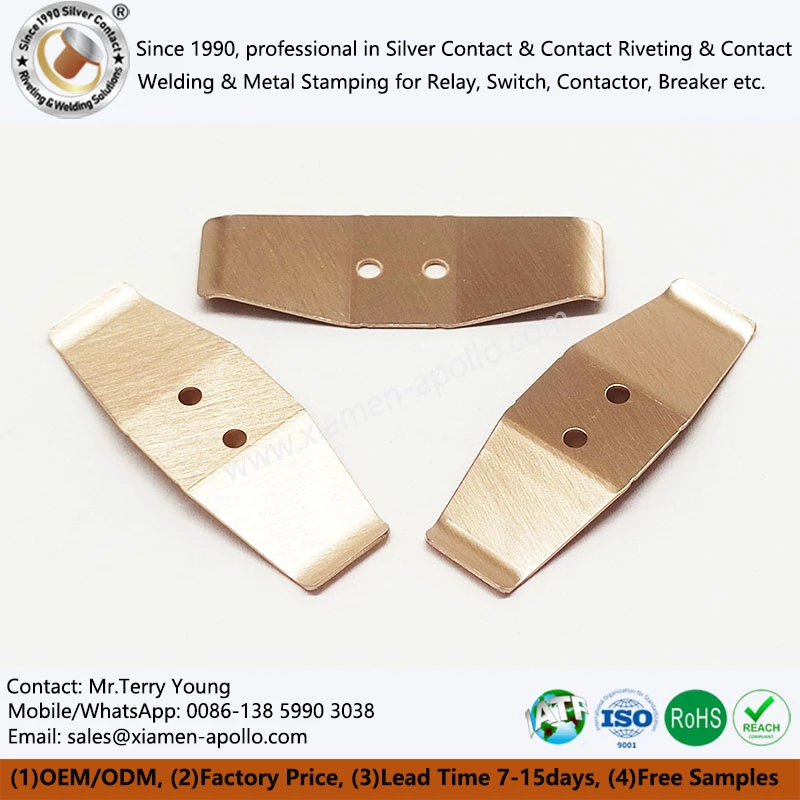
The hardness of copper is relatively low. This makes it relatively low in the stamping process. The pressure requirements on the die are relatively low, reducing the load on the die. But at the same time, low hardness also means that copper is easily scratched or indented during the stamping process. In order to avoid this situation, the surface finish of the mold needs to be higher, and during the stamping process, it is necessary to ensure that there are no impurities in the mold cavity to prevent damage to the surface of the Copper Metal Stamping Electrical Silver Contact Parts.
From the perspective of the crystal structure of the material, the crystal structure of copper is relatively regular. During the stamping process, this crystal structure will change with the action of external force. A reasonable stamping process can optimize the crystal structure of copper during the deformation process and improve the strength and hardness of the material. However, if the stamping process is unreasonable, such as too fast stamping speed and too high pressure, it may cause disordered crystal structure, internal defects, and reduce the quality of Stamped Copper Electrical Connectors.

In summary, the material properties of copper have many effects on the stamping process. In actual production, the design of the stamping process must fully consider factors such as the electrical conductivity, thermal conductivity, ductility, hardness and crystal structure of copper. Only in this way can high-quality Precision Stamped Copper Contacts be produced to meet the performance requirements of copper products in different industries, while extending the service life of the mold, improving production efficiency, reducing production costs, and promoting better development of copper stamping technology in the industrial field.
