

Silver contacts, as a vital component in electronic components, directly impact the performance of the entire electronic product. Recently, industry experts have explained the methods for assessing the quality of silver contacts, providing a reference for the majority of practitioners.
In recent years, with the rapid development of the electronics industry, the application of silver contacts in various types of electronic components has become increasingly widespread. However, the quality of Solid Silver Contacts on the market is uneven, and assessing silver contact quality is a focus of attention within the industry. To this end, we have specially invited industry experts to reveal the methods for evaluating silver contacts.

I. Visual Inspection: The "Appearance" Standard for High-Quality Silver Contacts
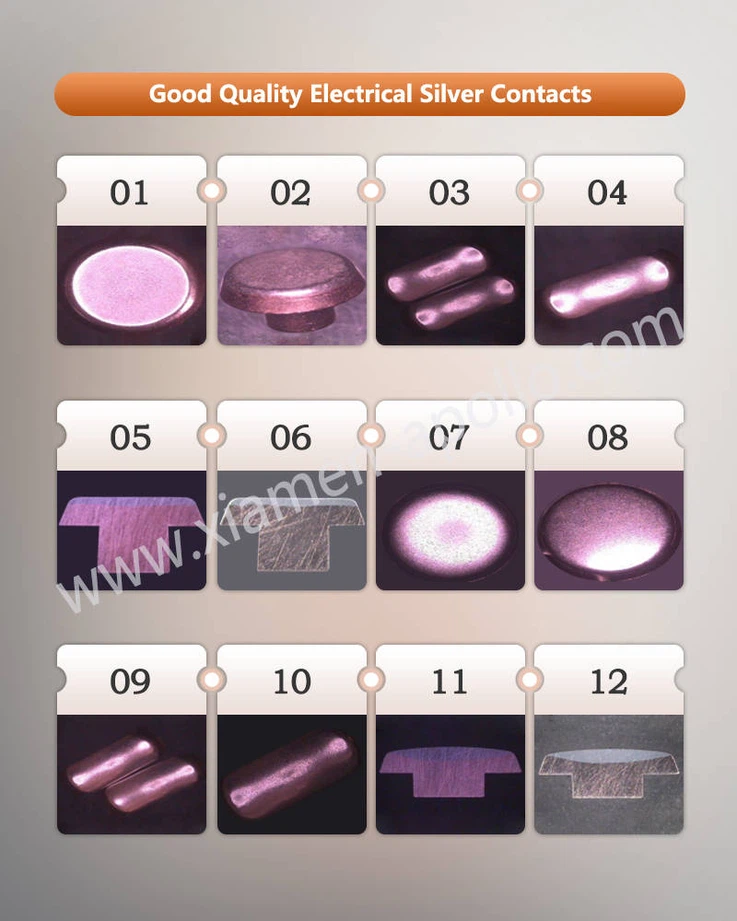
Experts indicate that visual inspection is the first step in assessing the quality of electrical contacts. The surface of high-quality silver contacts should present a silver-white color with a glossiness between 500-700 GU. If the contact surface appears dark black or yellowish spots, it may indicate insufficient silver content or the presence of impurities from other metals. Additionally, the shape of the silver contacts should be precise, with smooth edges free of burrs, and the size tolerance should be controlled within ±0.1mm. Dimensional parameters such as thickness typically range from 0.1mm to 0.5mm, which should be determined according to product standards.
II. Material Analysis: Unveiling the "Intrinsic Beauty" of Silver Contacts
The chemical composition and hardness of Silver Plated Contacts are key factors in measuring their quality. Experts point out that the silver content in high-quality silver contacts should not be less than 99.9%, and the total sum of impurities must not exceed 0.1%. High-precision instruments can be used for compositional analysis to ensure data accuracy. Simultaneously, the Vickers hardness (HV) of silver contacts should be maintained within the range of 30-60; values too high or too low may affect wear resistance and service life.

III. Performance Testing: A Comprehensive Evaluation of Silver Contacts' "Strength"
Conductivity and wear resistance are important indicators for measuring the performance of Cold Headed Bimetal Contacts. Experts suggest that the resistivity of silver contacts should be below 1.59×10^-8 Ω·m, and the contact resistance should not exceed 30mΩ. The dynamic friction coefficient should be between 0.1-0.3, with a wear amount not exceeding 5μm. These data can be tested using professional equipment.
IV. Reliability Testing: Strictly Controlling the "Quality Gate" of Silver Contacts
To verify the reliability and stability of State Contact Rivets, experts recommend conducting temperature cycle tests and salt spray tests. The temperature cycle test requires at least 1000 cycles between -55°C and +125°C, with a temperature change rate not exceeding 5°C/minute. The salt spray test involves placing the contacts in a 5% NaCl solution at 35°C for 48 hours. After the test, there should be no obvious corrosion spots or detachment on the contact surface.
V. Surface Treatment and Smoothness: The Key to Enhancing Silver Contact Performance
Surface treatment techniques such as electroplating and spraying can increase the conductivity and corrosion resistance of contacts. A high surface smoothness of silver contacts helps achieve more stable contact and disconnection operations.
VI. Mechanical Properties: Assurance of Hardness and Wear Resistance
With a hardness of 85HRB, silver contacts demonstrate good wear resistance and compressive strength, which is crucial for ensuring the long-term stable operation of contacts.
VII. Physical Properties: Balancing Electrical and Thermal Conductivity
Moving Silver Contact exhibits excellent electrical conductivity, far surpassing many other metals, meaning higher efficiency in electrical energy transmission in circuits.

Through the assessments in the above four areas, industry professionals can gain a comprehensive understanding of the quality of Electrical Fixed Contacts. In practical operations, practitioners should strictly adhere to national and industry standards to ensure product quality. Mastering the assessment methods helps in selecting high-quality silver contacts, providing a guarantee for the efficient and stable operation of electronic products.