

In the fields of modern precision sheet metal processing and electromechanical product assembly, robust structure and convenient installation have become core industry demands. The pain points of traditional welding and through-bolt connections, such as structural deformation and cumbersome operation, have driven press-fit fasteners to become the mainstream solution gradually. This new type of fastener, which achieves a stable connection without welding, is widely penetrating various sub-sectors such as server racks, medical equipment, and industrial electrical enclosures, providing support for the upgrading of high-end manufacturing industries, thanks to its core characteristics of high efficiency, robustness, and aesthetics. Industry experts suggest that the selection of stainless steel fasteners should be based on a scientific approach, considering factors such as the usage environment, load requirements, and budget.
Self-clinching fasteners embed nuts, studs, screws, and other components into metal sheets using pressure, achieving a strong and stable connection without the need for secondary tapping or drilling. Its core advantage lies in not damaging the sheet metal structure, effectively avoiding welding heat deformation, and being suitable for installation on sheets as thin as 1mm. The embedded design ensures a smooth and aesthetically pleasing product surface. This characteristic makes it highly favored in precision manufacturing scenarios, and it is currently widely used in various fields such as server/communication cabinets, medical equipment housings, industrial electrical enclosures, and automotive electronic sheet metal structures.

From a product type perspective, self-clinching fasteners have formed a diversified system to adapt to different application needs. Press-fit nuts can form internal threads in sheet metal, and materials include stainless steel, carbon steel, and aluminum; press-fit studs can form threaded external posts, suitable for board-to-board connections; press-fit screws are primarily for permanent fixation and are mostly used in applications where repeated disassembly and reassembly are unnecessary; press-fit locating pins, with their high precision, are the preferred choice for pluggable module positioning in medical and military products; press-fit sleeves and spacers focus on isolating and fixing distances between sheet metal parts, suitable for scenarios such as electronic module installation or heat sink fixation.
In practical applications, sheet metal thickness, material selection, and surface treatment are key parameters for selecting press-fit fasteners. The suitable sheet metal thickness is mostly concentrated between 0.8mm and 3.0mm. For ultra-thin sheet metal applications, a small flange design is recommended to prevent bursting. Material selection must be tailored to the application environment. For indoor sheet metal applications, galvanized carbon steel products are sufficient. In highly corrosive environments, stainless steel SUS304/SUS316 is preferred. For applications requiring lightweight construction, aluminum alloy press-fit fittings can be used. Surface treatments such as galvanizing, electrophoresis, Dacromet coating, and blackening can further enhance product adaptability.
Regarding the specific application scenarios for stainless steel fasteners, industry experts add that in common scenarios like indoor home decoration, 304 stainless steel fasteners offer excellent value and meet daily needs. In highly corrosive environments such as outdoor, marine, and chemical industries, or in high-strength load-bearing scenarios like steel structure buildings and heavy machinery, high-performance models such as 316 stainless steel fasteners should be prioritized. When selecting specifications, it is crucial to accurately confirm parameters such as diameter, length, and pitch to ensure compatibility with the application scenario. Attention should also be paid to accessory compatibility to ensure the fastener's performance is fully realized. Regarding cost control, stainless steel fasteners of different specifications and materials have varying prices. Bulk purchasing can effectively improve cost-effectiveness and help optimize project costs.
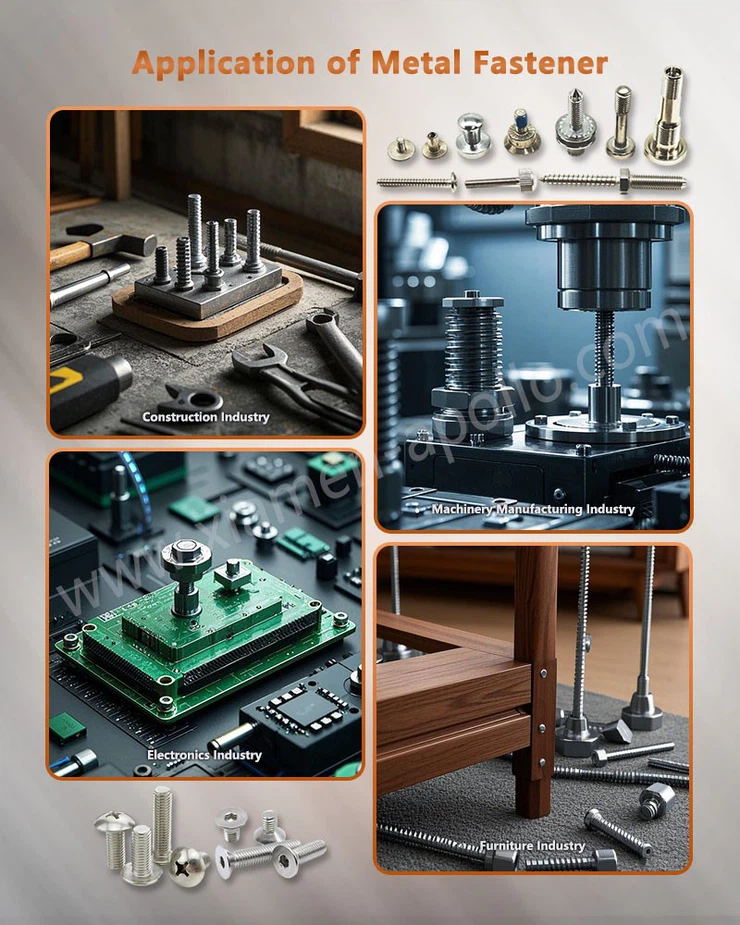
Currently, the global manufacturing industry is accelerating its transformation towards high-end, intelligent, and green development. Various industries are continuously raising their requirements for the performance stability, quality consistency, and environmental compatibility of core components. This trend directly drives the continuous expansion of the application scenarios for stainless steel fasteners. From the deep upgrading of traditional manufacturing fields to the innovative application in emerging industries, stainless steel fasteners, with their excellent corrosion resistance and reliable mechanical properties, have become a key support for the upgrading of connection technology. Material iteration and product structure innovation have thus become the core theme of industry development. Industry experts generally believe that with the continuous maturation of precision assembly technology and the widespread adoption of automated sheet metal processing production lines, the rational selection of self-clinching fasteners that meet the needs of different scenarios can not only significantly improve the assembly consistency and structural stability of end products and reduce after-sales maintenance costs caused by connection problems, but also achieve the dual benefits of cost savings and product quality improvement for enterprises by simplifying installation processes and shortening production cycles, thus building a core competitive advantage. Looking ahead, leveraging breakthroughs in materials science and innovations in manufacturing processes, stainless steel fasteners will further push the boundaries of existing performance, achieving deep penetration into more emerging fields: in high-end manufacturing, they will meet the lightweight and high-reliability connection requirements of aerospace components; in green building, they will support the efficient assembly and long-term corrosion resistance of prefabricated building components; and in smart home technology, they will align with the miniaturization and refinement trends of home appliances, achieving concealed, high-precision connections. It is foreseeable that stainless steel fasteners will continue to iterate and upgrade, providing more precise and reliable connection solutions to support the high-quality development of various industries.
Contact Us
