Overview of relay contacts
The Silver Electrical Contacts of a relay are in a normally open or normally closed state, which is to say that the contacts that connect or disconnect the signal when the switch is normally open or normally closed are called the contacts of the relay.
Contacts are one of the most important components of electromagnetic relays. The performance of contacts is affected by factors such as contact materials, contact pressure, load type, operating frequency, atmospheric environment, contact configuration and beating. If any of these factors cannot meet the predetermined value, point contact problems such as electrochemical corrosion of metals between contacts, contact welding, wear, and rapid increase in contact resistance may occur. The rated load of the contact refers to the voltage and current that the electromagnetic relay is allowed to disconnect. The size of the load determines the size of the voltage and current that the electromagnetic relay can control. Electromagnetic relays cannot exceed these two values during use, otherwise it will easily cause damage to the relay contacts.
Relay contact form
There are three contact forms of Silver Coated Electrical Contacts, namely point contact, line contact and surface contact. As far as electromagnetic relays are concerned, the contact form of the contacts is mostly point contact. Common electromagnetic relays on the market have one set of contacts, two sets of contacts, and three sets of contacts. In order to ensure that the contact itself is not accidentally failed due to quality problems during the experiment, and to ensure that the contact pressure is detected in the largest space, the electromagnetic relays with one set of contacts and three sets of contacts were abandoned during the experiment, and the electromagnetic relays with two sets of contacts were selected.
In the energized state, when the moving and static contacts are out of contact, if the current of the disconnected circuit exceeds a certain value (different relays have different contact materials and different rated currents), or the voltage applied to both ends of the contact gap after disconnection exceeds a certain value (different relays have different contact materials and different rated voltages), an arc will be generated in the contact gap. The arc is actually a discharge phenomenon generated by the gas between the contacts under a strong electric field, which generates high temperature and emits strong light and sparks. The existence of the arc not only burns the metal surface of the contact, reduces the life of the electrical appliance, but also prolongs the circuit disconnection time, and even causes the relay contact to fail. In severe cases, it can cause fire or gas accidents. Therefore, in order to accurately detect the change law of contact pressure, it is necessary to ensure that the current disconnected by the electromagnetic relay and the voltage applied to both ends of the relay contact do not exceed the rated value during the experiment.

What is the material of the relay contact?
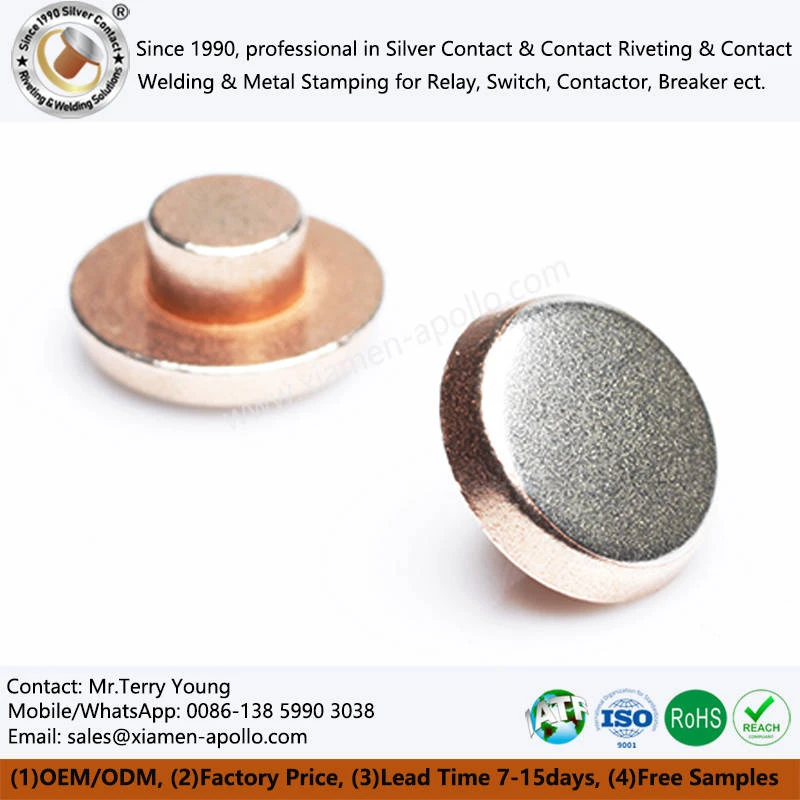
Common materials for relay Bimetal Electrical Silver Contact Point materials are: pure metal materials; metal alloy materials; metal ceramic materials (powder metallurgy materials). The contact capacity is related to the material. Generally, copper or silver plating is used. Gold plating is used for contacts with low on-resistance. Tungsten is used for high current and high intensity. Of course, there are other alloy materials, which are all related to the application (capacity, withstand voltage).
Electromagnetic relays use the "on" and "off" of Contactor Electrical Silver Contacts to control the circuit. The contact voltage drop caused by the difference in contact resistance between contacts is different. The greater the contact resistance of the contact, the greater the voltage drop on the contact. The resulting impact is: 1) Increase contact heating and shorten the service life of the contact; 2) Reduce the effective voltage on the load.

In order to avoid the above impact, it is required to reduce the contact resistance of the contact as much as possible. Materials with good conductivity should be selected. Commonly used materials are: copper, silver, -- silver has better conductivity than copper.
For small relays used in small signal circuits, due to the small control current, the contact surface of Bimetal Electronic Contacts is small, and copper contacts with gold plating can also be used.
Our Silver Coated Electrical Contacts have many outstanding features that make them an ideal choice for many fields. First, it has excellent conductivity. As an excellent conductive material, silver can ensure stable current transmission, greatly improving the performance and efficiency of equipment. Secondly, silver contacts are highly wear-resistant. During frequent switching operations, they can still maintain good contact status, extending the service life of the product. Furthermore, our silver contacts have undergone strict quality inspections and are reliable, safe and stable. Whether in power systems, industrial automation or communication equipment, silver contacts can play an important role.