

As a core component of precision electronic connections, beryllium copper spring contacts derive their unique value from the exceptional material properties of beryllium copper alloys. These alloys can withstand mechanical forces up to 11,500 N/mm² while maintaining a conductivity of 20-22% IACS. This combination of properties enables reliable current transmission in miniaturized designs. Compared to traditional elastic materials, beryllium copper has a significantly higher yield strength to Young's modulus ratio. This means that while maintaining the same spring force, beryllium copper components can be significantly reduced in size, providing critical support for the increasing integration of electronic devices.

Precision manufacturing processes guarantee the high performance of beryllium copper spring contacts. During the stamping process, the die clearance must be controlled within 5%-8% of the material thickness. For a 0.2mm thick spring, the clearance accuracy must reach 0.01mm. This high-precision requirement directly impacts the contact pressure stability of the contacts, while subsequent aging treatment further enhances material properties, achieving a yield strength exceeding 1000 MPa. Post-stamping deburring and surface treatment processes, though often overlooked, are crucial to the long-term reliability of the contacts. Pressure deviations as small as millinewtons or surface defects as small as microns can lead to connection failure.

From a market perspective, the beryllium copper alloy market, the material used in Beryllium Copper Stampings, is experiencing steady growth. The global beryllium copper market was estimated to be worth approximately $1.241 billion in 2024 and is projected to reach $1.455 billion by 2031, achieving a compound annual growth rate of 2.3%. Regionally, North America dominates the market, holding a 35% market share in 2023. Asia-Pacific follows closely behind with a 30% share and maintains a relatively fast growth rate. Among application sectors, the electrical industry accounts for the largest share, approximately 40%, while the automotive and aerospace sectors account for 30% and 15%, respectively. It's worth noting that beryllium copper accounts for approximately 13% of connector material composition. While lower than brass and phosphor bronze, it remains irreplaceable in applications requiring high reliability. Data from 2025 indicates that beryllium copper's potential for application in nuclear fusion is beginning to emerge. As a neutron multiplier and cladding material, its value is expected to account for 30%-40% of the material cost of fusion reactors.
However, the development of BeCu Electrical Contact Springs faces severe environmental challenges. Due to the element's high toxicity, the smelting process produces 3-5 tons of fluorine-containing waste slag per ton, leading to strict restrictions on its use under environmental standards such as the EU REACH regulation. While the EU's 2025 ban on bisphenol A doesn't directly target beryllium, it further tightens the environmental protection threshold for electronic materials. This backdrop has driven the rapid development of alternative materials. Copper-nickel-tin alloys, for example, have achieved a tensile strength of 1170 MPa, with processing costs approximately one-fifth that of beryllium copper. By 2024, their penetration rate in electronic connectors had risen to 28%. A new beryllium-free alloy has achieved a breakthrough in ultra-thin manufacturing, enabling thickness control to 0.04mm with tolerances within 2μm while maintaining a strength exceeding 1400MPa and meeting fatigue life requirements exceeding 1 million cycles. The newly developed ceramic particle-reinforced copper alloy material, developed in 2025, further improves material utilization and reduces production costs through a liquid die forging process, providing a new technological path for environmentally friendly transformation.
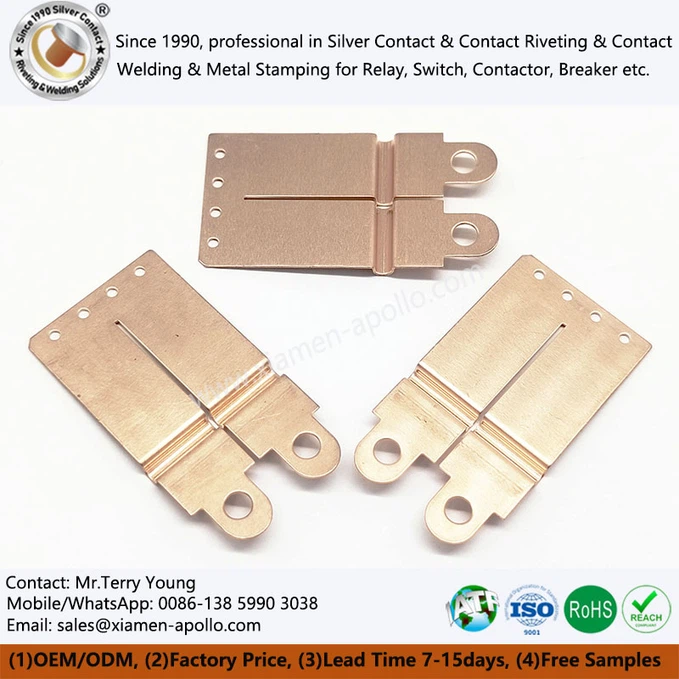
In terms of technological evolution, C17200 Beryllium Copper Stampings are experiencing a parallel development path of miniaturization and high performance. The demand for miniaturization in electronic devices is driving contact thicknesses to the 0.03-0.06mm range, requiring materials with superior formability while maintaining high strength. Advances in ultra-pure copper purification technology have enabled materials with copper contents reaching 99.9999%, minimizing the impact of impurities on electrical and thermal conductivity. In emerging sectors such as new energy vehicles, high-current connection scenarios place higher demands on the temperature resistance and corrosion resistance of contacts, driving research into surface treatment technologies and alloy composition improvements. At the same time, material innovation driven by environmental pressures is reshaping the industry landscape. Beryllium-free alloys are narrowing the performance gap with beryllium copper through technologies such as nano-precipitation strengthening.
The NGK Beryllium Copper Stamping industry is currently balancing technological advantages with environmental constraints. Its superior mechanical properties and electrical conductivity will continue to play a vital role in high-end precision connections, but the accelerated pace of material substitution has become an irreversible trend. The core challenge for industry development lies in meeting the demands of miniaturization and high reliability while addressing environmental concerns and controlling costs. With advances in materials science and innovative manufacturing processes, this field is steadily progressing towards the dual goals of optimized performance and environmental friendliness, providing critical support for the continued development of the electronic information industry.
contact us
