

Brass, with its excellent electrical conductivity and ease of stamping, has become a core material in the electrical and electronic industries. Brass stamping switches, terminals, and accessories are widely used in various electrical components such as switches, sockets, and terminals. However, if brass stamping is not effectively treated to prevent oxidation, it is prone to discoloration, blackening, and other defects, severely affecting product quality and even leading to scrapping. As a commonly used brass stamping product, anti-oxidation treatment of brass sheet stamping parts has become an indispensable core step in the processing.
The importance of anti-oxidation passivation treatment in brass stamping processes is self-evident. After stamping, brass parts retain stamping oil, fingerprints, dust, and a small amount of oxides on their surface. Even after degreasing and cleaning, without passivation and anti-oxidation treatment, they will still oxidize rapidly at room temperature, leading to a deterioration in surface color and performance, thus affecting the product's appearance and lifespan. The quality stability of brass sheet metal stamping depends entirely on a standardized passivation process.
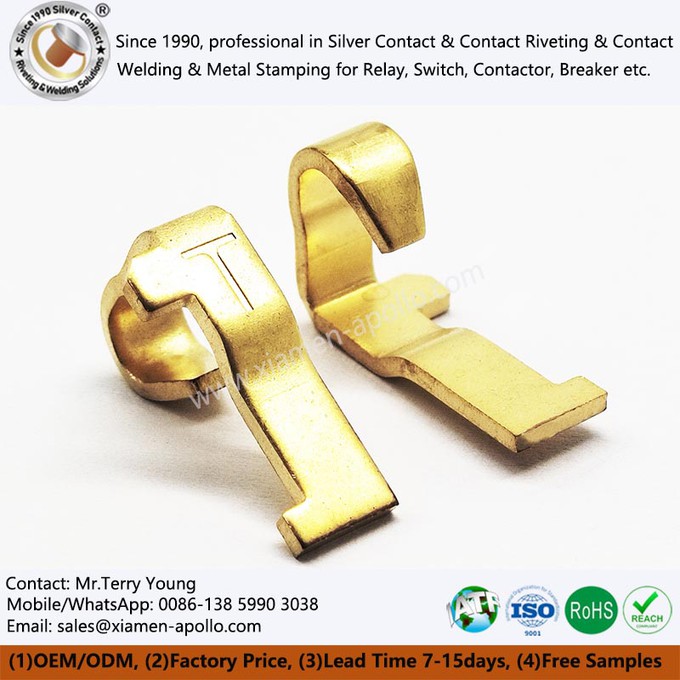
To effectively prevent oxidation of Electrical Contact Assemblies Brass Stamped Parts, a scientific passivation process must be followed. This process consists of three main steps: pretreatment, passivation and oxidation resistance, and washing and drying. Each step has clearly defined operating procedures. The high quality of Customized Brass Stamping Contact Parts for Wall Socket Plugs stems from precise control over each passivation process.
The first step is the pretreatment of brass for passivation-degreasing. This is the fundamental prerequisite for ensuring effective passivation. Passivation and oxidation resistance require the surface of the brass parts to be clean, free of oil, oxides, and other impurities. Otherwise, the passivation protective film will be incomplete, failing to achieve the desired anti-oxidation effect. After stamping, brass surfaces often retain stamping oil, fingerprints, and other processing residues. Generally, these can be removed directly using a copper brightening cleaner, achieving both degreasing and oxide removal.
If the surface of the Electric Brass Stamping Part for Wall Switch Socket is heavily contaminated with oil, it must first be initially degreased with an alkaline degreasing agent, followed by further treatment with a copper brightening cleaner to ensure surface cleanliness. In addition, if the product has special requirements, corresponding auxiliary processing techniques are needed. For example, chemical polishing can be performed to improve surface gloss, vibratory grinding can be used to remove burrs, and brushing can be performed to achieve a brushed texture. The fine processing of Electrical Brass Press Parts for Switch Socket often requires these auxiliary processes in conjunction with passivation treatment.
The second step is brass passivation and anti-oxidation treatment, which is the core step in preventing oxidation. The product's anti-oxidation ability directly depends on the density and integrity of the passivation film. Currently, the industry generally uses environmentally friendly chromium-free passivation solutions for treatment, which not only meet environmental requirements but also form a stable passivation protective film. This process is simple to operate; simply immerse the pre-treated clean brass part in the passivation solution and allow it to react fully for at least 5 minutes to complete the passivation treatment.
It is important to note that commonly used passivation solutions are mostly weakly alkaline. During processing, it is crucial to strictly prevent acidic liquids from being introduced into the passivation solution; otherwise, the passivation solution will fail, preventing the formation of an effective passivation protective film and thus affecting the anti-oxidation effect. The passivation treatment for Electrical Brass Metal Stamping for Socket Switches places extremely high demands on the purity and usage specifications of the passivation solution.
The third step is water washing and drying, which is a critical final step to ensure the longevity of the passivation effect. A water washing operation must be performed between each processing step to prevent the chemicals from the previous step from being carried into the subsequent processing, contaminating the chemicals and causing poor surface treatment of the brass parts, affecting product quality. The drying process requires strict temperature control, generally between 80~100℃. Excessively high temperatures should not be used for baking to avoid damaging the passivation film due to high temperatures, thus losing its anti-oxidation effect.

In summary, passivation treatment for brass metal stampings is a crucial process for ensuring product quality and extending service life, and it is applied throughout the entire brass stamping process. Proper pretreatment, appropriate passivating agent selection, and a rigorous washing and drying process are all indispensable. These three steps effectively prevent oxidation, discoloration, and blackening of brass parts, while ensuring the product's conductivity and surface precision, meeting the stringent requirements of industries such as electrical engineering.
If you would like to learn more about brass sheet cutting components or have technical consultation or procurement needs, please contact us for professional and comprehensive industry support and customized solutions.
contact us
