

In modern power systems and industrial distribution networks, circuit breakers, as core protection and control devices, bear the crucial responsibility of ensuring the safe operation of circuits. Essentially, they are electrical devices capable of connecting, carrying, and disconnecting current under normal and abnormal operating conditions. When abnormal conditions such as overload, short circuit, or undervoltage occur in a circuit, the circuit breaker can quickly interrupt the current within a specified time, thereby preventing equipment damage and the escalation of accidents. Therefore, circuit breakers are widely used in power generation, transmission and distribution, and terminal power consumption systems, and are an indispensable key component of electrical systems.
Based on the application voltage level, circuit breakers are generally divided into high-voltage circuit breakers and low-voltage circuit breakers. Generally, 3kV is used as the dividing line; equipment with voltage levels higher than this is classified as high-voltage circuit breakers, mainly used in substations and transmission systems; while low-voltage circuit breakers are widely used in industrial control, electrical equipment protection, and building power distribution systems. Circuit breakers of different voltage levels differ significantly in structural design and arc-extinguishing methods, but their core functional logic remains consistent.

In terms of structural composition, circuit breakers typically consist of an operating mechanism, a contact system, an arc-extinguishing system, and conductive connectors. Among these, the copper stamped components in the conductive system play a crucial role. Due to copper's excellent electrical and thermal conductivity, the "Copper Stamping" process is extensively used in the manufacture of conductive connectors and structural components within circuit breakers. These "Copper Stamping Parts" not only ensure the stability of current transmission but also reduce temperature rise under high load conditions, thereby improving the overall performance of the equipment.
In manufacturing processes, copper stamping parts are typically processed using "Stamping Copper Sheet" or "Copper Strip Stamping," achieving one-piece molding of complex structures through high-precision molds. This process not only boasts high production efficiency and good dimensional consistency but also meets the stringent requirements of circuit breakers for the precision and reliability of conductive components. In practical applications, "Electrical Copper Stamping Parts" are widely used in critical locations such as contact supports, current conductors, and connecting pieces, and their performance directly affects the breaking capacity and service life of the circuit breaker.
From a classification perspective, circuit breakers can be divided into several dimensions. For example, according to the operating method, they can be divided into manual operation, electric operation, and energy storage operation; according to the structural form, they can be divided into universal type and molded case type; according to the arc-extinguishing medium, they can be divided into oil-immersed type, vacuum type, air type, and SF6 circuit breakers, etc. Furthermore, based on the number of poles, they can also be divided into single-pole, double-pole, three-pole, and four-pole structures to meet the needs of different circuit systems.
In the high-voltage field, one of the core performance characteristics of a circuit breaker is its arc-extinguishing capability. When a circuit fault occurs, an electric arc is generated during contact separation. If this arc cannot be effectively extinguished, it will seriously affect equipment safety. Different types of circuit breakers employ different arc-extinguishing methods. For example, vacuum circuit breakers utilize a vacuum environment for rapid arc extinguishing, while gas circuit breakers suppress arcs using highly insulating gases. These technological advancements enable circuit breakers to maintain stable operation even under high voltage and high current conditions.
Meanwhile, in low-voltage circuit breakers, the structural design of copper stamped components is equally crucial. For instance, "Copper Stamped Components" in the contact system not only provide conductivity but also require excellent mechanical strength and resistance to arc erosion. In some high-performance applications, silver contact materials are combined to form "Copper Metal Stamping Electrical Silver Contact Parts" to further enhance conductivity and ablation resistance.
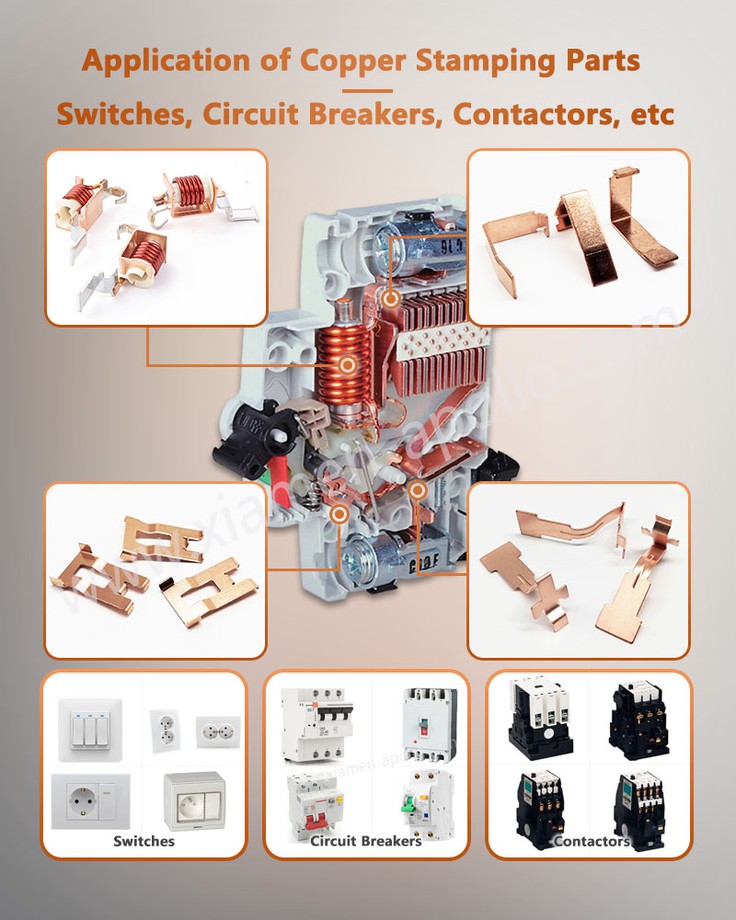
In actual operation, circuit breakers not only need excellent electrical performance but also need to maintain long-term stable operation in complex environments. This places higher demands on the corrosion resistance, fatigue resistance, and conductivity stability of copper stamping parts. Therefore, during the design and manufacturing process, material properties, process precision, and assembly quality must be comprehensively considered to ensure the overall reliability of the product.
Overall, as a key protection device in power systems, the performance of circuit breakers depends not only on electrical design but also on the manufacturing level of their internal key components. In particular, conductive connection technologies, represented by "Copper Stamping Processing Connecting," have become crucial for improving circuit breaker performance. In the future, with the development of smart grids and new energy systems, circuit breakers and their copper stamping parts will continue to evolve towards higher reliability, higher efficiency, and customization.
contact us
For more information on High Precision Progressive Stamping Copper Parts selection or customized processing solutions, please contact us. We will provide professional technical support and optimization suggestions based on your application needs.
