Why is it said that "The 5G era is the era of ceramics"? The core of this statement cannot be separated from the support of the Metallization of Alumina technology.
5G communication technology has become an important strategic development for countries around the world. All countries are actively planning in key components, upstream material preparation, and network deployment. And Metallized Ceramic is one of the key technologies that help upgrade 5G components. With the arrival of the 5G era, semiconductor chips show a trend of increasing power, lightweighting, and high integration. The heat dissipation problem becomes more prominent, and the requirements for packaging heat dissipation materials are also more stringent.
As an emerging electronic material, ceramics possess high thermal conductivity, low dielectric loss, insulation properties, heat resistance, high strength, and a thermal expansion coefficient that matches that of chips. They are ideal packaging and heat dissipation materials for power electronic components, and thus have become an important choice for domestic and foreign enterprises in their strategies for the 5G era and their deep exploration of the Ceramic Metallization field.
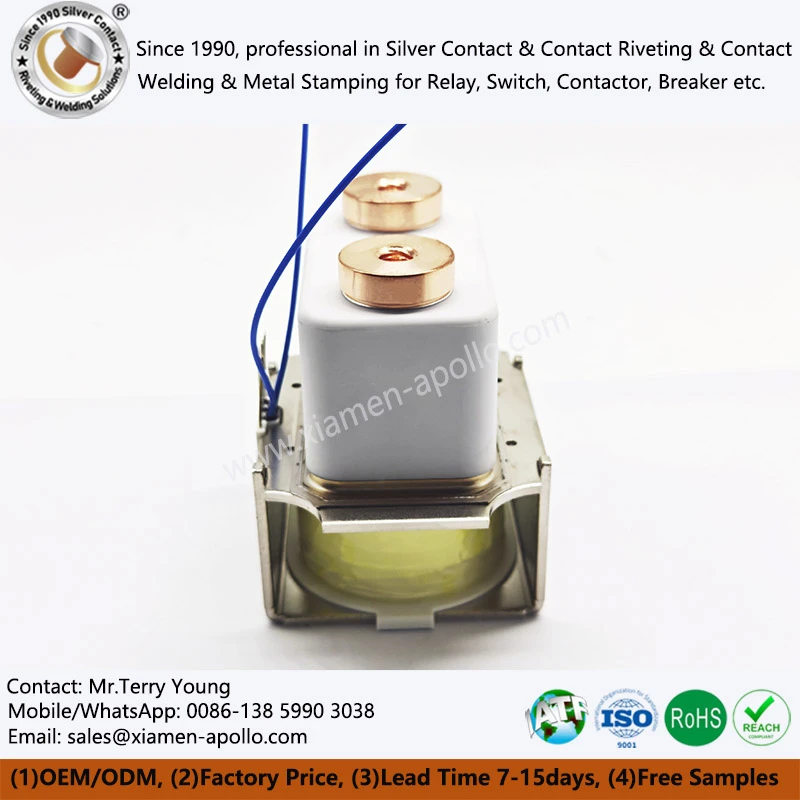
Metallization helps ceramics overcome application challenges, and Ceramic to Metal is the key approach to solving this problem.
Ceramic materials (including salt-based ceramics, silicon carbide, etc.) often require operations such as welding, etching circuits, and achieving shielding in their applications. However, there are numerous difficulties in welding ceramics with metals, which further highlight the necessity of Metallization Ceramics.
Most ceramic and metal layers are difficult to bond together, and the difference in their thermal expansion coefficients is significant, which easily leads to problems such as separation, blistering, and cracks. These are the key issues that need to be addressed during the Metalized Ceramic process.
High thermal conductivity materials such as aluminum nitride, silicon carbide, and diamond, when connected with the cooling unit, are best bonded using processes like gold-silver soldering. The welding temperature is high, and under high and low temperature impacts, the interfaces of materials with different thermal expansion coefficients are prone to separation, leading to failure and thermal transfer failure. This poses a considerable challenge for the Metallized Ceramics process.
Most ceramics have poor conductivity or are non-conductive, making them difficult to connect using electric welding. This is one of the core challenges that Ceramic Metallization needs to overcome.
Ceramics are mostly covalent crystals and are not prone to deformation. They are prone to brittle fractures. Currently, the welding temperature is usually reduced by using an intermediate layer, and indirect diffusion welding is adopted. This method is also widely applied in the field of Ceramic to Metal.
The structural design for welding ceramics and metals includes four types: flat sealing, sleeve sealing, pin sealing, and face sealing. Among them, the sleeve sealing structure has the best effect, and the production requirements for various joint structures are relatively high, which directly affects the final effect of Metallized Ceramic.
Therefore, the ceramic needs to undergo metallization treatment - the core operation of Metalized Ceramic. A metal film that is firmly bonded to the ceramic and does not melt easily is applied on the surface of the ceramic, making it conductive. Then, through the welding process, it is connected with metal leads or other metal conductive layers.
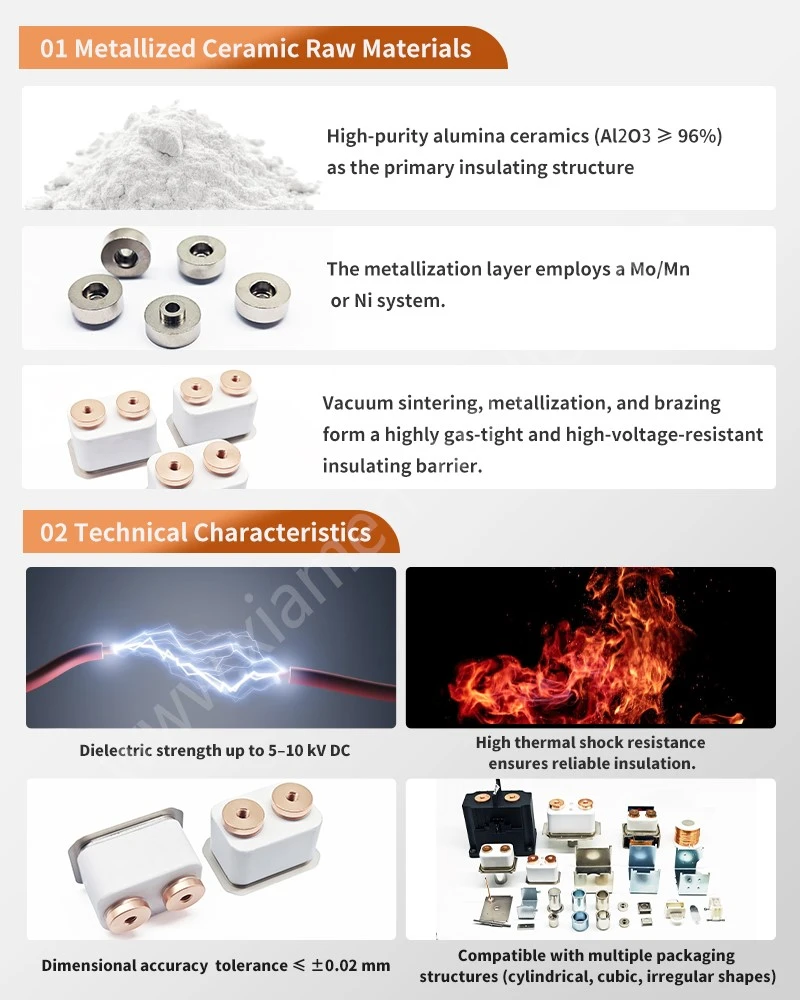
The current Metallized Ceramics methods all have certain limitations in terms of performance, cost, and application. Innovative processes, overcoming technical difficulties, and breaking through development bottlenecks have become the focus of competition among domestic and foreign enterprises.
The industry has innovatively developed a new technology for surface metallization of high thermal conductivity ceramic materials - the new HE-ION high-energy ion deposition process. This technology provides a new path for Metallization Ceramic, featuring extremely strong metal layer adhesion and high-temperature welding resistance, with a high surface finish that is conducive to precise assembly and improvement of electrical performance. At the same time, the process temperature is relatively low, which can protect the ceramic substrate and prevent stress concentration.
The research on Ceramic Metallization is constantly advancing through innovation. Only by continuously making efforts in research and development can it better align with the future development directions of digitization, miniaturization, flexibility, low energy consumption, multi-functionality, and high reliability. This technology is not only a feasible solution to the electronic material problems in the 5G era, but also an important direction for the sustainable development of electronic packaging materials in the future.
about us
Based on the demands of the 5G industry, our Metallization of Alumina product perfectly aligns with the aforementioned development direction. Relying on advanced metallization technology, it effectively addresses core pain points such as insufficient adhesion between ceramics and metals, mismatched thermal expansion coefficients, and insufficient conductivity. It also boasts excellent thermal conductivity, insulation properties, and high-temperature soldering performance, and can be widely applied to key components such as 5G ceramic substrates, ceramic filters, and ceramic antennas, providing reliable support for the stable operation of 5G equipment.
If you would like to know the detailed parameters, application scenarios, and customization solutions of the Precision Metallized Alumina Ceramic Components, please feel free to contact us at any time. We sincerely invite you to place an order and cooperate with us to embark on the new journey of 5G new material development.
contact us